How to Store Food While Camping: Complete Guide (2026)
How to store food while camping: cooler packing for 5-day ice, bear-proof storage, camp kitchen setup, and food safety rules.
Proper food storage while camping solves three problems at once: it keeps wildlife out of your supplies, prevents food poisoning in the backcountry, and stretches your ice supply for days instead of hours. Most camping food disasters — ruined meat, raccoon-ransacked coolers, unexpected bear encounters — come down to the same root cause: poor storage planning before the trip.
This guide covers every aspect of camping food storage, from choosing and packing the right cooler to hanging bear bags in grizzly country. Whether you’re car camping for a weekend or heading into the backcountry for a week, these techniques will keep your food safe, cold, and wildlife-proof.
Coolers — Keeping Food Cold for Days
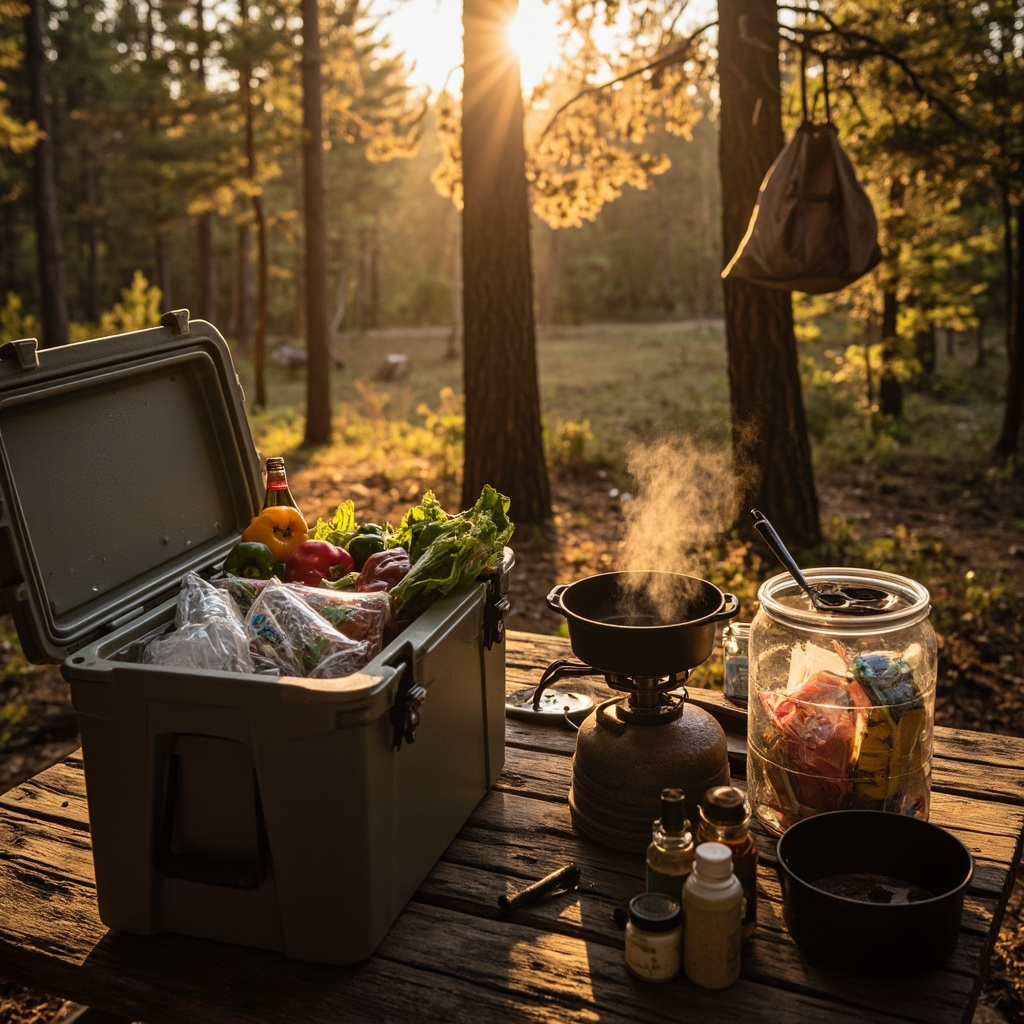
A cooler is the centerpiece of any camping food storage system. The difference between a well-packed cooler and a haphazardly stuffed one is the difference between fresh burgers on day three and warm, questionable hot dogs.
What You Need for Cooler-Based Food Storage
Before you pack your cooler, gather these essential items. Having everything ready prevents the common mistake of tossing food in haphazardly, which costs you 1-2 days of ice life. The most critical items are the cooler itself (quality matters), block ice (not cubed), and a thermometer so you know when it’s time to resupply ice.
| Item | Purpose | Recommended |
|---|---|---|
| Hard cooler | Primary cold storage for 1-2 day trips | Igloo Profile Series ($35, 25-quart, budget pick) |
| Wheeled cooler | Family trips, 3-5 day capacity, easy transport | Coleman Classic 65qt ($60, 65-quart) |
| Block ice (10 lb) | Long-lasting base layer, melts ~1 lb per 12 hrs | Available at gas stations and camp stores |
| Frozen water bottles | Reusable ice packs that become drinking water | Empty plastic bottles refilled 90% full and frozen |
| Fridge thermometer | Monitor cooler temp stays below 40°F | Any digital probe thermometer, $5-10 |
| Gallon zip-lock bags | Separate raw meat from ready-to-eat items | Freezer-grade, 3x thicker than standard bags |
| Cooler bungee strap | Prevents lid from popping open during transport | Any bungee cord that fits your cooler handle |
Budget tip: You can get by with just a cooler, cubed ice, and zip-lock bags for a single overnight trip. But for anything longer than 2 days, the block ice and thermometer become essential — without a thermometer you’re guessing at food safety, and guesswork leads to illness.
Choose the Right Cooler for Your Trip
Cooler selection comes down to trip length and group size. For a solo weekend trip, a 25-quart hard cooler like the Igloo Profile Series holds enough food for two days and fits easily in a car trunk. At $35, it’s the most cost-effective option for short trips where you’ll replenish ice daily. The Profile Series uses insulated foam walls rated for 2-3 day ice retention — sufficient for a Friday-to-Sunday trip without mid-trip ice runs.
For family camping or trips lasting 3-5 days, step up to a wheeled cooler like the Coleman Classic 65qt. The 65-quart capacity holds 104 cans plus food, and the telescoping handle with heavy-duty wheels means you don’t have to lug 40 pounds of ice and groceries across the campsite. The Classic Series features Coleman’s insulated lid design, which seals better than swing-out lids on cheaper models. For extended trips in hot weather, consider a rotomolded cooler — they cost $200-400 but keep ice frozen for 5-7 days compared to 2-3 days for standard coolers. See our best camping coolers guide for a full comparison.
A common mistake is using a soft cooler for a multi-day trip. Soft coolers (insulated bags) work for day trips and picnics but lose their cold within 12-24 hours in summer heat. They lack the insulation thickness of hard coolers and can’t hold block ice effectively. Another frequent error is overpacking — cramming a cooler full of room-temperature food forces all the ice to cool the food down first, cutting ice life in half from the start.
How to Pack a Cooler for Maximum Ice Life
The single biggest factor in cooler performance isn’t the cooler — it’s how you pack it. Follow this layering method for 3-5 day ice retention:
Step 1: Pre-chill everything. Put the empty cooler in a freezer or fill it with bagged ice for 2-4 hours before packing. Freeze all meat, and refrigerate all drinks and produce. Cold items going into a cold cooler waste zero ice capacity on cooling things down.
Step 2: Block ice on the bottom. Lay 10-pound blocks of ice across the cooler floor and sides. Block ice has a much lower surface-area-to-volume ratio than cubed ice, so it melts slowly — roughly 1 pound per 12 hours in a good cooler. This base layer keeps the coldest zone at the bottom.
Step 3: Raw meat at the bottom. Place raw chicken, steak, and ground meat in sealed zip-lock bags directly on the block ice. Meat stays coldest here, and keeping it at the bottom means it won’t drip onto ready-to-eat items like cheese and vegetables.
Step 4: Dairy, produce, and drinks in the middle. Layer cheese, eggs, butter, cut vegetables, and drinks on top of the meat. Fill gaps between items with cubed ice or frozen water bottles — air pockets are the enemy of cold retention.
Step 5: Top with loose ice. Fill the remaining space at the top with cubed ice or crushed ice. This creates an ice seal that keeps cold air from escaping when you open the lid.
Step 6: Don’t drain meltwater for 2 days. Melted ice water sits at 32-38°F, which is still cold enough to help maintain the cooler temperature. Draining it lets warm air rush in and accelerates remaining ice melt. After day two, drain only if water is soaking food that shouldn’t be submerged. For the full technique, read our how to pack a cooler guide.
Ice vs Ice Packs vs Dry Ice
Block ice outperforms cubed ice by 2-3x in retention time. A 10-pound block melts at roughly 1 pound per 12 hours, while the same weight in cubes melts in 4-6 hours. The reason is surface area — a cube exposes more ice to warm air per unit of volume than a solid block, so it melts faster. Gel packs sit between the two — convenient and reusable but with less total cooling capacity than block ice because they contain less water mass.
For the best results, combine types: block ice as the primary cooling layer on the bottom and sides, frozen water bottles as secondary coolers (they hold their shape and provide cold drinking water as they thaw), and a thin layer of cubed ice on top to fill air gaps around food.
Dry ice (frozen CO₂) is worth considering for trips longer than 5 days or when transporting frozen meat. A 10-pound block of dry ice keeps a standard cooler below freezing for 18-24 hours when placed on top of regular ice. It sublimates directly from solid to gas, so it produces no water mess. Important safety rules: never handle dry ice bare-handed (it causes frostbite in seconds — always use insulated gloves or tongs), never store it in an airtight container (CO₂ gas buildup can cause explosions as pressure increases), never place it directly against food (it will freeze-solid and damage the texture of meat, fruit, and vegetables), and never breathe the fog directly (CO₂ displaces oxygen in enclosed spaces). Use newspaper or cardboard as a barrier between dry ice and food items.
Dry Food Storage — Organizing Your Camp Kitchen
Not everything goes in the cooler. Dry goods — pasta, rice, spices, oatmeal, trail mix, coffee — need their own storage system that keeps out moisture, insects, and wildlife.
Essential Camp Kitchen Setup
The three-bin system is the most practical approach for car camping. Use three clear plastic bins with lids:
- Bin 1 — Cooking: Stove, fuel, matches, spatula, cutting board, pots, pans. Keep these together so meal prep doesn’t involve rummaging through multiple bags.
- Bin 2 — Food: All dry goods in their original packaging, transferred to zip-lock bags, or stored in airtight containers. Label bags with contents and date if you pre-measured ingredients at home.
- Bin 3 — Cleanup: Biodegradable soap, sponge, trash bags, paper towels, water container. Having cleanup supplies separate prevents cross-contamination between dirty and clean items.
Set up a folding table as your prep station. Keep it clean by wiping it down after each meal — sticky surfaces attract ants and wasps within minutes in warm weather. If you’re tent camping without table space, use the tailgate of your car or a flat rock at a comfortable working height. If you’d rather buy a ready-made version of this system, our best camp kitchens guide covers folding stations, chuck boxes, and cook sets.
For backcountry trips where bin weight matters, use a BearVault BV500 Journey Bear Resistant Food Container as your food storage container. It holds 700 cubic inches (enough for 3-5 days of solo backcountry meals), doubles as a bear-proof container, and eliminates the need for separate dry storage bags.
Best Food Containers for Camping
Airtight hard plastic containers beat zip-lock bags for multi-day trips. They don’t puncture, they stack neatly in bins, and they keep moisture and insects out completely. Look for containers with locking latches — standard press-fit lids can pop off when bins bounce around in a car trunk. Rubbermaid Brilliance and similar lines are transparent, so you can identify contents without opening. For backcountry travel, skip the hard plastic — it’s too heavy and fragile. Use a BearVault BV500 Journey Bear Resistant Food Container as your primary container; it seals tight against rodents, holds several days of dry food, and satisfies bear canister requirements in regulated areas.
Zip-lock freezer bags work for short trips and items you’ll consume within a day or two. The freezer-grade bags are 3x thicker than standard bags and resist punctures from sharp items like spaghetti or crackers. Pre-measure ingredients into labeled gallon bags at home: one bag for each meal’s dry ingredients, one for spices, one for snacks. This saves time and reduces waste at camp.
Dry sacks (nylon roll-top bags designed for kayaking) are excellent for backcountry food storage inside a bear canister. They’re lightweight, waterproof, and rodents can’t chew through the nylon. They’re not bear-proof on their own, but they organize food inside your canister or bear hang, keeping scents contained and preventing cross-contamination between items.
Meal Prep and Portioning Before Your Trip
Prepping meals at home saves time, reduces pack weight (no extra boxes or bottles), and minimizes waste at camp. The strategy: pre-measure rice, pasta, and oatmeal into zip-lock bags labeled with meal name and date. Pre-mix spice blends — a taco seasoning bag, a pasta sauce spice bag — so you’re not bringing full bottles of seven different spices. One small bag of mixed seasoning weighs 2 ounces versus 14 ounces for seven individual bottles.
For breakfast, prepare overnight oats in mason jars: oats, milk powder, dried fruit, and nuts layered in the jar. They keep for 2-3 days without refrigeration and actually taste better on day two as the oats fully absorb the liquid. For lunches, pre-make wraps or sandwiches and freeze them — they’ll thaw in your pack by lunchtime while acting as an additional ice pack for surrounding items.
Dinner is where pre-planning pays off most. Pre-chop vegetables (onions, peppers, carrots) and store in airtight containers. Marinate chicken or beef in zip-lock bags and freeze solid — the marinade doubles as a flavor booster and a protective ice layer. Pre-cook rice or pasta at home and vacuum-seal it; it reheats in minutes over a camp stove. Check our camping meal plan guide for complete meal-by-meal recipes designed for 2-5 day trips.
Wildlife-Proof Food Storage
In bear country, food storage isn’t just convenience — it’s a safety requirement and a legal mandate. A bear that gets human food even once becomes a problem bear, and problem bears are often euthanized. Proper food storage protects both you and the wildlife.
When Is Bear-Proof Food Storage Required?
Bear canisters are legally required in the following areas:
- Yosemite National Park: Required above 9,600 feet elevation and at all trailhead food lockers. Fines for non-compliance start at $5,000.
- Sequoia and Kings Canyon National Parks: Required in all backcountry, regardless of elevation.
- Inyo National Forest / Sierra Nevada: Required above 10,000 feet in most ranger districts.
- Adirondack Park (NY): Required in Eastern High Peaks Wilderness. Black bear density here is among the highest in the eastern US.
- Olympic National Park (WA): Required in designated wilderness areas. Both black bears and Roosevelt elk are known food-seeking animals.
Outside these mandatory zones, many national forests and state parks recommend or require bear-safe storage. Check the specific park or forest website before your trip — regulations change seasonally and rangers enforce them actively. Even in areas without bears, raccoons, squirrels, mice, and jays will ransack improperly stored food within hours. Raccoons can unzip tent vestibules, open latched coolers, and untie knot-loosened food bags. A cooler left on a picnic table is a raccoon buffet by midnight.
The simplest rule: if a park provides food lockers, use them. If a ranger tells you to store food a certain way, follow those instructions exactly. Park-specific requirements supersede general best practices, and violating them can result in fines, permit revocation, or being asked to leave the park.
What You Need for Wildlife-Proof Storage
Wildlife-proof storage requirements vary by location. Always check the specific park or forest regulations before your trip — requirements change and fines for non-compliance can reach $5,000. The minimum you need depends on where you’re going: bear canisters for the Sierra Nevada, paracord for areas with bears but no canister mandate, and simple lockable bins for campgrounds without significant wildlife pressure.
| Item | Purpose | Required When |
|---|---|---|
| Bear canister | Mandatory food storage, rodent-proof | Sierra Nevada, Yosemite, Adirondacks, Olympic NP backcountry |
| BearVault BV500 Journey Bear Resistant Food Container | IGBC-certified canister, 700 cu in capacity | All backcountry trips in bear country, dual-use as dry storage |
| Paracord (200 ft) | Bear bag hanging when canisters not required | Areas with bear activity but no canister mandate |
| Carabiner (2) | Clip stuff sacks to paracord for hanging | Always carry as backup, even with a canister |
| Stuff sacks (2) | Hold food for counter-balance hanging | Backcountry trips without campground lockers |
| Odor-proof bags | Contain scents inside canister, double layer of protection | All multi-day backcountry trips, store toothpaste and sunscreen too |
Cost note: A BearVault BV500 costs around $85 and lasts for years of backcountry trips. Paracord and carabiners are a one-time $15 investment. Compared to a $5,000 fine or a ruined trip caused by a bear encounter, this gear pays for itself on the first outing.
Bear Canisters — The Gold Standard
Bear canisters work through a simple design principle: the opening is too wide for a bear’s paws to grip, and the lid screws on tight enough that even a determined 400-pound grizzly can’t pry it open with claws or teeth. The Interagency Grizzly Bear Committee (IGBC) tests and certifies canisters using live bears and experienced captive bears — a canister must withstand 60 minutes of focused bear interaction without opening to earn certification. Always choose an IGBC-certified model; non-certified canisters can get you fined and may fail against a determined bear.
The BearVault BV500 Journey Bear Resistant Food Container is the most popular choice for backpackers. It holds 700 cubic inches (approximately 3-5 days of solo food), weighs 2.7 pounds empty, and its transparent polycarbonate body lets you see contents without opening — a real advantage when you’re searching for the coffee bag at 5 AM. The BV500 is IGBC-certified for both grizzly and black bears, and its wide mouth makes packing and retrieving items easier than narrow-mouth models like the Garcia Container.
Packing a bear canister efficiently is a learned skill. Start with dense, high-calorie items at the bottom (nuts, jerky, energy bars, peanut butter — things that fill dead space), then layer in lighter items (instant meals, coffee, dried fruit) toward the top. Remove all excess packaging before packing — transfer everything to zip-lock bags to save space and reduce bulk. You’ll be surprised how much fits when you strip the cardboard boxes. Most backpackers can fit 4-5 days of food in a BV500 with proper packing, compared to 3 days with sloppy packing.
Bear Bag Hanging — The PCT Method
When bear canisters aren’t required but you’re still in bear habitat, the counter-balance bear hang is the standard approach. Here’s the step-by-step method used by Pacific Crest Trail hikers:
What you need: 200 feet of paracord, two carabiners, two nylon stuff sacks, a rock or throw bag.
Step 1: Attach the rock to one end of the paracord and throw it over a branch 15-20 feet high. The branch should be strong (at least 6 inches in diameter) and extend at least 4 feet from the trunk.
Step 2: Retrieve the paracord from the far side of the branch. Attach one food sack to the cord end and hoist it as high as it will go.
Step 3: Tie the second food sack to the cord at the height you can reach. When you release, the second sack acts as a counterweight, pulling both sacks up beyond your reach.
Step 4: The final position must meet three distances: 12 feet off the ground, 6 feet from the trunk, and 6 feet below the branch. If the first attempt doesn’t meet all three, adjust and try again.
The common beginner mistake is hanging the bag too low or too close to the trunk. Black bears can reach 8 feet standing and are excellent climbers. If your bag is within reach of any bear standing on the ground or on the trunk, it’s not hung properly.
Campground Food Lockers
At developed campgrounds in bear country, metal food lockers (bear boxes) are provided at each campsite. Use them — don’t leave food in your car. Bears in Yosemite and Sequoia have learned to break into cars by prying doors off their hinges, smashing windows, and even popping trunk latches. A car door offers zero resistance to a 400-pound bear that has learned the technique from watching other bears succeed.
Store everything scented in the bear box: food, coolers, cooking utensils, pots and pans (they hold food residue), toothpaste, sunscreen, insect repellent, lip balm, and trash. Yes, bears have been known to investigate toothpaste and sunscreen because they contain ingredients derived from food sources (mint, coconut, citrus, peppermint). Even seemingly non-food items like deodorant and hand sanitizer have attracted bears in documented incidents. The rule of thumb: if it has a scent, it goes in the box.
Clean the locker before leaving your campsite — wipe up spills and crumbs with a damp cloth or paper towel. Leaving food residue trains bears to associate lockers with easy meals, which encourages them to investigate campsite equipment even when campers aren’t present. The next camper (and the next bear) will benefit from your tidiness.
Food Safety While Camping
Foodborne illness can turn a dream camping trip into a miserable (or dangerous) experience. The same food safety rules that apply in your kitchen apply at camp — but with higher stakes since you’re hours from the nearest hospital.
The Temperature Danger Zone
Bacteria multiply rapidly between 40°F and 140°F (the “danger zone” in food safety terminology). Food shouldn’t sit in this range for more than 2 hours — and only 1 hour if the ambient temperature is above 90°F, which is common during summer camping at lower elevations. At 90°F+, bacteria double in number every 20 minutes, so even a short exposure can push food into unsafe territory.
Keep a digital probe thermometer in your cooler and check it morning and evening. If the internal cooler temperature reads above 40°F, prioritize eating the most perishable items first (raw meat, dairy, cut fruit). Ice is cheap and available at most gas stations and camp stores near popular camping areas — resupply daily rather than risk food poisoning. A $3 bag of ice is always cheaper than a ruined trip.
Here’s a practical timeline for common camping foods in a well-iced cooler maintained below 40°F:
- Raw chicken and ground meat: 1-2 days maximum
- Steaks, chops, and bacon: 2-3 days
- Hot dogs and cured meats: up to 5-7 days
- Hard cheeses (cheddar, Swiss): 7+ days
- Eggs (in shell, unwashed): 3-4 weeks
- Cut fruit and vegetables: 2-3 days
- Butter: 3-5 days
Preventing Cross-Contamination
Cross-contamination is the most common cause of foodborne illness while camping. Raw chicken juice dripping onto ready-to-eat food is a fast track to camp diarrhea, giardia, or worse. The problem is amplified at camp because you have limited sink access and smaller prep surfaces. Prevent it with these rules:
Separate everything in the cooler. Raw meat goes in sealed freezer bags at the bottom (it needs the coldest spot anyway). Ready-to-eat items (cheese, deli meat, cut fruit) go at the top in their own bag or container. Use a separate cooler for drinks if possible — every time someone opens the cooler for a soda, warm air rushes in and raises the internal temperature by 5-10°F for several minutes. A dedicated drink cooler means your food cooler stays closed 90% of the time.
Use separate cutting boards. Bring two lightweight plastic cutting boards: one for raw meat, one for vegetables and ready-to-eat items. Color-code them if possible (red for meat, green for produce). If you only have one board, cut raw meat last and wash it thoroughly with hot soapy water before using it for anything else.
Wash your hands consistently. Set up a hand-washing station at your prep area: a 2-gallon water jug with a spigot, biodegradable soap, and a clean towel. Wash hands after handling raw meat, after using the bathroom, and before every meal. The CDC estimates that proper handwashing could prevent 30% of diarrhea-related illnesses — and that percentage is even higher in camp settings where sanitation infrastructure is limited. Our best camping water jugs guide covers spigot models sized for hand-washing stations and camp cooking.
Managing Leftovers and Waste
The rule is simple: when in doubt, throw it out. Cooked food that has sat above 40°F for more than 2 hours isn’t worth the risk. At camp, food poisoning means 24-48 hours of misery in a tent with limited toilet access and no nearby medical facilities. It’s infinitely worse than eating a fresh meal from your backup supplies.
Store leftovers in airtight containers in your cooler and eat them at the next meal. Most cooked items — grilled chicken, pasta, rice, vegetables — are fine refrigerated overnight and reheated over a camp stove the next morning. Label containers with the time they were cooked so you can track the 2-hour danger window.
For dishwater, strain food particles with a mesh strainer and pack out the solids with your trash. Scatter the strained gray water 200 feet from any water source (lakes, streams, even dry creek beds). Never dump soapy water directly into a stream — even biodegradable soap requires soil contact to break down properly, and direct water disposal harms aquatic life. Many campgrounds have designated gray water disposal pits — use them when available.
Pack out all trash without exception. Animals learn to associate campsites with food when they find trash, and a bear that finds a garbage bag today will be checking coolers tomorrow. Double-bag all trash and store it in your bear box or vehicle — never leave it at the campsite overnight, not even in a closed trash can. Bears have been documented opening latching trash cans, so only wildlife-proof dumpsters are safe.
Food Storage Checklist by Trip Length
Weekend Trip (1-2 Nights)
For a quick weekend getaway, your food storage needs are minimal but still specific. A standard hard cooler loaded with cubed ice handles 1-2 nights easily even in 85°F summer heat. Bring zip-lock bags to separate raw meat from ready-to-eat items, two airtight containers for any dinner leftovers, and double-bag your trash to keep raccoons and other scavengers out overnight. Pack a small 2-gallon water jug with biodegradable soap for a handwashing station at your cooking area.
- Hard cooler with 1-2 bags cubed ice
- Zip-lock bags for raw meat separation
- 2 airtight containers for leftovers
- Trash bags (double-bag system)
- Hand soap and 2-gallon water jug
- Paper towels and wet wipes
Common mistake: bringing too much perishable food. For a 2-night trip, plan exactly 3 meals plus snacks — anything extra just wastes cooler space and accelerates ice melt by requiring the ice to cool more mass. Pre-cook Friday night’s dinner at home, freeze it solid, and pack it in your cooler. It’ll thaw by Saturday evening while acting as a free ice pack for surrounding items. Freeze half a dozen water bottles to use as reusable ice packs that become cold drinking water on day two, reducing the weight you pack out compared to loose ice that just melts into water you drain away.
Extended Trip (3-5 Nights)
Extended trips demand more planning and better equipment than weekend getaways. A wheeled cooler with block ice and frozen water bottles provides the cold capacity for 3-5 days. If you’re camping in bear country, add a BearVault BV500 Journey Bear Resistant Food Container to your gear list — it’s mandatory in many national parks and forest service areas. Pre-measure meals at home to reduce bulk and waste, and set up the three-bin camp kitchen system for organized food access throughout the trip.
- Wheeled cooler with 10 lb block ice + frozen water bottles
- Fridge thermometer for cooler monitoring
- Bear canister (if in bear country) or bear box access
- 3-bin camp kitchen storage system
- Pre-measured meal bags from home
- Biodegradable dish soap and mesh strainer for gray water
- Cooler bungee cord (keeps lid sealed during transport)
Ice resupply strategy: Map gas stations and camp stores near your route before the trip. Most popular camping areas have ice available within 10-15 miles. Resupply on day 2 or 3 to extend your cooler life through day 5. If no ice is available nearby, switch to your backup plan: canned goods, jerky, crackers, and nut butter don’t require refrigeration and can carry you through the remaining days without risk of spoilage.
Backcountry Trip (No Cooler)
Backcountry food storage is defined by weight and wildlife requirements. Every item must earn its place in your pack. A BearVault BV500 Journey Bear Resistant Food Container serves triple duty: food container, bear protection, and dry storage. Pair it with paracord and carabiners for backup bear hangs when trees are available but the canister doesn’t cover all your scented items. Pre-packaged dehydrated meals are the standard — they’re lightweight, don’t require refrigeration, and cook with just boiling water.
- Bear canister (IGBC-certified, mandatory in many areas)
- Paracord (200 ft) + 2 carabiners for bear hang backup
- Dry sacks for food organization inside canister
- Pre-packaged dehydrated meals (Mountain House, Backpacker’s Pantry)
- Odor-proof bags for all scented items (toothpaste, sunscreen)
- Water filter or purification tablets for cooking water
- Lightweight stove and fuel (see our stove guide)
Proper food storage camping isn’t complicated, but it does require planning. A cooler packed correctly saves you daily ice runs. A bear canister keeps you legal and safe in the backcountry. And basic food safety practices prevent the one thing that can ruin a trip faster than bad weather. Pack smart, store right, and enjoy your time outdoors without worrying about warm burgers or unwanted midnight visitors.
For more camping skills, check out our guides on choosing a camping stove, water filtration, camping safety tips, and our full camping packing list.
Frequently Asked Questions
How do you keep food cold for 5 days while camping?
Pre-chill your cooler for 2 hours, use block ice as the base layer, and freeze water bottles as reusable ice packs. Pack raw meat at the bottom (it stays coldest), keep drinks in a separate cooler if possible, and don't drain meltwater for the first 2 days. A quality [hard cooler](https://www.amazon.com/dp/B0CGTDBP1L?tag=camplabx-20) with this technique holds ice for 3-5 days.
Do I really need a bear canister?
Yes — if you're camping in the Sierra Nevada, Yosemite, Adirondacks, or Olympic National Park backcountry, bear canisters are legally required. Even outside these areas, many national forests and state parks recommend or require them. A [BearVault BV500 Journey Bear Resistant Food Container](https://www.amazon.com/dp/B0019LSGQE?tag=camplabx-20) holds 3-5 days of solo food and meets all IGBC certification requirements.
How long is raw meat safe in a cooler?
Raw chicken and ground meat stay safe for 1-2 days in a well-iced cooler (below 40°F). Steaks and chops last 2-3 days. Bacon and hot dogs last up to a week. Use a fridge thermometer — if the internal temperature rises above 40°F for more than 2 hours, cook or discard the meat. Check our [cooler packing guide](/guides/how-to-pack-a-cooler-for-camping/) for maximum ice retention.
What's the best way to hang a bear bag?
Use the PCT method: throw a rock attached to 200 feet of paracord over a branch 15-20 feet high. Hoist your food bag at least 12 feet off the ground, 6 feet from the trunk, and 6 feet below the branch. For a two-bag counter-balance, split food between two stuff sacks and clip them to both ends of the cord. This method works even when bears learn to defeat simple hangs.
Can bears smell food in a cooler in a car?
Yes — bears have an extremely acute sense of smell and can detect food through cooler walls, car doors, and even closed windows. In bear country, never leave food, coolers, or anything scented (toothpaste, sunscreen, deodorant) in your car overnight. Use campground bear lockers or a [BearVault BV500 Journey Bear Resistant Food Container](https://www.amazon.com/dp/B0019LSGQE?tag=camplabx-20) instead.
How do I set up a camp kitchen for food storage?
Use a three-bin system: one for cooking gear, one for food and spices, one for cleanup supplies. Set up a folding table as your prep station with a cutting board and knife. Store all food in airtight containers or zip-lock bags to keep out insects and rodents. For tent camping, use a hanging pantry or a [waterproof storage box](https://www.amazon.com/dp/B07QXGRHDY?tag=camplabx-20) elevated off the ground.