How to Choose a Camping Power Bank (2026 Guide)
Camping power bank guide: capacity, wattage, weight, solar, and durability explained. Pick the right portable charger for your trip.
Why Your Phone Dies Faster While Camping
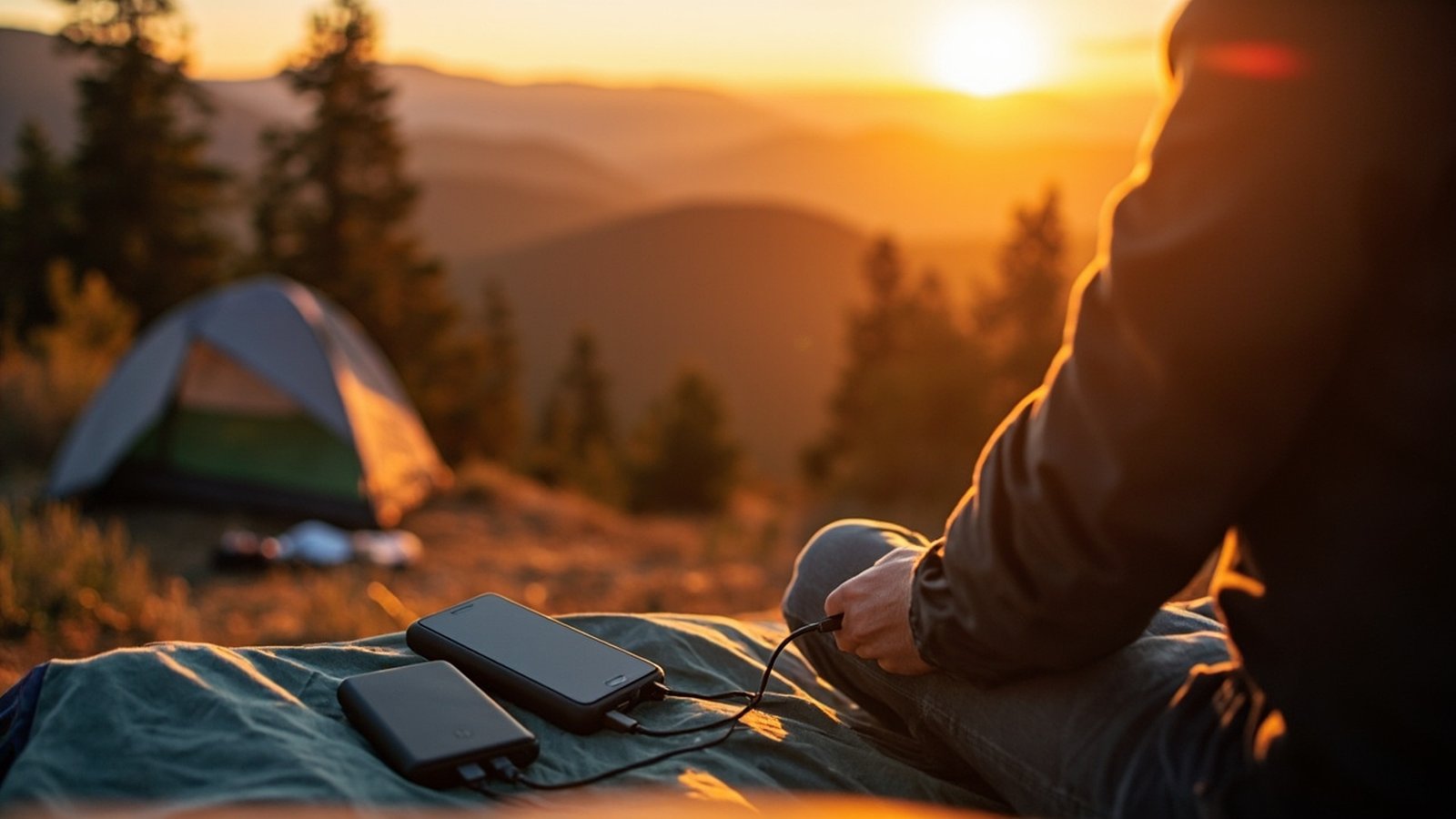
Your phone battery drains faster outdoors than you think. Cold temperatures cut battery capacity by up to 20%. GPS navigation runs the battery down in hours. Taking photos, checking weather apps, and using headlamp apps all add up. And when you’re miles from the nearest outlet, a dead phone means no navigation, no emergency calls, and no way to document your trip.
A camping power bank solves this — but picking the wrong one means wasted money, excess weight in your pack, or discovering it can’t actually charge your devices. The difference between a power bank that works perfectly and one that can’t charge your laptop comes down to a few specs that most product descriptions bury in fine print.
This guide explains exactly what matters when choosing a camping power bank — capacity, output wattage, weight, solar charging, and durability — so you pick the right one for how you actually camp.
Understanding Capacity: What mAh Really Means
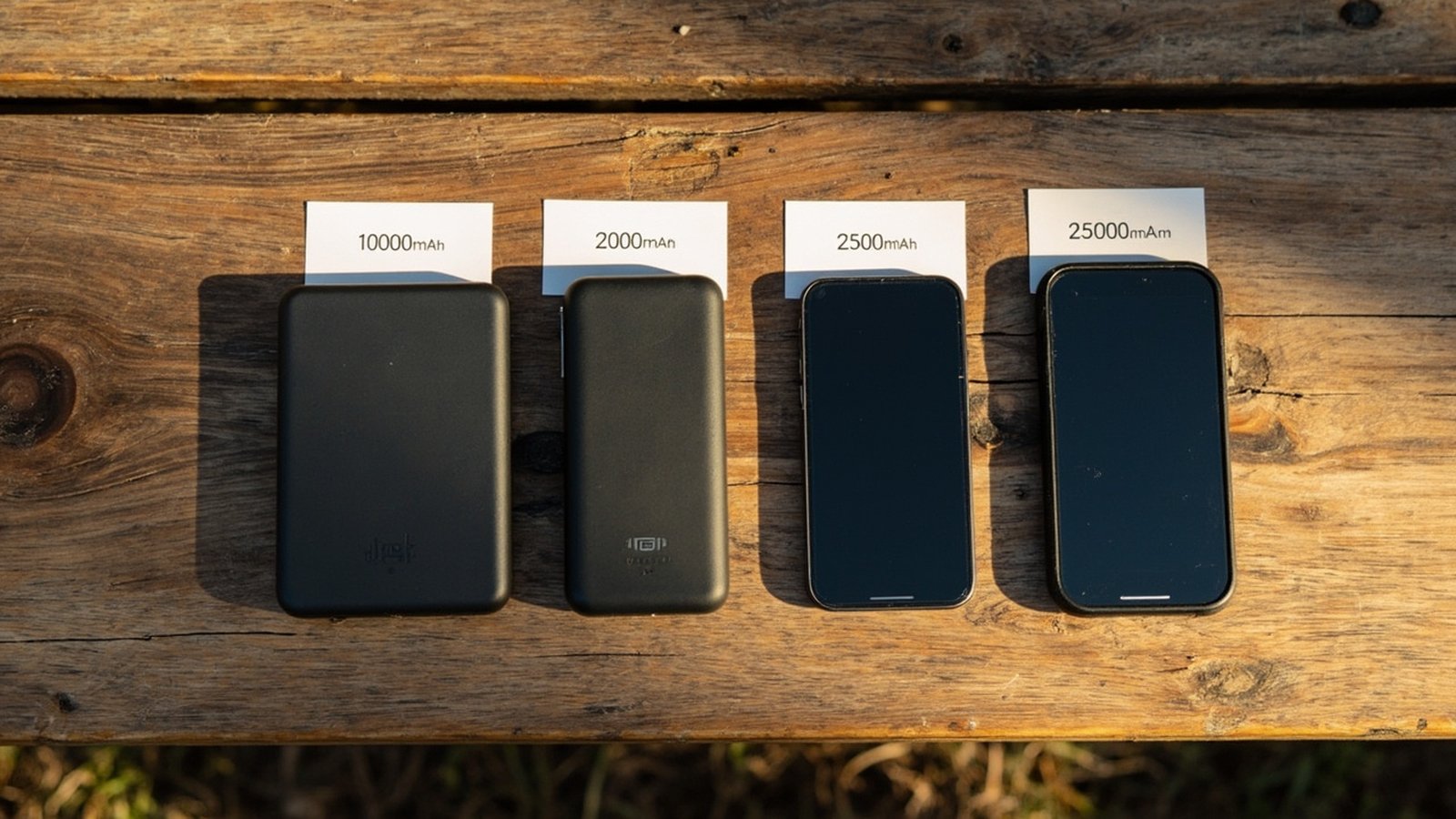
Capacity is measured in milliamp-hours (mAh). A higher number means more total charge stored. But mAh alone doesn’t tell the whole story — you need to convert it to watt-hours (Wh) to compare power banks accurately.
How to calculate watt-hours: Multiply mAh by voltage (typically 3.7V for lithium-ion), then divide by 1,000. A 20,000mAh power bank at 3.7V = 74Wh.
What this means in practice:
| Capacity | Approximate Charges | Best For |
|---|---|---|
| 10,000mAh | 2-3 phone charges | Weekend trips, day hikes |
| 20,000mAh | 4-6 phone charges or 1-2 tablet charges | 3-5 day trips, car camping |
| 25,000mAh | 5-7 phone charges or 1-2 laptop partial charges | Extended trips, laptop users |
Keep in mind that you never get the full rated capacity — energy is lost during voltage conversion and heat. Expect about 70-80% of the rated capacity in actual delivered charge. A 20,000mAh power bank delivers roughly 14,000-16,000mAh of usable charge.
Output Power (Wattage) Matters More Than Capacity
Capacity tells you how much total energy is stored. Wattage tells you how fast that energy gets delivered to your device. This is the spec that determines what you can actually charge.
Low power (15-22W): Charges phones at normal speed. Cannot charge tablets at full speed or laptops at all. Fine if you only need to top up your phone.
Medium power (45-65W): Charges phones fast and most tablets at full speed. Can charge some 13-inch laptops at reduced speed. This is the sweet spot for most campers who carry a tablet or small laptop.
High power (87-220W): Charges everything — phones, tablets, and laptops at full speed. Only necessary if you regularly charge laptops off-grid. The Anker Prime 220W is the fastest option here, with app control for monitoring your battery level.
For most campers, 45-65W is the right range. The INIU 20,000mAh 45W covers phone and tablet charging at under 1 lb. If you need laptop support, the INIU 65W is a solid budget option that handles most 13-inch models.
The key technology here is USB-C Power Delivery (PD). Any power bank with USB-C PD can negotiate the right voltage for your device — your phone gets 20W, your tablet gets 30W, your laptop gets 65W. You don’t need to think about it; the chips handle the negotiation automatically.
Weight vs. Capacity: Finding Your Balance
Every ounce matters when it’s on your back. Here’s how weight scales with capacity across the power banks we researched:
| Power Bank | Capacity | Weight | Weight/Capacity |
|---|---|---|---|
| INIU 45W | 20,000mAh | 0.86 lb | Best ratio |
| Anker 87W | 20,000mAh | 0.95 lb | Good |
| Aswayke Rugged | 20,000mAh | 1.03 lb | Average |
| Anker Prime | 20,100mAh | 1.12 lb | Average |
| INIU 65W | 20,000mAh | 1.1 lb | Average |
| Anker 165W | 25,000mAh | 1.31 lb | Heavy |
| BLAVOR Solar | 20,000mAh | 1.72 lb | Heavy |
| BLAVOR Crank | 20,000mAh | 1.8 lb | Heaviest |
For backpackers: Weight is king. The INIU 45W at 0.86 lb is the lightest option that still delivers real charging speed, and portability is its standout trait — it disappears into a pack lid pocket. Pair it with a lightweight solar panel like the ones in our best solar chargers guide for extended backcountry trips.
For car camping: Weight barely matters since it stays in the car or at camp. Go for higher capacity and more output wattage instead. The Anker 165W charges laptops and multiple devices simultaneously — perfect for basecamp setups. Skim recent listing reviews for real-world charging-speed reports before you buy.
Solar Charging: Worth It or Gimmick?
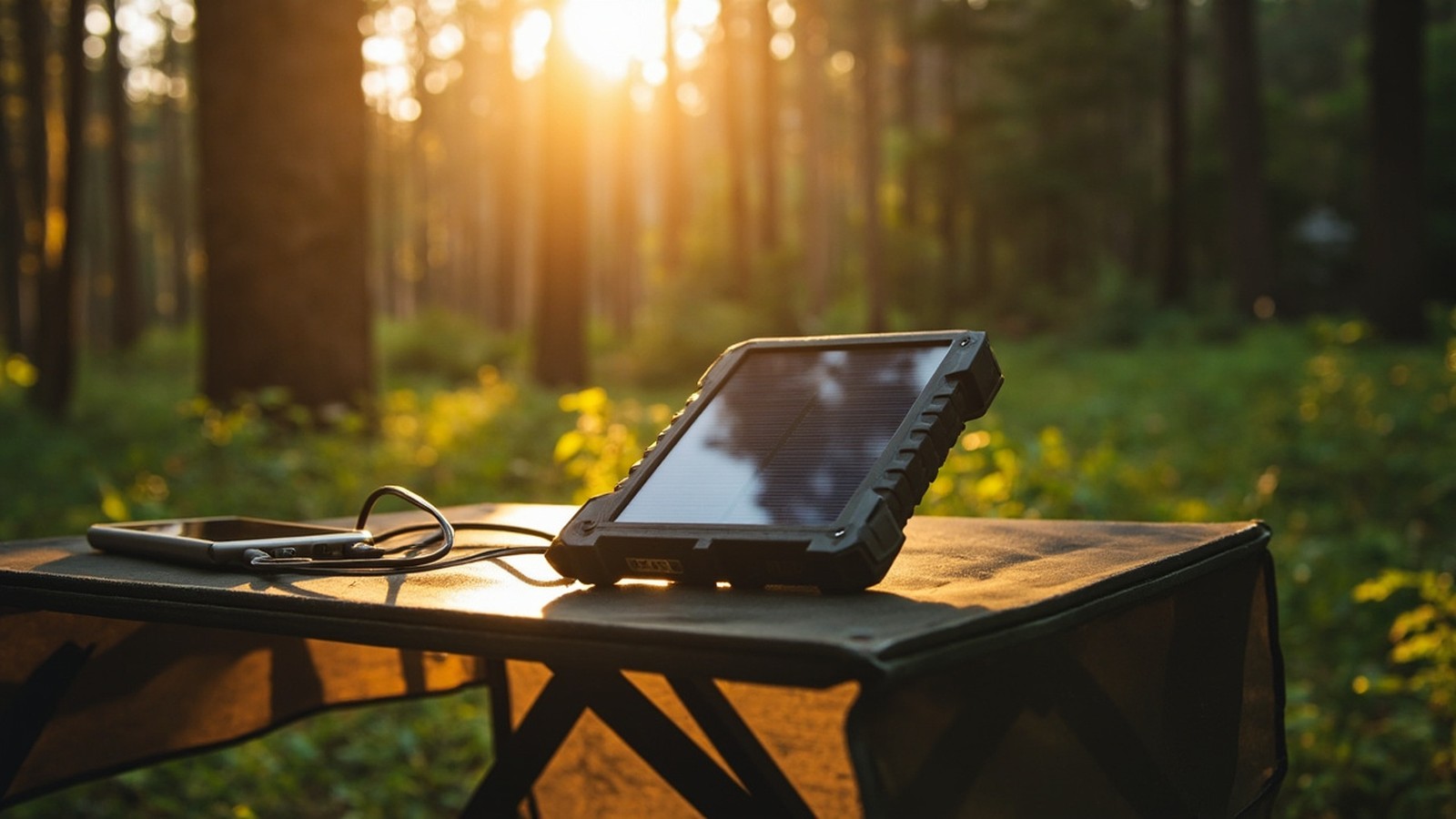
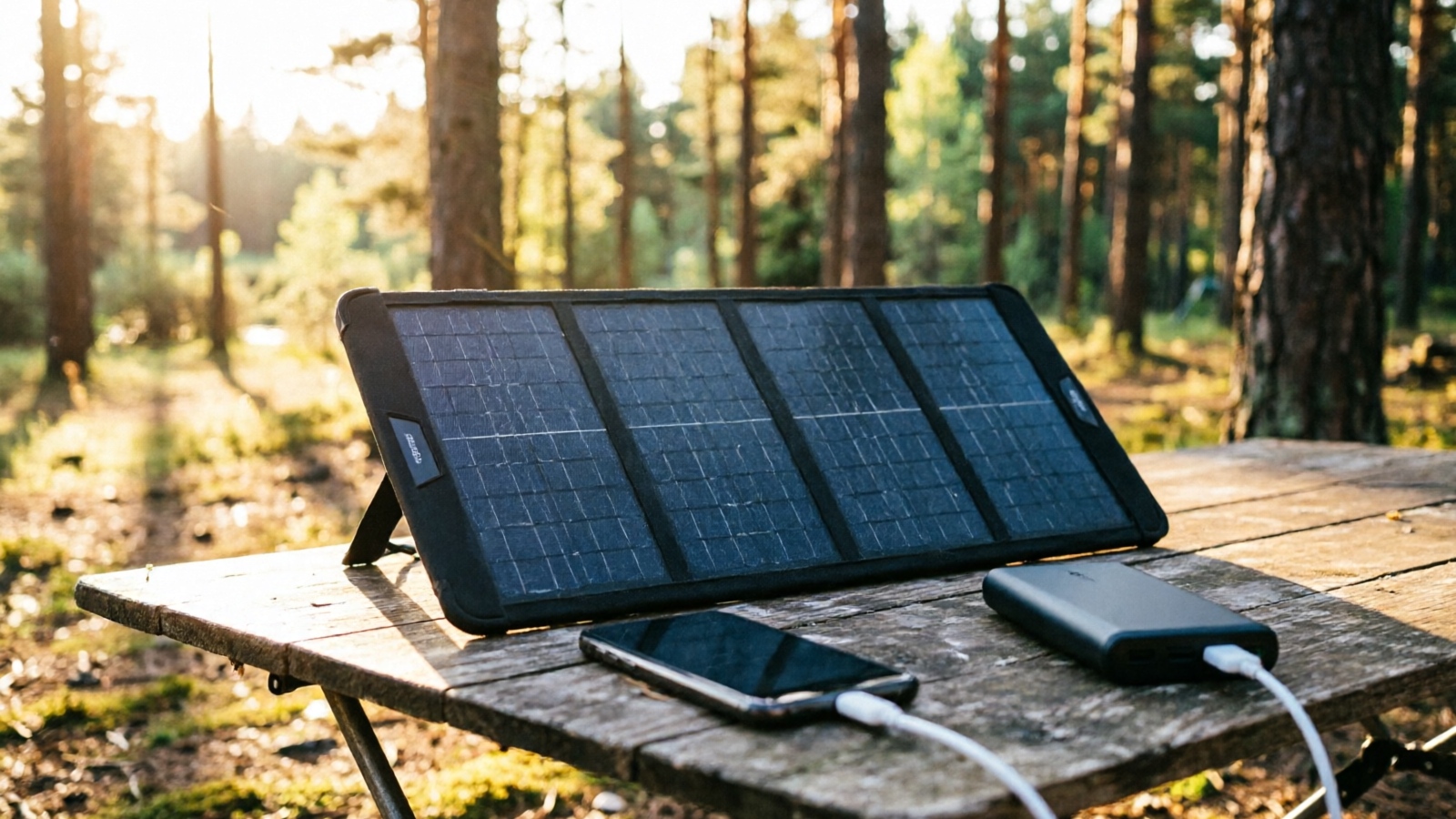
Solar panels built into power banks are appealing in theory. Leave your power bank in the sun all day, and it charges itself — what could be better?
In practice, the small solar panels on most power banks generate just 2-5 watts. For context, your phone charger delivers 15-30W. At 3W solar output, one hour of direct sunlight adds roughly enough charge for a 10-minute phone call. You’d need 8-12 hours of direct sun to add a meaningful charge.
That said, solar charging has a real niche: extended trips where every watt counts. Over three days of solar camping, a solar power bank might accumulate enough trickle charge to give you an extra phone charge on day four. It’s an emergency buffer, not a primary charging method.
The BLAVOR Solar Power Bank adds wireless charging and built-in cables on top of the solar panel — a reasonable value if you want the solar backup. The BLAVOR Hand Crank version adds a hand crank for a third charging method, which is genuinely useful in survival scenarios.
If solar charging is a priority, consider a dedicated portable solar panel instead — they generate 15-30W and charge your power bank much faster than any built-in panel.
Durability and Weather Resistance
Most power banks are designed for desk use. Camping subjects them to rain, dust, drops, and temperature swings. If you camp in wet conditions or near water, durability matters.
IP ratings explained:
- No rating: Keep it dry. Fine for car camping under a tarp.
- IPX4: Splash-resistant. Survives light rain.
- IP68: Fully waterproof. Submersible. Survives drops in streams and heavy rain.
The Aswayke Rugged Power Bank is the only option in this guide with IP68 waterproofing. The Aswayke includes a 420-lumen camping lantern built in — one less light to pack. If you camp in the rain frequently (see our rain camping tips), waterproofing is worth paying for.
Power Bank Safety Checklist
- ✅ Pack in carry-on luggage (TSA requires lithium batteries under 100Wh in carry-on only)
- ✅ Keep above 32°F — cold permanently damages lithium-ion cells
- ❌ Never put in checked baggage — airlines confiscate loose lithium batteries
- ❌ Don’t leave in direct sunlight on hot days — temperatures above 113°F degrade battery chemistry
- ❌ Don’t use cracked or swollen power banks — fire risk
For dry-weather camping, standard power banks work fine. Most Anker and INIU models have rubberized exteriors and reasonable drop resistance, though they’re not rated for water exposure.
Extra Features That Actually Matter
Beyond the core specs, a few features separate useful power banks from frustrating ones:
Built-in cables eliminate one thing to pack and one cable to lose. The Anker PowerCore 87W, INIU 45W, and INIU 65W all include built-in USB-C cables. The downside: the built-in cable is a single point of failure — when it wears out, the whole power bank goes with it. That makes it the most likely long-term failure point on all three.
Wireless charging lets you set your phone on top of the power bank to charge — convenient but slow (typically 5-10W). The BLAVOR models include this. It’s a nice extra, not a reason to choose a power bank.
LED flashlights and lanterns serve double duty. The Aswayke includes a 420-lumen lantern that genuinely illuminates a campsite. The BLAVOR Hand Crank has a smaller camping light. Both save you from packing a separate light.
Flight-safe rating means the battery is under 100Wh — the TSA limit for carry-on lithium batteries. All power banks in this guide qualify. Always pack them in carry-on, never checked baggage.
Battery level displays tell you how much charge remains. Basic models use 4 LED dots (25% increments). Better models show exact percentage on a small screen. This matters more than you’d expect — knowing you have 23% vs 50% changes whether you ration charge or use your phone freely.
According to the TSA, lithium-ion batteries between 101-160Wh require airline approval before flying, while anything under 100Wh needs no approval — all power banks in this guide fall in the safe range.
Our Top Picks by Use Case
| Use Case | Best Pick | Why |
|---|---|---|
| Budget phone charging | INIU 45W | Lightest at 0.86 lb, fast phone charging |
| Best all-rounder | Anker 87W | Reliable 87W, 3 ports, built-in cable |
| Budget laptop | INIU 65W | Laptop charging at budget price |
| Solar backup | BLAVOR Solar | Wireless charging + solar trickle |
| Rugged conditions | Aswayke IP68 | Waterproof + 420lm lantern |
| Emergency survival | BLAVOR Crank | Solar + hand crank + USB |
| Full laptop charging | Anker 165W | 100W per port, charges any laptop |
| Maximum power | Anker Prime 220W | Fastest output, app control |
For most campers, the Anker PowerCore 87W hits the best balance of price, weight, and charging speed. It charges three devices simultaneously, has a built-in USB-C cable, and weighs under 1 lb. If you only need phone charging and want the lightest option, the INIU 45W is tough to beat.
Power Bank vs. Portable Power Station
Power banks and portable power stations serve different needs. Here’s when to choose each:
Choose a power bank when: You need to charge phones, tablets, and small laptops. You’re backpacking or weight matters. You want something pocket-sized.
Choose a power station when: You need AC outlets to run appliances. You’re car camping or basecamping. You need to power a CPAP machine, mini-fridge, or other 110V devices. Weight isn’t a concern.
If you’re looking for the best portable charger for camping, the key is matching wattage to your devices. A camping power bank vs portable power station comes down to one question: do you need USB charging or AC outlets? For backpacking trips and car camping where USB charging covers your needs, a power bank is simpler, lighter, and cheaper.
Charging Tips for Camping
-
Charge to 100% before your trip. Don’t rely on solar or car charging to top up before you leave. A full power bank is your safety net.
-
Keep your power bank warm. Cold temperatures (below 32°F) significantly reduce battery performance. Store it inside your sleeping bag at night or in an insulated pocket during the day.
-
Prioritize essential devices. When battery is running low, charge your phone before your tablet. Navigation and emergency communication trump entertainment.
-
Turn on airplane mode to conserve. A phone in airplane mode uses 5-10x less battery than one searching for signal. This is one of the simplest ways to figure out how to charge your phone while camping — minimize drain while your power bank tops it up. Charge your phone, then switch to airplane mode until you need connectivity.
-
Use the right cable. A USB-C to USB-C cable rated for PD is required for fast charging. Old USB-A to USB-C cables limit you to 12W regardless of what your power bank can deliver.
-
Don’t drain to 0%. Lithium-ion batteries last longer when kept between 20-80%. If possible, top up before your power bank hits empty.
Frequently Asked Questions
Can I bring a 20,000mAh power bank on a plane?
Yes. A 20,000mAh power bank equals roughly 74Wh, which is well under the TSA's 100Wh carry-on limit. Pack it in carry-on, not checked baggage.
How long does it take to charge a 20,000mAh power bank?
About 3.5 to 4 hours with a 30W charger, or 2.5 hours with a 65W+ charger. Always charge it fully before your trip.
Is solar charging on power banks actually useful?
It's a trickle charge at best — most built-in solar panels generate only 2-5W, barely enough for a 10-minute phone call per hour of sun. It works as a multi-day emergency backup, not a primary charging method.
What's the difference between a power bank and a portable power station?
Power banks are compact, USB-only, and power small electronics. Power stations are larger with AC outlets for appliances. See our [best portable power stations](/reviews/best-portable-power-stations) guide if you need AC power.
How do I know if my power bank can charge my laptop?
You need at least 65W output for most 13-inch laptops and 100W+ for 15-16 inch models. Use a USB-C cable that supports Power Delivery (PD). The Anker 165W and INIU 65W in this guide both handle laptop charging.