How to Use Solar Power While Camping: Complete Guide
Learn how to set up solar power for camping. Complete guide to panels, power banks, and generators for off-grid camping.
Why Solar Power Is a Game-Changer for Camping
Solar camping eliminates the tradeoff between off-grid freedom and powered convenience. Five years ago, your options at a remote campsite were simple: bring extra batteries and ration device usage, or drag a gas generator that weighs 50+ pounds, needs fuel storage, and annoys every camper within earshot. Solar panels changed the equation.
Modern foldable solar panels weigh under 2 pounds for a 28W unit and under 18 pounds for a 200W powerhouse. Pair one with a portable power station and you have silent, emission-free electricity for phones, laptops, camping fans, lights, and even small fridges. No fuel. No noise. No maintenance beyond wiping the panel clean.
The cost has dropped too. A capable solar camping setup — 100W panel plus 300Wh power station — costs less than a single weekend of RV park fees with electrical hookups. The investment pays for itself within a few trips for anyone who camps regularly without hookups. For beginners planning their first off-grid trip, our car camping guide covers the basics of site selection — including sun exposure, which matters for solar.
Three real benefits drive solar adoption: freedom (camp anywhere without worrying about outlet access), convenience (charge devices without rationing battery percentage), and cost savings (no fuel purchases, no battery replacements, panels last 10+ years). Solar camping is not perfect — clouds, shade, and short winter days reduce output significantly. But for most campers in most conditions, a basic solar setup delivers reliable power for the devices that matter.
Understanding Your Solar Power Needs
Before buying any solar gear, calculate how much power you actually use. This section saves you from overspending on a 200W panel when a 28W foldable panel covers your needs — or underspending when your fridge drains a 300Wh station overnight.
How to Calculate Watt-Hours
Watt-hours (Wh) measure total energy consumption. The formula is straightforward:
Device wattage × hours of use = daily watt-hours
Add up every device you plan to run, then match your total to a panel and battery combination that covers it.
Here is a practical reference table for common camping devices:
| Device | Wattage | Hours/Day | Daily Wh |
|---|---|---|---|
| Smartphone (charging) | 10-18W | 3 hrs | 30-54 Wh |
| Headlamp (USB charging) | 5W | 1 hr | 5 Wh |
| Laptop | 30-65W | 2 hrs | 60-130 Wh |
| Portable speaker | 10-20W | 3 hrs | 30-60 Wh |
| Camping fan | 8-20W | 6 hrs | 48-120 Wh |
| LED camp light | 5-10W | 5 hrs | 25-50 Wh |
| 12V camping fridge | 30-60W | 24 hrs | 720-1440 Wh |
| CPAP machine | 40-60W | 8 hrs | 320-480 Wh |
| Drone (charging) | 50-100W | 1 hr | 50-100 Wh |
Example calculation: A weekend camper charging two phones (50Wh), a laptop (100Wh), running a speaker (40Wh), a fan (60Wh), and a camp light (30Wh) uses roughly 280 Wh per day. A 100W solar panel produces 400-600 Wh in full sun — comfortably covering this load with buffer for clouds.
Critical rule: Always add 20-30% buffer to your calculated total. Solar panels rarely produce their rated wattage in real conditions (clouds, angle, temperature, dust all reduce output). If you need 300Wh daily, plan for 400Wh of solar generation capacity.
What Can You Run on Solar?
The answer depends on your panel wattage and battery storage:
- 20-30W panel + power bank (20-30Wh): Phones, GPS units, headlamps, Bluetooth earbuds. Enough for basic communication and navigation on 1-2 night trips.
- 100W panel + 300Wh station: Everything above plus laptops, speakers, fans, lights, drone batteries. The sweet spot for most weekend campers.
- 200W panel + 500Wh+ station: Everything above plus 12V fridges, CPAP machines, and multiple simultaneous devices. The standard for extended off-grid trips and RV use.
A 12V camping fridge is the dividing line. If you need to keep food cold continuously, skip the small panels and go straight to 200W solar with a 500Wh+ power station. Fridge compressors run 24/7 and consume more daily energy than every other device combined.
For detailed product comparisons, see our reviews of the best solar chargers and best portable power stations.
Types of Camping Solar Setups
Three distinct solar camping setups exist, each serving a different type of camper. Understanding the differences prevents buying the wrong system.
Portable Solar Panels
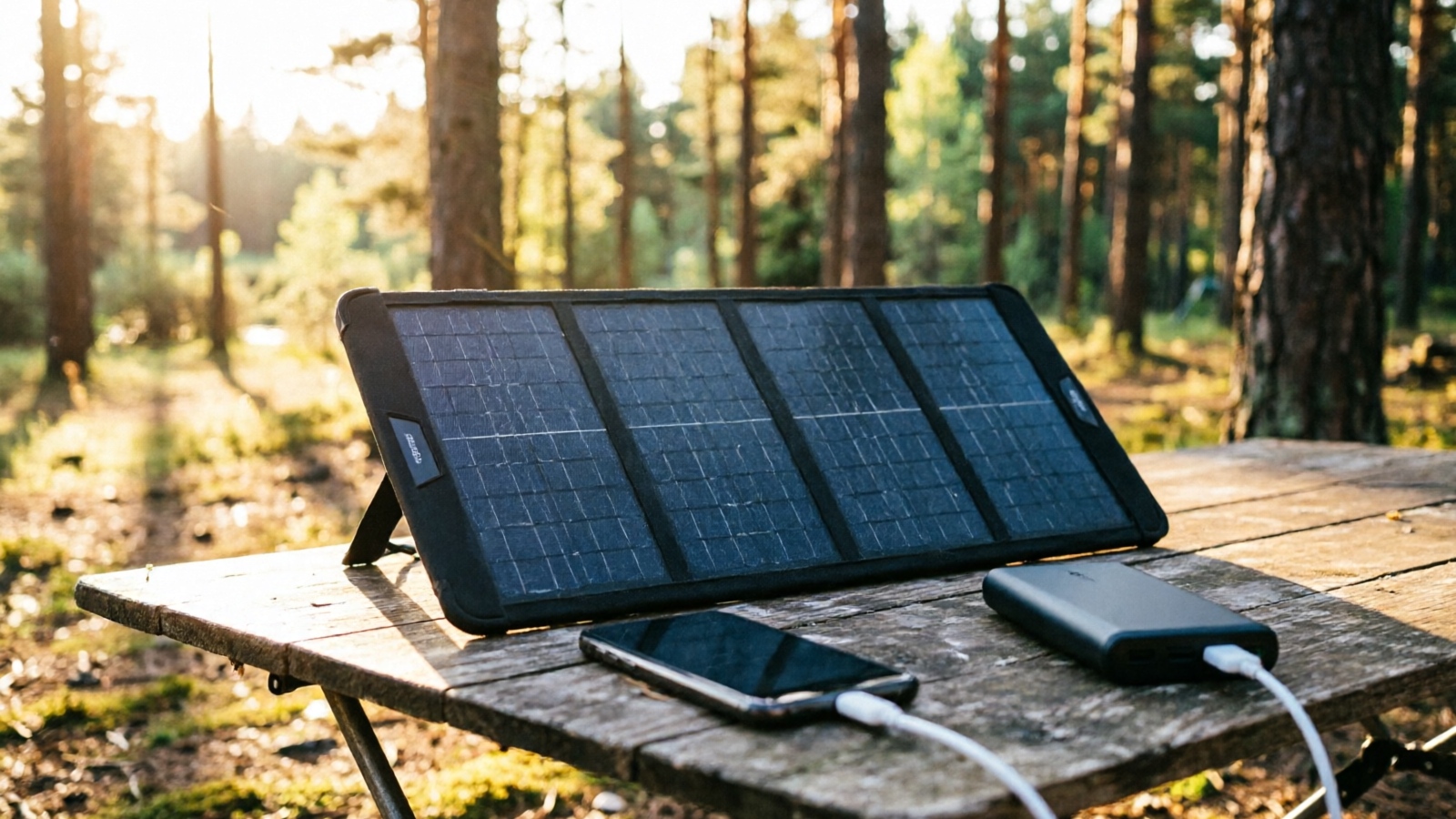
Foldable solar panels are the most versatile option. They range from 20W pocket-sized panels to 200W suitcase-style units. Unfold them in the sun, plug in your device or power station, and charge. Key advantages: lightweight for their output, foldable for storage, no installation required. The BigBlue 28W weighs just 1.1 lbs and fits in a jacket pocket — ideal for backpackers and day hikers. The FlexSolar 100W delivers serious power at 8.8 lbs for car campers. The Renogy 200W pushes 17.6 lbs but outputs enough to run a 12V fridge and charge a power station simultaneously.
Limitation: panels produce zero power at night. You either use power in real-time during daylight or store it in a battery.
Solar Power Banks
Solar power banks combine a small solar panel with a built-in battery. They charge slowly from sunlight during the day and deliver stored power to devices on demand. The BLAVOR 20K Solar Bank holds 20,000mAh (74Wh) with a built-in panel — but that tiny panel takes 2-3 days of direct sun for a full recharge. Solar power banks are emergency backups, not primary power sources. Charge them fully at home before your trip, then use the solar panel to top off during extended outings.
Best for: campers who want a single device that charges from the wall and supplements with sun. Not suitable as your only power source on multi-day trips.
Solar Generator Kits
Solar generator kits bundle a portable power station with a compatible solar panel — an all-in-one system designed to work together. The power station stores energy, the panel recharges it. No guessing about compatibility, connector types, or charge rates. For a comprehensive comparison across solar, gas, and dual-fuel options, see our best camping generators review. Kits range from 200W systems for weekend trips to 400W+ systems for RV off-grid living.
Best for: campers who want a plug-and-play system without researching individual components.
Here is a comparison of the three types:
| Setup Type | Best For | Weight Range | Power Output | Cost Range |
|---|---|---|---|---|
| Foldable panel | Backpackers, day trippers | 0.5-18 lbs | 20-200W | Check Price → |
| Solar power bank | Emergency backup, light users | 0.5-1.5 lbs | 5-20W panel + 20-74Wh battery | Check Price → |
| Solar generator kit | Car campers, RV users | 15-40 lbs | 100-400W panel + 300-1000Wh battery | Check Price → |
How to Set Up Solar Power at Your Campsite
Proper setup separates campers who get reliable solar power from those who stare at a flat battery wondering why their panel “does not work.” Position and angle matter more than panel wattage.
Step-by-Step Setup
Step 1: Assess your campsite sun exposure. Before pitching your tent, identify the sun path. South-facing (in the Northern Hemisphere) open areas receive the most direct sunlight. Avoid campsites under dense tree canopy if solar charging is a priority. Partial shade on even one cell of a solar panel reduces the entire panel’s output by 30-80% — solar panels are only as strong as their weakest cell.
Step 2: Position the panel. Place the panel on a flat, stable surface facing the sun. If your panel includes a kickstand or frame, angle it at approximately 45 degrees toward the sun. Many foldable panels come with built-in kickstands — use them. Without stands, prop the panel against a backpack, log, or rocks to achieve the angle.
Step 3: Connect your devices. For direct device charging, plug your phone or USB device into the panel’s output ports. For power station charging, connect the panel to the station via the included cable (typically MC4 or DC barrel connector). The power station will show incoming wattage on its display — this tells you immediately if your panel position is effective.
Step 4: Adjust throughout the day. The sun moves east to west. Adjust your panel angle 2-3 times during the day to track the sun’s position. Morning: face east. Midday: face south and flatten the angle. Afternoon: face west. This single habit can increase daily harvest by 20-30% compared to a fixed position.
Step 5: Store power for nighttime. Charge your power station during peak sun hours (10 AM - 3 PM). Use stored battery power at night for lights, fans, and device charging. Solar panels produce nothing after sunset — your battery bank is your nighttime lifeline.
Tips for Maximum Efficiency
- Avoid partial shade at all costs. Even a tree branch shadow across one corner of a 100W panel can drop output to 30W. Move the panel to full sun, period.
- Keep the panel clean. Dust, pollen, bird droppings, and campfire ash on the panel surface block sunlight. Wipe with a damp cloth daily.
- Cold weather improves panel efficiency but reduces battery capacity. Solar panels actually produce slightly more power in cold temperatures, but your power station’s battery delivers less capacity in the cold. Keep the power station insulated (inside your tent or vehicle) while the panel stays outside.
- Use MPPT charge controllers when available. They extract 15-20% more power from solar panels than basic PWM controllers, especially in variable light conditions. Some power stations include MPPT — check before buying.
- Cloud edge effect: Panels can briefly produce above-rated output when the sun peeks out from behind a cloud edge due to reflected light from surrounding clouds. This is normal, not a malfunction.
Best Solar Gear for Camping
Our detailed reviews cover every product below. Here are the standout recommendations for different solar camping needs.
Best Solar Chargers for Camping
For detailed specs, ratings, and full comparisons, see our complete solar charger review.
| Product | Wattage | Weight | Best For |
|---|---|---|---|
| BigBlue 28W | 28W | 1.1 lbs | Best all-around foldable panel |
| FlexSolar 100W | 100W | 8.8 lbs | Best 100W value for car camping |
| Renogy 200W | 200W | 17.6 lbs | Most powerful for fridges and heavy use |
| Goal Zero Nomad 20 | 20W | 1.1 lbs | Premium ultralight option |
| BLAVOR 20K Solar Bank | Built-in | 1.3 lbs | Solar power bank with 74Wh battery |
Best Portable Power Stations
See our full power station review for battery chemistry, cycle life, and output specs.
| Product | Capacity | Solar Input | Best For |
|---|---|---|---|
| GRECELL 288Wh | 288Wh | MC4/DC | Best value weekend station |
| Jackery Explorer 300 | 293Wh | MC4 | Most reliable mid-range |
| Anker SOLIX C1000 | 1056Wh | MC4 | Best overall heavy-duty station |
| Jackery Explorer 1000 v2 | 1008Wh | MC4 | Best mid-range heavy duty |
Best Camping Generators (Solar, Gas, Dual Fuel)
For trips that demand more power than solar can provide, see our best camping generators review covering solar generators, gas inverter generators, and dual-fuel options.
| Product | Type | Output | Best For |
|---|---|---|---|
| EcoFlow DELTA 2 | Solar generator | 1800W | Best overall camping generator |
| Honda EU2200i | Gas inverter | 2200W | Quietest gas option |
| WEN 2350W | Gas inverter | 2350W | Best budget gas generator |
Solar Camping Tips for Different Situations
Summer vs Winter Camping
Summer is solar camping prime time. Long days (14+ hours of daylight), high sun angle, and clear skies maximize panel output. A 100W panel in July can produce 600-800Wh — enough for most camping loads. Keep the power station in the shade while the panel sits in full sun to prevent battery overheating.
Winter is the opposite challenge. Short days (8-10 hours of daylight), low sun angle, and overcast skies slash solar output by 40-60%. A 100W panel in December might produce only 200-300Wh. Strategies: oversize your panel (go 200W instead of 100W), supplement with a charged power station brought from home, and keep batteries warm inside your tent or vehicle — cold temperatures reduce lithium battery capacity by 20-30%. Angle panels steeper (60-70 degrees) to catch the low winter sun directly. Snow reflection can actually boost output slightly if the panel is angled above white ground.
RV Camping with Solar
RV solar setups range from simple portable panels to permanent roof installations. For occasional solar use, a foldable 100-200W panel placed outside the RV is the most flexible approach — angle it toward the sun and move it to avoid shade from trees and neighboring RVs. Connect it to your RV’s house battery via a solar charge controller.
For full-time off-grid RV living, roof-mounted panels (200-400W total) with an MPPT charge controller and upgraded battery bank provide continuous power. This is a permanent installation that requires wiring knowledge — not a weekend project. Either way, monitor your battery levels and adjust power consumption when days are cloudy. Pair your solar setup with LED camping lanterns for efficient nighttime lighting that minimizes battery drain.
Backpacking with Solar
Every ounce matters on the trail. A solar power bank like the BLAVOR 10K at under 1 lb provides emergency phone charging without the weight penalty. Small 20-28W foldable panels under 1.5 lbs charge a phone during rest stops, but on-the-move charging is inefficient — constant angle changes and tree shade make trail hiking poor for solar harvesting.
Better approach for backpackers: carry a fully charged 10,000-20,000mAh power bank (6-12 oz) as your primary power source. It delivers guaranteed power regardless of weather, weighs less than a solar panel, and requires no sun. Use solar only as a supplemental top-up during multi-day trips when you have extended rest periods at camp in open areas. See our camping hacks guide for more weight-saving outdoor tips.
Common Solar Camping Mistakes to Avoid
1. Buying a panel without a battery. Solar panels only produce power when the sun shines. Without a power station or battery bank, you have zero power after sunset and zero power in cloudy conditions. Always pair your panel with storage.
2. Positioning panels in shade. Partial shade on one cell drops entire panel output dramatically. Campers often set panels near their tent for convenience — but if the tent or trees cast any shadow on the panel, output plummets. Walk the panel 10-20 feet away to full sun if needed. Use an extension cable.
3. Underestimating power needs. Most campers calculate phone charging only and forget about fans, lights, speakers, and fridges. Use our watt-hour table above and add 20-30% buffer. A 12V fridge alone can consume more daily energy than every other device combined.
4. Leaving panels flat on the ground. Flat panels receive indirect light at oblique angles, reducing output by 30-50% compared to angled panels facing the sun. Use kickstands or prop panels up. Even a 30-degree angle makes a significant difference.
5. Forgetting cold weather reduces battery capacity. Lithium batteries deliver 20-30% less capacity in freezing temperatures. Your power station that lasts 3 days in summer may only last 2 days in winter. Store batteries inside your tent or vehicle, not outside in the cold.
6. Not adjusting panel angle throughout the day. The sun moves. A panel facing east at noon catches zero direct light. Adjust your panel 2-3 times daily to track the sun — this simple habit boosts daily output by 20-30%.
Frequently Asked Questions
Is solar power worth it for camping?
For trips of 2+ days off-grid, yes. A 100W panel paired with a power station provides continuous power for phones, lights, fans, and small appliances. For single overnight trips, a charged power station alone is sufficient. Solar becomes essential at 3+ days without hookups.
How much solar do I need?
Calculate your daily watt-hours using our table above. Most campers need 200-500Wh per day. A 100W panel produces 400-600Wh in full sun. For 12V fridges and CPAP machines, go 200W panel with 500Wh+ station. Always add 20% buffer.
Can I run a fridge on solar?
Yes. Most camping fridges draw 30-60W (720-1440Wh/day). A 200W panel produces enough to run a fridge during daylight while charging a 500Wh+ station for nighttime. See our best portable power stations for fridge-capable units.
Do solar panels work in clouds?
At 10-25% of rated output in heavy overcast. Thin clouds still allow 50-70%. Heavy clouds mean slow charging — enough for a phone, not enough for appliances. In consistently cloudy regions, consider a gas generator backup.
Best solar setup for RVs?
Permanent roof panels (200-400W) for full-timers, portable foldable panels (100-200W) for casual users. Both pair with a power station or house battery bank. See our best camping generators for high-output RV options.
How do I charge a power station with solar?
Connect the panel via MC4 or DC cable to the station’s solar input. A 100W panel charges a 300Wh station in 3-5 hours of direct sun. 200W panel cuts that to 2-3 hours. Use MPPT controllers when available for 15-20% more efficiency.
Can I use solar while backpacking?
Solar power banks under 1 lb provide emergency charging. Small 28W foldable panels charge phones at rest stops. But on-trail charging is inefficient. A pre-charged power bank delivers guaranteed power with less weight. See our camping hacks for weight-saving tips.
Solar panel vs power station — what is the difference?
Panels generate electricity from sunlight (daytime only). Power stations store electricity in batteries (anytime use). For solar camping you need both: the panel harvests during the day, the station stores for night. Neither alone provides 24/7 off-grid power.
Frequently Asked Questions
Is solar power worth it for camping?
For trips of 2+ days off-grid, solar is absolutely worth it. A 100W foldable panel paired with a portable power station lets you charge phones, run lights, power a small fan, and even run a 12V fridge indefinitely — as long as you get sun. For single overnight trips, a charged power station alone is usually enough. Solar becomes essential when you camp 3+ days without electrical hookups. The upfront cost pays for itself in generator fuel savings and the convenience of silent, emission-free power.
How much solar do I need for camping?
Calculate your daily watt-hours (device watts × hours of use). Most campers need 200-500Wh per day. A 100W solar panel produces roughly 400-600Wh in a full day of direct sun — enough for phones, laptops, lights, and a fan. For 12V fridges and CPAP machines running continuously, you need 200W+ panels and a 500Wh+ power station. Start with our watt-hour calculation table in this guide, then add 20% buffer for cloudy days and inefficiency.
Can I run a 12V camping fridge on solar?
Yes. Most camping fridges draw 30-60W, using 720-1440Wh per day. A 200W solar panel produces enough power to run a fridge continuously during daylight hours while also charging a power station for nighttime operation. You need a power station with at least 500Wh capacity and a 100-200W solar panel to keep it charged. Check out our [best portable power stations](/reviews/best-portable-power-stations/) for units that handle fridge loads.
Do solar panels work in cloudy weather?
Solar panels produce 10-25% of their rated wattage in cloudy conditions. A 100W panel might output 10-25W under heavy clouds — enough to slowly charge a phone but not enough to run appliances. Overcast days with thin clouds still allow 50-70% output. Position panels toward the brightest part of the sky and avoid any shade. Solar camping in consistently cloudy regions is frustrating — consider a gas generator as backup in those conditions.
What is the best solar setup for RV camping?
For RVs with roof space, permanent roof-mounted panels (200-400W) connected to a solar charge controller and house battery bank provide continuous power. For casual RV users, portable foldable panels (100-200W) offer flexibility — angle them toward the sun and move them around shade. Pair with a 500-1000Wh power station or the RV's built-in battery. For serious off-grid RV living, see our [best camping generators](/reviews/best-camping-generators/) for higher-output options including solar generator kits.
How do I charge a power station with solar?
Most power stations accept solar input via MC4 or DC barrel connectors. Connect the solar panel to the power station using the included cable, place the panel in direct sunlight angled toward the sun, and the station charges automatically. A 100W panel charges a 300Wh station in about 3-5 hours of direct sun. A 200W panel cuts that to roughly 2-3 hours. Use an MPPT charge controller if your panel and station support it — it extracts 15-20% more power than PWM controllers.
Can I use solar power while backpacking?
Yes, but with weight limitations. Solar power banks under 1 lb (like the [BLAVOR 10K Solar Bank](https://www.amazon.com/dp/B07FDXDB3W?tag=camplabx-20)) work for emergency phone charging. Small foldable panels under 1.5 lbs (like the [BigBlue 28W](https://www.amazon.com/dp/B01EXWCPLC?tag=camplabx-20)) charge a phone during rest stops. But on-the-move charging is inefficient — panel angle changes constantly and tree shade interrupts output. Best practice: charge during rest breaks at camp, not while hiking. For ultralight trips, a fully charged power bank weighs less than a solar setup and delivers guaranteed power.
What is the difference between a solar panel and a portable power station?
A solar panel generates electricity from sunlight — it only produces power when the sun shines. A portable power station stores electricity in a battery — charge it at home or via solar, then use it anytime, day or night. For solar camping, you need both: the panel generates power during the day, the station stores it for use at night. Panels alone cannot power devices after sunset. Stations alone run out after 1-3 days without recharging. Together, they provide continuous off-grid power.