
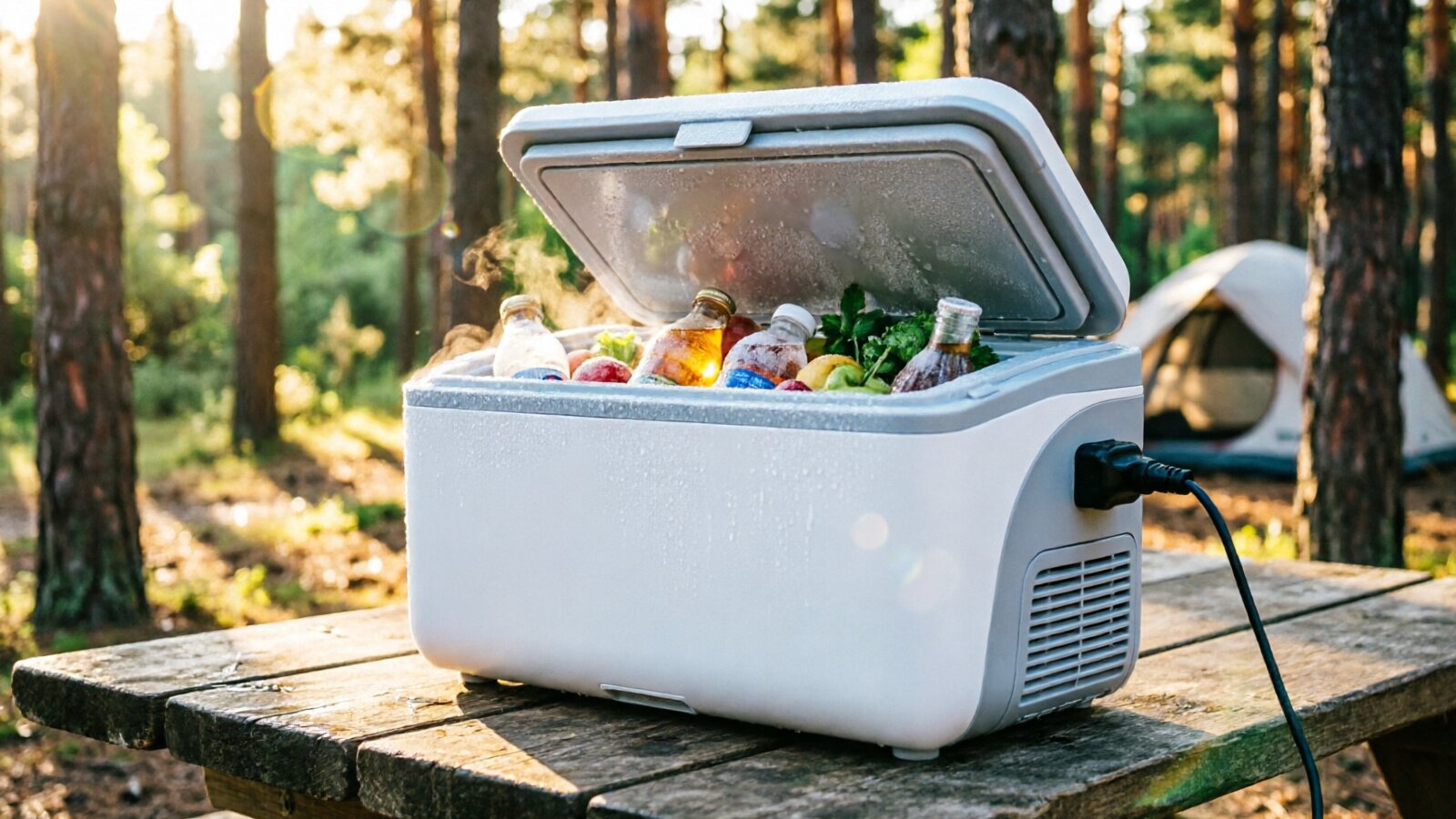
Best Electric Camping Cooler (2026): No Ice, No Problem
Find the best electric camping cooler for your next trip. We compare compressor vs thermoelectric models, battery life, and top picks from...
If you’ve ever spent your camping trip hunting for bagged ice at 10 PM, it’s time to consider the best electric camping cooler. No more melting, no more soggy sandwiches, no more drain plugs leaking in your trunk. Electric coolers plug into your car’s 12V outlet or a portable power station and keep your food cold — or frozen — for days.
But the category is confusing. Thermoelectric vs compressor, $70 vs $500, 9-can mini-fridges vs 55-quart freezers. This guide to the best electric camping cooler cuts through the noise: how they work, what to buy, and which models are worth your money.
What Is an Electric Camping Cooler?
An electric camping cooler is a portable refrigeration unit that runs on 12V DC (your car’s cigarette lighter), AC wall power, or a built-in lithium battery — no ice required. Unlike traditional ice coolers, electric coolers let you set an exact temperature, keep food safely refrigerated at 34-40°F, and some models can even freeze down to -4°F.
There are two main types, and understanding them is key to choosing the best electric camping cooler for your needs:
- Thermoelectric (Peltier) coolers use a solid-state heat pump with no moving parts (just a fan). They cool 36-40°F below ambient temperature. At 90°F outside, your drinks hit about 50-54°F — cool but not refrigerator-cold.
- Compressor coolers use the same refrigerant cycle as your kitchen fridge. They reach 32°F and below, regardless of outside temperature, and some models can freeze food.
Power sources include 12V car adapters, AC wall plugs (110-240V), and some models with built-in lithium batteries for off-grid use. Weight ranges from roughly 10 lbs for compact thermoelectric units to 45 lbs for large compressor models.
Thermoelectric vs Compressor — Which Type Do You Need?
This is the decision that matters most. Here’s the full breakdown:
| Factor | Thermoelectric (Peltier) | Compressor |
|---|---|---|
| Cooling Method | Solid-state heat pump | Refrigerant gas cycle |
| Temperature Range | 36–40°F below ambient | Down to -4°F (freezing) |
| Can Freeze? | No | Yes |
| Noise Level | Near-silent fan | Low hum (35-45 dB) |
| Weight | 10–15 lbs | 25–45 lbs |
| Price Range | $60–$180 | $200–$500 |
| Power Draw | 40–60W | 40–70W (cycling) |
| Durability | No moving parts (fan only) | Compressor has moving parts |
| Best For | Day trips, drinks, mild temps | Multi-day trips, frozen food, hot climates |
Choose thermoelectric if: You car camp in mild weather (under 80°F), mostly need cold drinks and snacks, and want to spend under $150. Thermoelectric coolers are lighter, quieter, and cheaper — perfect for road trips and tailgating.
Choose compressor if: You camp for multiple days, camp in hot weather (90°F+), need to keep meat, dairy, or medication at safe refrigerator temperatures, or want the option to freeze food. Compressor coolers cost more upfront but perform like a real refrigerator in any conditions.
How to Choose the Right Electric Cooler
Don’t overcomplicate this. Answer these five questions in order:
1. How long are your trips?
Day trips and single overnights → thermoelectric is fine. Multi-day camping trips where you need real refrigeration → compressor.
2. What’s your power source?
If you only have your car’s 12V outlet, thermoelectric draws less consistently. If you’re bringing a portable power station or camping near AC hookups, compressor is the better choice.
3. How much capacity do you need?
Solo camper: 20-30L (about 20-30 cans). Couple: 30-50L. Family of 3-4: 50L+.
4. What’s your budget?
Thermoelectric: $60-180. Compressor: $200-500. The sweet spot for value is $120-220 (small compressor models from brands like EUHOMY and Alpicool).
5. Any deal-breaker features?
App control for temperature monitoring, USB ports for phone charging, dual-zone compartments (separate fridge/freezer), built-in battery for off-grid use, and wheels for transport are worth considering but not essential.
Powering Your Electric Cooler — Battery & Solar Guide
This is where most people get confused, so here’s a clear reference. Your electric cooler’s power needs depend on which type you buy:
| Cooler Type | Avg Power Draw | 24h Usage (Wh) | Runs On 300Wh PPS | Runs On 500Wh PPS |
|---|---|---|---|---|
| Thermoelectric 30L | 45W | ~600Wh (50% duty) | ~12 hours | ~20 hours |
| Compressor 30L | 40W avg (cycling) | ~480Wh | ~15 hours | ~25 hours |
| Compressor 50L | 55W avg (cycling) | ~660Wh | ~10 hours | ~18 hours |
PPS = Portable Power Station. Estimates based on manufacturer specs with ~50% compressor duty cycle.
Three ways to power your cooler:
Car 12V outlet: Unlimited power while the engine is running. When the engine is off, most cars can handle 4-8 hours before the battery drops too low. Most electric coolers have a low-voltage shutoff (usually at 10.5V or 11V) that prevents your car battery from dying completely. Always use this feature.
Portable power station: This is the most versatile option for camping. A best portable power station for camping with 300Wh handles thermoelectric coolers for a day trip. For compressor coolers, 500Wh+ is recommended for overnight use. The compressor cycles on and off, so actual draw is lower than the max wattage suggests.
Solar panel pairing: For multi-day off-grid camping, a 100W solar panel paired with a 500Wh power station creates a sustainable cooling loop. The panel recharges the station during daylight hours, and the station powers the cooler through the night. This setup can run indefinitely in decent weather.
Best Thermoelectric Coolers
Thermoelectric coolers are budget-friendly, lightweight, and perfect for keeping drinks cold on road trips. If you’re looking for the best electric camping cooler on a budget, these are the top picks:
Ivation Electric Cooler & Warmer — Best Overall Thermoelectric
Ivation 24L Electric Cooler on Amazon
The Ivation 24L is one of the most popular thermoelectric coolers on Amazon. 24-liter capacity (about 30 cans), 110V AC and 12V DC power cords included, and a built-in carrying handle. It cools and warms (up to 130°F), which is handy for keeping food warm on the drive to camp. The design is clean and simple — no app, no Bluetooth, just plug it in and go.
- Price: ~$100
- Capacity: 24L / ~30 cans
- Power: 110V AC + 12V DC
- Cooling range: 36-40°F below ambient
Pros: Simple operation | AC + DC included | Cooler/warmer dual function | Lightweight (~10 lbs)
Cons: No freezer capability | Struggles above 85°F ambient | No battery protection display
Best for: Road trips, day camping, tailgating, keeping drinks cold in mild weather.
Koolatron P-27 — Most Compact Thermoelectric
The Koolatron P-27 is a compact 18-quart (17L) thermoelectric cooler that’s been around for years. It fits 26 cans, has a tall bottle slot, and runs on 12V DC only. The lid is removable for easy loading, and the design is slim enough to fit behind a car seat. It’s 12V only — no AC wall adapter included — which keeps the price lower but limits home use.
- Price: ~$153
- Capacity: 18qt / ~26 cans
- Power: 12V DC only
- Cooling range: 36-40°F below ambient
Pros: Compact and slim | Tall bottle storage | Removable lid | Proven design
Cons: 12V only (no AC adapter) | Higher price for the size | No warming function
Best for: Truck cabs, tight car spaces, drivers who only need 12V.
Coleman PowerChill 40-Quart — Best Value Thermoelectric
Coleman PowerChill 40-Quart on Amazon
The Coleman PowerChill is a classic name in electric cooling. 40-quart capacity (about 44 cans), runs on 12V DC and 110V AC, and features a tray shelf for organization. Coleman’s brand recognition means wide availability and consistent quality. The rectangular shape is easy to pack, and the hinged lid provides better access than the Koolatron’s removable top.
- Price: ~$80-100
- Capacity: 40qt / ~44 cans
- Power: 110V AC + 12V DC
- Cooling range: 36-40°F below ambient
Pros: Large capacity | AC + DC included | Tray shelf for organization | Trusted brand
Cons: Bulkier than smaller units | No warming mode | Fan noise slightly louder than competitors
Best for: Budget buyers who want maximum capacity, family road trips, basecamp cooling.
Best Compressor Electric Coolers
The best electric camping cooler options in the compressor category are where electric cooling gets serious. These units perform like real refrigerators, reaching 32°F and below regardless of outside temperature.
EUHOMY 19QT Compressor — Best Value Compressor
EUHOMY 19QT Compressor Fridge on Amazon
The EUHOMY 19QT (18L) is the best-selling compressor electric cooler on Amazon, and for good reason. It reaches -4°F to 68°F, has app control via Bluetooth, runs on 12V/24V DC and 100-240V AC, and costs around $123. The compressor cycles efficiently, drawing only about 40W on average. At 18L, it holds roughly 20 cans or a weekend’s worth of food for two people.
- Price: ~$123
- Capacity: 19qt / 18L
- Power: 12V/24V DC + 100-240V AC
- Temp range: -4°F to 68°F
Pros: Real refrigerator performance | App control | Wide voltage range | Best value in category
Cons: 18L is tight for families | No built-in battery | Single zone only
Best for: Solo and couple campers who want real refrigeration on a budget. This is the smartest first compressor cooler purchase.
BougeRV 12V Portable Fridge — Best Mid-Size Compressor
BougeRV 12V Portable Fridge on Amazon
BougeRV has become one of the most popular compressor fridge brands on Amazon, offering models from 23L to 58L. Their mid-size models (around 30-40L) hit the sweet spot for couple and small-family camping. BougeRV fridges feature a battery protection system (three levels), app control, and operate from -4°F to 50°F. The build quality is solid for the price, with a steel shell and recessed handles.
- Price: ~$180-250 (varies by size)
- Capacity: 23L-58L options
- Power: 12V/24V DC + 100-240V AC
- Temp range: -4°F to 50°F
Pros: Multiple size options | Battery protection (3 levels) | App control | Good build quality
Cons: Slightly heavier than competitors | App can be finicky | No built-in battery
Best for: Campers who need 30-40L capacity and want a reliable mid-range compressor cooler.
Dometic CFX3 — Best Premium Compressor
Dometic is the gold standard in portable refrigeration. The CFX3 series uses a Danfoss compressor (the same brand used in commercial refrigeration), offers WiFi-enabled app control with temperature display, and comes in sizes from 25L to 95L. The CFX3 can operate at a 30° tilt angle, making it suitable for uneven ground. It also features an integrated USB-C port for device charging and a redesigned lid that’s easier to open with one hand.
- Price: ~$400-900 (varies by size)
- Capacity: 25L-95L options
- Power: 12V/24V DC + 100-240V AC
- Temp range: -7°F to 50°F
Pros: Danfoss compressor (industry best) | WiFi app | USB-C charging | 30° tilt operation | Excellent warranty
Cons: Expensive | Heavy at larger sizes | Overkill for casual campers
Best for: Serious overlanders, RV owners, and campers who want the most reliable cooler available.
Engel MR040 — Best Built-in Japan
The Engel MR040 is made in Japan with a Sawafuji swing compressor — one of the most durable compressors in the portable refrigeration industry. It’s been used by off-road enthusiasts, military, and emergency services for decades. The 40-quart capacity (38L) handles family-sized loads, and the steel cabinet is built to withstand serious abuse. Temperature range goes down to 0°F.
- Price: ~$400-500
- Capacity: 40qt / 38L
- Power: 12V/24V DC + 110V AC
- Temp range: 0°F to 50°F
Pros: Japanese-made Sawafuji compressor | Extremely durable | Steel cabinet | Decades of proven reliability
Cons: No app/Bluetooth | Basic controls | Heavy (~42 lbs) | Premium price
Best for: Overlanders and serious campers who prioritize durability over features. This is a buy-it-for-life cooler.
Best Budget Electric Coolers Under $150
Not every best electric camping cooler needs to cost $400. Here are the best options under $150:
| Product | Type | Price | Capacity | Best For |
|---|---|---|---|---|
| Coleman PowerChill 40qt | Thermoelectric | ~$80-100 | 44 cans | Budget families, basecamp |
| Ivation 24L | Thermoelectric | ~$100 | 30 cans | Road trips, dual cooling/warming |
| Cooluli Mini Fridge | Thermoelectric | ~$44 | 6 cans | Personal drinks, desk, car |
| ICEROVER 9L | Thermoelectric | ~$86 | 12 cans | Compact personal use |
| EUHOMY 19QT | Compressor | ~$123 | 20 cans | Best real refrigeration under $150 |
The EUHOMY 19QT stands out as the only compressor cooler under $150 that delivers real refrigeration performance. For pure budget thermoelectric cooling, the Coleman PowerChill offers the most capacity per dollar.
Electric Cooler vs Traditional Ice Cooler — When to Switch
This isn’t always an upgrade — sometimes a $40 ice cooler is the right tool. Here’s when the best electric camping cooler makes sense and when to stick with ice:
✅ Choose electric when:
- Multi-day camping trips where buying ice daily is impractical
- You hate dealing with melted ice, soggy food, and drain plugs
- You need consistent temperature for medications, baby formula, or insulin
- Car camping with reliable power access (12V or portable power station)
- Camping in hot climates where ice melts fast
- You want to prep food at home and keep it safely refrigerated
✅ Stick with traditional ice coolers when:
- Backpacking or hiking in (no power source available)
- Short 1-2 day trips where a bag of ice is sufficient
- Camping in bear country (electric coolers are not bear-proof)
- Extreme budget constraints
- Off-grid camping without solar or power station access
Cost comparison over 3 years:
- Electric cooler path: $200-300 cooler + ~$50/year power cost = ~$350-450 total
- Ice cooler path: $50-80 cooler + $8-12 per bag × 20 trips/year = ~$170-320/year in ice alone = ~$560-1,040 total
The best electric camping cooler pays for itself by year two if you camp frequently. For occasional campers (3-5 trips per year), the ice cooler is cheaper.
Tips to Get the Most From Your Best Electric Camping Cooler
-
Pre-cool everything. Run the cooler on AC power the night before your trip. Put drinks and food in the fridge first, then transfer to the cooler. A warm cooler working from scratch uses significantly more power.
-
Pack full, not half. Empty air space makes the unit work harder to maintain temperature. If you don’t have enough food, fill gaps with frozen water bottles (they double as ice backup and drinking water).
-
Park in shade. Direct sunlight forces the compressor to work harder. Use a reflective windshield cover or a light-colored towel over the cooler in full sun.
-
Set temperature conservatively. 38°F for drinks, 34°F for perishable food. Every degree below 34°F noticeably increases power consumption.
-
Minimize opening. Organize items so you know where everything is without rummaging. Every time you open the lid, cold air escapes and warm air enters.
-
Switch power sources strategically. Use car 12V while driving (engine charges the battery). Switch to your portable power station when parked. Use solar to recharge the station during the day.
-
Don’t block ventilation. Compressor units need airflow around the back and sides. Leave at least 2 inches of clearance, and never stack gear on top of the cooler.
-
Keep the drain plug tight. Condensation accumulates inside — especially in humid weather. Check the drain plug periodically and keep it sealed during transport.
Electric Cooler Maintenance & Troubleshooting
Even the best electric camping cooler needs occasional attention. Most problems have simple fixes:
Cooler not cooling at all?
Check the power connection first — a loose 12V plug is the most common cause. Verify the temperature setting (it’s easy to accidentally set it to “warm” on dual-function models). Clean the ventilation grilles — dust buildup reduces cooling efficiency on compressor units.
Car battery draining too fast?
Enable battery protection mode. Most units have three levels: high (cuts off at 11.8V), medium (11.4V), and low (10.5V). Set it to “high” if you’re concerned about your battery. Remember: the car battery charges while the engine runs, so use the cooler mainly while driving.
Excessive condensation inside?
Check the door seal for gaps or debris. In high humidity, some condensation is normal — wipe it out with a towel. Reduce the frequency of opening the lid in humid conditions.
Compressor making loud or unusual noises?
A soft hum on startup is normal. If you hear rattling or grinding, the compressor mount may be loose (contact support). Continuous loud operation could mean the ventilation is blocked or the ambient temperature is extremely high.
Thermoelectric cooler barely cooling in hot weather?
This is expected behavior, not a defect. Thermoelectric coolers cool 36-40°F below ambient. At 95°F outside, the best you’ll get is 55-59°F. If you need true refrigeration in hot weather, you need a compressor model.
Best Electric Coolers for Specific Uses
Not every camper has the same needs. The best electric camping cooler for you depends on how you camp. Here are targeted recommendations:
Best for truck camping: Dometic CFX3 55L or BougeRV 46L — large compressor units with dual-zone options, durable enough for rough roads, 50+ can capacity.
Best for road trips: Ivation 24L or Coleman PowerChill — thermoelectric, lightweight, plug into the car and forget it. Keep drinks cold between gas stations.
Best for family camping: EUHOMY 55L or BougeRV 46L — 50L+ capacity handles a family’s worth of food and drinks for 3-4 days. App control lets you monitor temp without opening the lid.
Best for solo/weekend: EUHOMY 19QT — 18L compressor cooling at $123, small enough for one person, powerful enough for real refrigeration. The best value pick for solo campers.
Best for tailgating: BougeRV dual-zone models — keep drinks in one compartment and food in another at different temperatures. Large enough for a tailgate spread, AC powered from your vehicle.
FAQ — Electric Camping Coolers
Can an electric cooler run on a car battery overnight?
Most electric coolers draw 40-60W, which will drain a typical car battery in 4-8 hours. Use the battery protection setting (most units have low-voltage cutoff at 10.5V or 11V) to prevent a dead battery. For overnight cooling, a portable power station is the safer choice.
Do electric coolers work as well as a real refrigerator?
Compressor electric coolers perform identically to mini-fridges — they use the same refrigerant cycle and reach the same temperatures (32°F to -4°F). Thermoelectric coolers are less powerful, cooling only 36-40°F below ambient, so they struggle in 90°F+ weather.
Can you put ice in an electric cooler?
You can, but it defeats the purpose. Ice blocks airflow and can trigger the drainage system, creating a watery mess. If you need supplemental cooling, use frozen gel packs instead — they won’t interfere with the cooling mechanism and won’t make everything wet.
How long does a portable power station run an electric cooler?
A 500Wh power station runs a 40W compressor cooler for roughly 12-18 hours (compressor cycles on and off). A 300Wh unit gets about 8-12 hours. Pair with a 100W solar panel for sustainable multi-day cooling without AC or car power access.
Are electric coolers loud?
Thermoelectric coolers produce a low fan hum around 30 dB — quieter than a laptop fan. Compressor coolers emit a soft cycling hum around 35-45 dB when running, similar to a hotel room mini-fridge. Neither type will disturb conversation or sleep.
What is the best electric cooler for camping?
For most campers searching for the best electric camping cooler, the EUHOMY 19QT ($123) offers the best value — compressor cooling to -4°F, 18L capacity, 12V/24V + AC, and app control for under $150. Budget buyers should consider a thermoelectric model like the Coleman PowerChill ($80). Premium users should look at the Dometic CFX3 or Engel MR040 for maximum durability and performance.
When packing for your next trip, the best electric camping cooler is just the start — don’t forget to check our car camping checklist for the complete gear rundown, and if you’re planning meals ahead, our camping meal plan guide pairs perfectly with electric cooler storage. For families heading out, our family camping essentials guide covers everything you need to keep everyone happy and fed.
Frequently Asked Questions
Can an electric cooler run on a car battery overnight?
Most draw 40-60W, draining a car battery in 4-8 hours. Use battery protection mode or a portable power station for overnight.
Do electric coolers work as well as a real refrigerator?
Compressor coolers perform identically to mini-fridges. Thermoelectric coolers are less powerful, limited to 36-40°F below ambient.
Can you put ice in an electric cooler?
You can but it's counterproductive. Ice blocks airflow. Use frozen gel packs instead.
How long does a portable power station run an electric cooler?
500Wh runs a 40W compressor for 12-18 hours. 300Wh gets 8-12 hours. Pair with solar for multi-day trips.
Are electric coolers loud?
Thermoelectric ~30dB (quieter than laptop). Compressor 35-45dB (like hotel mini-fridge). Neither disturbs sleep.
What is the best electric cooler for camping?
Alpicool C30 (~$180) best value. Coleman PowerChill (~$80) best budget. Dometic CFX3 or Engel for premium.