Best Electric Camping Coolers 2026: 6 Picks Ranked
6 electric camping coolers ranked from $70 to $590 — compressor vs thermoelectric, 12V runtime data, solar pairing picks for off-grid trips.
Products Reviewed
Nothing ruins a camping trip faster than discovering your ice melted overnight and your food is swimming in lukewarm water. Electric camping coolers solve this problem entirely — no ice to buy, no drain plugs, no soggy sandwiches. Just plug into your car’s 12V outlet or a portable power station and keep food cold or frozen for days.
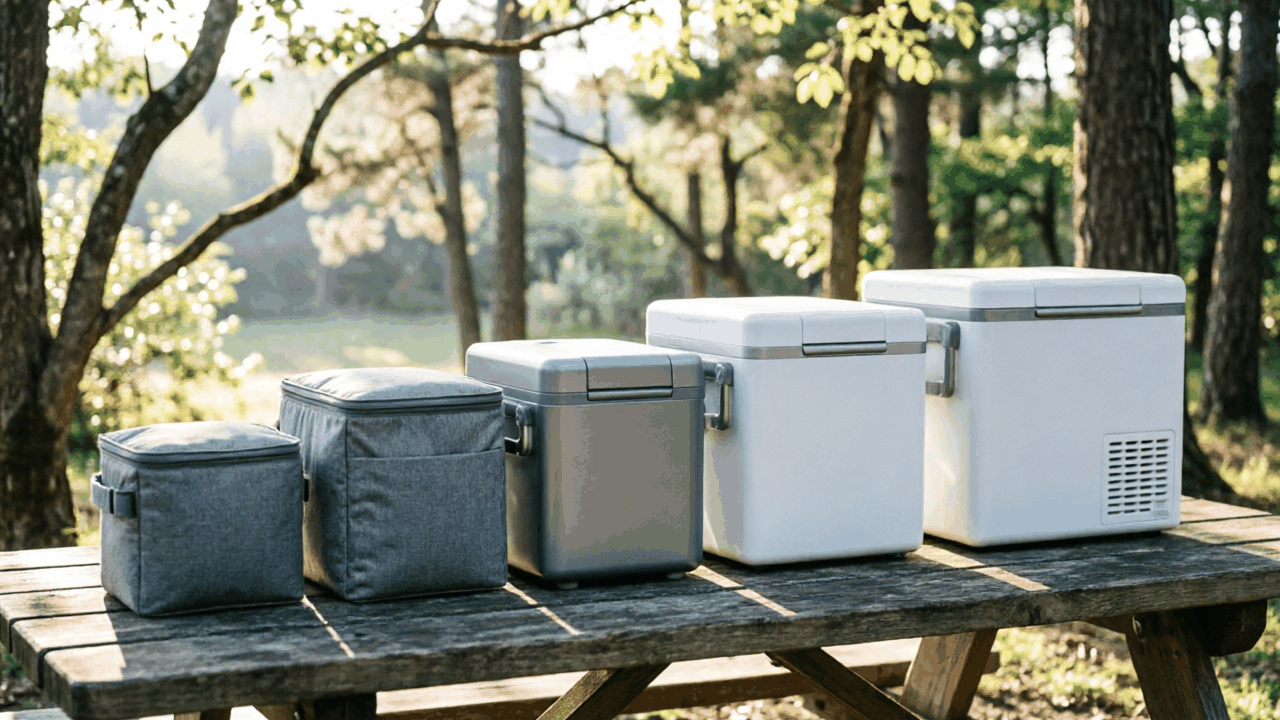
We researched six models ranging from a $70 thermoelectric day-trip bag to a $590 dual-zone compressor freezer with a built-in battery. Whether you’re car camping for a weekend, running multi-day off-grid trips, or tailgating in 95°F heat, there’s a pick here for your situation. This review covers the best electric cooler for camping from every angle — compressor vs thermoelectric, 12V runtime expectations, and solar pairing for off-grid trips.
If you’re new to electric coolers, our camping cooler buying guide covers sizing and insulation basics. And if you want to compare these against traditional ice models, check our best ice camping coolers roundup.
Quick Comparison: Best Electric Camping Coolers
| Product | Type | Capacity | Price | Best For | Badge |
|---|---|---|---|---|---|
| BougeRV CRD2 43QT | Compressor (Dual Zone) | 43 QT | $309.99 | Overall | Best Overall |
| EUHOMY 19QT | Compressor | 19 QT | $134.96 | Budget | Best Budget Compressor |
| Ivation 15L | Thermoelectric | 15 L | $69.99 | Day Trips | Best Value Day Trip |
| BougeRV 55QT w/ Battery | Compressor (Dual Zone) | 55 QT | $569.99 | Off-Grid | Best for Off-Grid |
| Dometic CFX2 28L | Compressor | 28 L | $598.69 | Premium | Best Premium Build |
| ICECO GO20 | Compressor (Dual Zone) | 21 QT | $449.00 | Compact | Best Compact Dual-Zone |
Short on time? If you want one cooler that handles the widest range of camping trips, the BougeRV CRD2 43QT Dual Zone at $309.99 is our pick for Best Overall — dual-zone fridge and freezer at a mid-range price. On a strict budget, the EUHOMY 19QT compressor fridge hits $134.96 and still reaches true freezing temps.
Our Top Picks Reviewed
1. BougeRV CRD2 43QT Dual Zone — Best Overall
The BougeRV CRD2 43QT dual-zone portable refrigerator is our top pick because it covers the widest range of camping scenarios at a reasonable price point. At $309.99, you get independent fridge and freezer compartments in a single 43-quart unit — meaning you can keep drinks cold at 38°F on one side while freezing steaks at -4°F on the other. That eliminates the need to carry two separate coolers on a family camping trip.
Where it wins: Weekend car camping with a family of four. The 43QT capacity holds roughly 60 cans of drinks plus a week’s worth of perishable food. The dual-zone setup means you can set the left side as a freezer for meat and ice cream while the right side stays at refrigerator temp for produce, dairy, and beverages. The unit runs on 12V/24V DC from your car or power station, plus 100-240V AC from any wall outlet. The companion app lets you monitor and adjust temperatures from your phone, which matters when the cooler is in the trunk and you want to check it without stopping.
Where it falls short: At an estimated 30 lbs empty, this is not a cooler you carry on a trail. It’s designed for vehicle-based camping. The dual-zone partition reduces the usable space of each individual compartment compared to a single-zone unit of the same overall capacity, so if you only need one temperature, a single-zone model gives you more room. The compressor produces 40-45 dB of noise — comparable to a quiet office — which most campers tune out but light sleepers parked next to their tent may notice.
Specs: 43 QT (41L) · Dual zone -4°F to 68°F each · 12V/24V DC + 100-240V AC · ~30 lbs · APP control · 3-level battery protection
Pros: True dual-zone fridge/freezer · App-based temp control · Battery protection prevents dead car battery · Solar-ready for off-grid extension Cons: Heavier than single-zone units · Partition eats into per-zone capacity · Compressor noise noticeable in quiet campsites
Owners report that the CRD2 holds temperature well even when ambient temps climb into the 90s, with the dual-zone divider maintaining independent temps without bleed-through. Owners moving from single-zone coolers frequently cite the ability to run a real freezer section as the feature they didn’t know they needed. The app connectivity draws some complaints about pairing reliability on the initial setup, but once connected, temperature monitoring works reliably for the duration of most camping trips.
2. EUHOMY 19QT 12V Compressor Refrigerator — Best Budget Compressor
The EUHOMY 19QT delivers genuine compressor cooling at $134.96 — a price point where most coolers are thermoelectric bags that can’t freeze anything. This unit reaches -4°F, making it a true freezer, not just a chiller. For solo campers or couples who want real frozen-food capability without spending $300+, this is the value pick.
Where it wins: Weekend trips for one or two people. The 19QT capacity holds about 25 cans or a mix of drinks and frozen meals for a 2-3 day trip. It’s compact enough to sit on the back seat of a sedan or behind the seats of a truck cab. The dual-power setup (12V/24V DC + 110-240V AC) means you can run it from your car while driving, then plug into a wall outlet at a motel or powered campsite. The included app control adds temperature monitoring that you typically don’t find at this price.
Where it falls short: 19 quarts is tight for anything beyond a weekend. If you’re feeding a family of four for 3+ days, you’ll be rationing space carefully. The unit lacks dual-zone capability — everything sits at one temperature. At an estimated 22 lbs, it’s relatively portable for a compressor unit but heavier than any thermoelectric option. The build quality is solid for the price but won’t match Dometic or ICECO in long-term durability expectations.
Specs: 19 QT (18L) · -4°F to 68°F · 12V/24V DC + 110-240V AC · ~22 lbs · APP control · battery protection
Pros: True freezer temps at budget pricing · Compact sedan-friendly size · Dual power inputs · App control included Cons: Single zone only · Tight capacity for groups · Build quality reflects price tier
Owner reviews on retail listings describe this cooler as punching well above its price class for cooling performance, with many noting it reaches freezing temps within 30-40 minutes of plug-in. Owners who upgraded from thermoelectric coolers consistently report the difference is night and day — frozen meat stays frozen rather than slowly thawing. The most common complaint involves the included car cord being shorter than ideal, requiring an extension or strategic placement near the vehicle’s 12V outlet.
3. Ivation 15L Soft-Sided Thermoelectric Cooler Bag — Best Value Day Trip
The Ivation 15L thermoelectric cooler bag is the lightest, cheapest pick in this roundup at $69.99. It’s designed for a specific use case: keeping drinks and sandwiches cold on day trips, picnics, and short car camping outings in mild weather. No compressor, no heavy battery draw, no noise.
Where it wins: Day trips and picnics where you’re driving to a spot and plugging in on arrival. The soft-sided design with a shoulder strap makes it easy to carry from car to picnic table. The 15L capacity holds roughly 18 cans — plenty for a family day out. Plug it into your car’s cigarette lighter and it cools to 36-40°F below ambient temperature. On a 75°F day, that gets your drinks into the mid-30s. The thermoelectric system has no moving parts, runs silently, and weighs just 5 lbs — you barely notice it in the car.
Where it falls short: This is not a multi-day cooler. It cannot freeze anything. In hot weather above 90°F ambient, it struggles to maintain safe food temperatures because it can only cool relative to the surrounding air. It also draws power continuously while plugged in (thermoelectric coolers don’t cycle on and off like compressors), which means a constant 40-60W drain on your car battery. There’s no battery protection mode, so leaving it plugged in for too long can drain your car battery enough to prevent starting.
Specs: 15 L (~18 cans) · Cools 36-40°F below ambient · 12V DC only · ~5 lbs · Shoulder strap · Soft-sided
Pros: Lightest and cheapest option · Silent operation · Easy to carry with strap · No moving parts to break Cons: Cannot freeze · Struggles in 90°F+ heat · No battery protection · Constant power draw
Owners describe this bag as perfect for its intended purpose — keeping drinks and sandwiches cold on day trips without the bulk or expense of a compressor unit. Owners consistently report that managing expectations is key: if you understand it’s a 40°F-below-ambient cooler and not a refrigerator, it performs exactly as advertised. The most frequent complaint comes from users who expected freezing capability and were disappointed, which reflects a mismatch in expectations rather than a product defect.
4. BougeRV RockyV3 55QT Dual Zone with Built-In 240Wh Battery — Best for Off-Grid
The BougeRV RockyV3 55QT is the only cooler in this roundup with a built-in battery. The integrated 240Wh battery pack means you can run the cooler without plugging it into anything — no car, no power station, no solar panel required for short-term operation. That makes all the difference for off-grid camping where vehicle access is limited.
Where it wins: Multi-day off-grid trips where you set up camp and walk away from the vehicle. The 55QT dual-zone capacity is large enough for a family of 4-5 on a 3-4 day trip, with independent fridge and freezer zones. The built-in battery provides approximately 4-6 hours of standalone cooling per charge, which covers the gap between arriving at camp and setting up your solar panel or other power source. You can recharge via 12V car outlet, AC wall outlet, or solar panel — giving you three independent ways to keep it running indefinitely.
Where it falls short: At $569.99 and an estimated 38 lbs, this is a serious investment in both money and weight. The 4-6 hour battery runtime is enough for transitional periods but won’t get you through a full day off-grid without a recharge plan. The built-in battery adds weight and complexity — if the battery fails, you’re carrying dead weight. For campers who already own a portable power station, the built-in battery may be redundant.
Specs: 55 QT (52L) · Dual zone -4°F to 68°F each · 12V/24V DC + 100-240V AC · Built-in 240Wh battery · ~38 lbs · APP control · Solar-ready
Pros: Built-in battery for standalone operation · Large family-size capacity · Triple charging options · Dual-zone flexibility Cons: Most expensive at $569.99 · Heaviest at ~38 lbs · Battery runtime limited to 4-6 hours · Battery adds failure point
Owners report that the built-in battery changes how they use a camping cooler — instead of running extension cords or moving the cooler to the vehicle every time, they set it at the camp kitchen and let it run independently. Owners moving from standard plug-only compressor coolers consistently describe the freedom of battery operation as the single feature that changed their camp setup. The weight is the most common complaint, with several owners noting it’s a two-person lift when fully loaded.
5. Dometic CFX2 28-Liter Portable Refrigerator and Freezer — Best Premium Build
The Dometic CFX2 28L comes from the brand that overlanders and van-lifers trust above all others. At $598.69, it’s the most expensive single-zone cooler here, but Dometic’s reputation for compressor reliability and build quality sets the standard in portable refrigeration. This is a buy-it-for-life camping investment.
Where it wins: Frequent campers, overlanders, and anyone who values long-term durability over upfront savings. The CFX2 series uses a proven compressor design that Dometic has refined across multiple product generations. The 28L capacity hits a sweet spot — large enough for 2-3 day trips for a couple, compact enough to fit between front seats or in a truck bed organizer. AC/DC powered with 12/24V DC and 100-240V AC inputs, plus solar compatibility. The build quality feels premium in every detail — hinges, latches, insulation, and the exterior finish all reflect the price point.
Where it falls short: $598.69 for a 28L single-zone cooler is steep when the BougeRV CRD2 gives you 43QT dual-zone for $280 less. If your priority is capacity or features per dollar, Dometic loses that comparison. The single-zone design means one temperature for everything — no simultaneous fridge and freezer. Dometic’s premium pricing extends to accessories too; replacement parts and covers cost more than competing brands.
Specs: 28L (~30 QT) · -4°F to 68°F · 12V/24V DC + 100-240V AC · ~28 lbs · USB charging port · Solar-compatible
Pros: Industry-leading build quality · Proven compressor reliability · Strong resale value · Solar-compatible Cons: Highest price per liter · Single-zone only · Accessories are premium-priced · Overkill for occasional campers
Owners describe the CFX2 as a cooler you buy once and forget about — it simply works, trip after trip, year after year. Owners who have owned cheaper compressor coolers consistently cite the difference in insulation quality and compressor longevity as justification for the premium price. The most common feedback pattern is that owners wish they’d bought a larger Dometic rather than a cheaper brand, suggesting the satisfaction rate is very high despite the cost. The USB charging port on the unit gets frequent praise as a thoughtful detail for charging phones at camp.
6. ICECO GO20 Dual Zone 12V Refrigerator — Best Compact Dual-Zone
The ICECO GO20 packs dual-zone capability into the smallest footprint in this roundup. At 21 quarts, it fits between the front seats of most vehicles — something no other dual-zone cooler here can claim. The SECOP compressor inside is the industry gold standard, the same component brand used in medical-grade refrigeration.
Where it wins: Campers who need dual-zone functionality but don’t have space for a 43QT or 55QT unit. The 21QT footprint is compact enough for truck cabs, SUV cargo areas, or small van builds where every inch counts. Both zones are independently temperature-controlled, so you can run one side as a freezer and one as a fridge simultaneously. The SECOP compressor runs quieter than budget-brand compressors and has a longer expected service life. At $449.00, it splits the difference between budget compressors and the premium Dometic.
Where it falls short: 21 quarts split across two zones means each compartment is small — roughly 10-11 quarts each. That’s enough for essentials but not for stocking up. At this capacity, you’re limited to short trips or supplemental cooling alongside a primary cooler. The insulated cover is included, which adds bulk. The dual-zone divider is fixed rather than removable — you can’t convert to a single large compartment when needed.
Specs: 21 QT (20L) · 0°F to 50°F each zone · 12V/24V DC + 100-240V AC · ~25 lbs · SECOP compressor · Insulated cover included
Pros: Smallest dual-zone available · SECOP compressor (industry standard) · Quieter than budget compressors · Fits between vehicle seats Cons: Small per-zone capacity · Fixed divider limits flexibility · Pricier per quart than larger units · Cover adds bulk
Owners report that the SECOP compressor is noticeably quieter and more efficient than the generic compressors in budget units, with many citing the compact size as the reason they chose it over larger alternatives. Owners who use it in van builds and truck setups consistently describe the between-seats fit as the key advantage that no other dual-zone cooler matches. The limited capacity is the most frequent complaint, but most owners acknowledge it as an expected trade-off for the compact dual-zone form factor.
Compressor vs Thermoelectric — Which Type for Your Trip?
The single most important decision when buying an electric camping cooler is choosing between compressor and thermoelectric technology. Getting this wrong means either overspending on features you don’t need or ending up with a cooler that can’t keep food safe in summer heat.
How Compressor Coolers Work
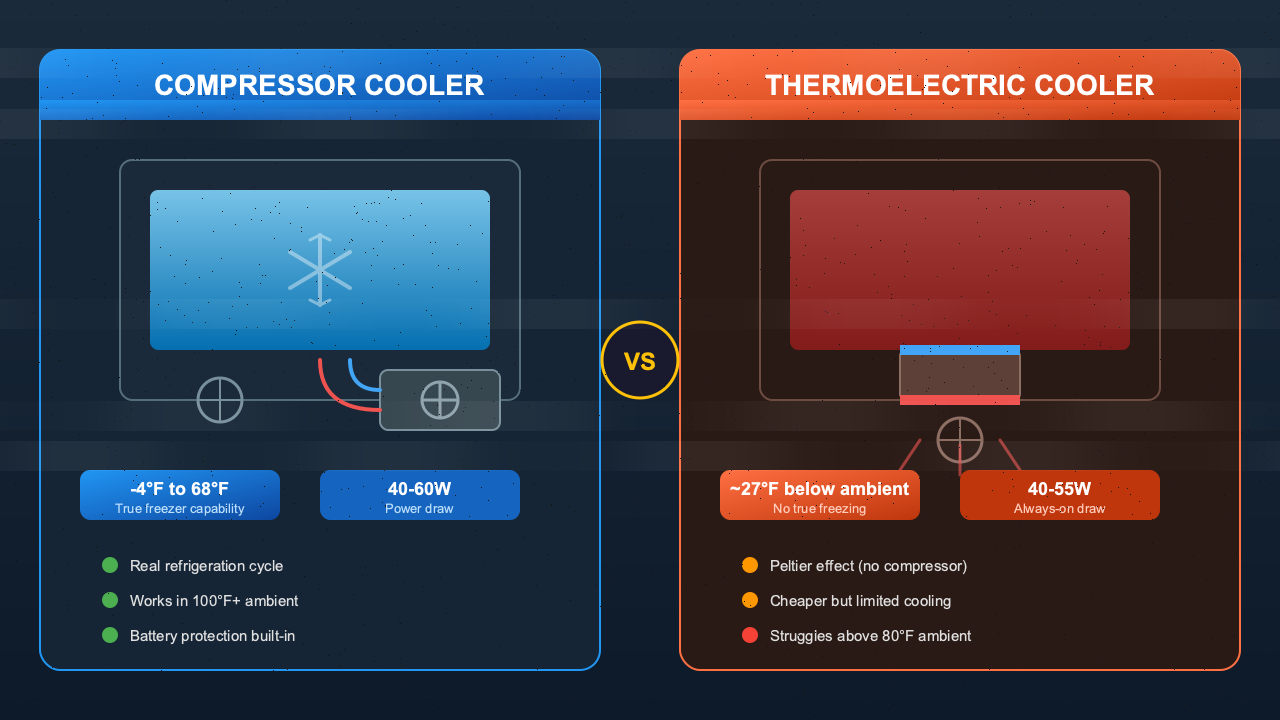
Compressor coolers use the same technology as your home refrigerator — a compressor circulates refrigerant through a closed loop, actively removing heat from the interior. This allows them to reach true freezing temperatures down to -4°F regardless of ambient conditions. They cycle on and off as needed to maintain the set temperature, which makes them energy-efficient over long periods. Most models in this category offer precise digital temperature control, app connectivity, and multi-level battery protection.
The trade-off is weight and cost. Compressor coolers range from $100 to $600+ and typically weigh 20-40 lbs even when empty. The compressor also produces noise in the 40-50 dB range — similar to a quiet conversation or hotel mini-fridge. For most campers, this is a non-issue, but light sleepers in a tent may want to position the cooler a few feet away.
How Thermoelectric Coolers Work
Thermoelectric coolers use the Peltier effect — an electrical current passes through a semiconductor junction, creating a temperature differential between two sides. Hot air is exhausted out one side while cool air circulates inside. This technology has no moving parts (silent, no vibration, no compressor fluid to leak) and costs $50-$130.
The limitation is fundamental: thermoelectric coolers can only cool to 36-40°F below the ambient air temperature. On a 75°F day, they’ll get your food into the mid-30s — fine for drinks and sandwiches. On a 95°F day, the interior barely reaches the 50s, which is above the 40°F FDA safe food storage threshold. They also run constantly when powered (no thermostat cycling), meaning a continuous 40-60W draw that drains batteries faster than a cycling compressor.
Decision Framework — Which Should You Buy?
| Trip Type | Recommended Type | Why |
|---|---|---|
| Day trip / picnic (mild weather) | Thermoelectric | Cheap, light, silent — sufficient for keeping drinks cold |
| Weekend car camping (summer) | Compressor | Handles hot weather, keeps food at safe temps |
| Multi-day off-grid (3+ days) | Compressor + battery/solar | Efficiency matters when power is limited |
| Overlanding / RV | Compressor | Proven durability, real freezing capability |
| Hot climate camping (90°F+) | Compressor (mandatory) | Thermoelectric can’t maintain safe food temps |
12V Runtime and Power Draw — What to Expect on a Car Battery
This is the section most camping cooler reviews skip. Understanding how much power your electric cooler draws — and how long your car battery can sustain it — is the difference between a great trip and a dead battery in the middle of nowhere.
How Long Will a Cooler Run on Your Car Battery?
A typical car battery stores 50-70 amp-hours at 12 volts, which translates to 600-840 watt-hours of total energy. But you can only safely use about half of that before risking permanent battery damage, leaving you with roughly 300-420 usable watt-hours.
A compressor cooler drawing 40-60W with a 30-50% duty cycle (it only runs the compressor part-time) consumes an average of 12-30W continuously. On a healthy car battery with 300Wh of usable capacity, that translates to 10-25 hours of runtime. A thermoelectric cooler draws 40-60W constantly — no cycling — giving you just 5-10 hours before the battery hits dangerous levels.
For overnight use without the engine running, a portable power station rated at 300Wh or higher is strongly recommended. It isolates your cooler’s power draw from your vehicle’s starting battery, eliminating the risk of being stranded with a dead car. Alternatively, camping generators provide reliable AC power for extended stays at sites where solar isn’t practical.
Battery Protection Mode — What You Need to Know
Most compressor coolers include a 3-level battery protection system that automatically cuts power before your car battery drops too low. The typical cutoff thresholds are:
- High mode: Cuts at 11.8V — safest setting, preserves maximum cranking power
- Medium mode: Cuts at 11.2V — balanced setting for most camping scenarios
- Low mode: Cuts at 10.6V — maximizes cooler runtime but risks leaving insufficient charge to start the engine
Always use at least Medium protection when running a cooler from your car’s 12V outlet. High is recommended for older batteries or vehicles with smaller alternators. Thermoelectric coolers typically don’t include battery protection — they’ll drain your battery until there’s nothing left. If you use a thermoelectric model, set a timer or use a standalone low-voltage disconnect to prevent getting stranded.
Solar Panel Pairing Guide for Off-Grid Camping
Most electric cooler reviews stop at which one to buy. Here we go further — how to keep it running off-grid for days.
Matching Solar Wattage to Cooler Power Consumption
The rule of thumb: your solar panel wattage should be roughly double your cooler’s average power draw. This accounts for the fact that solar panels rarely produce their rated output in real-world conditions (angle, cloud cover, heat all reduce efficiency).
- Compressor coolers (average 12-30W cycling): A 60-100W solar panel generates enough surplus to run the cooler during the day while charging a buffer battery for nighttime operation
- Thermoelectric coolers (constant 40-60W draw): Need a 100W+ panel just to keep up during daylight, plus significant battery storage for overnight
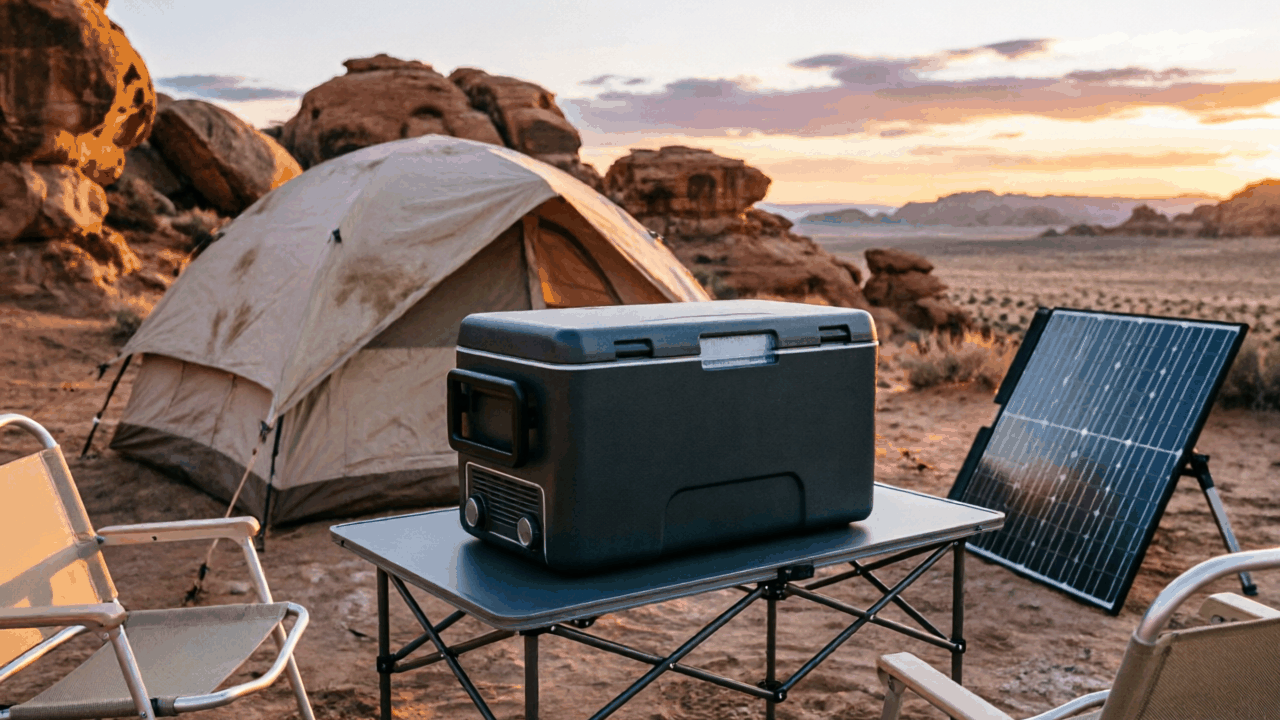
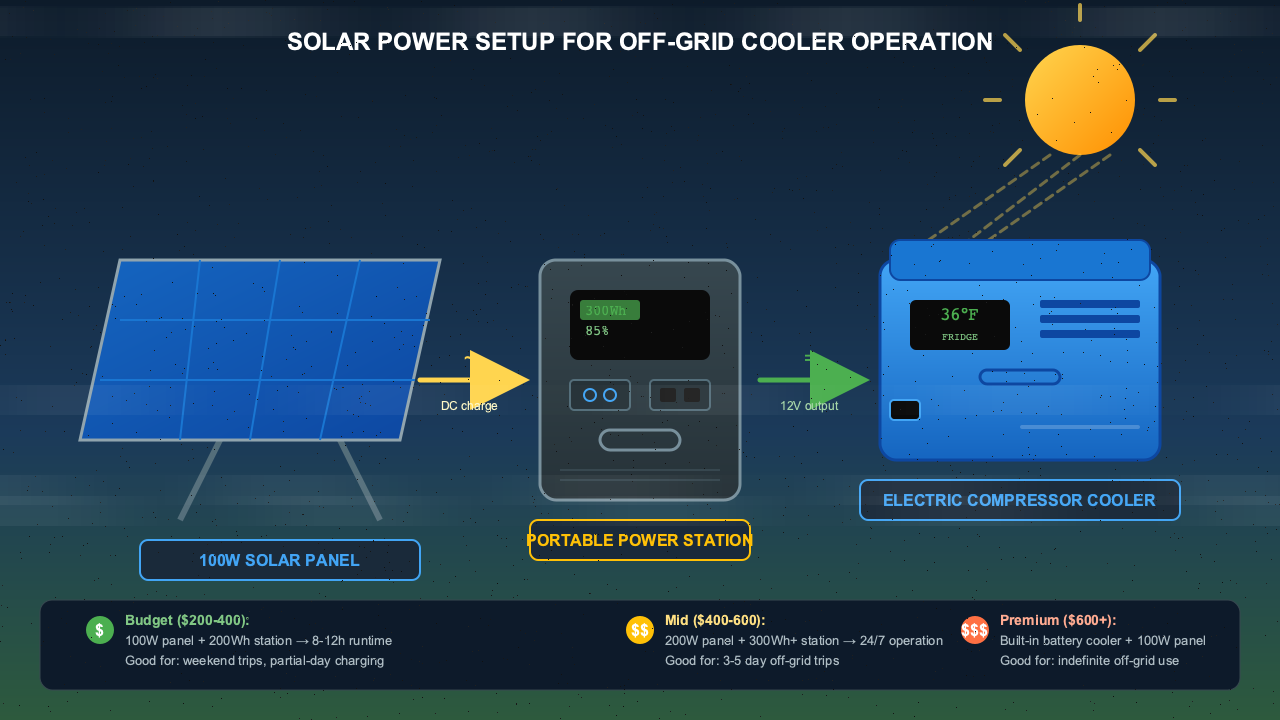
In practice, a 100W solar charger paired with a 200Wh+ power station can run a compressor cooler 24/7 during summer camping conditions. The panel charges the power station during the day, and the power station runs the cooler at night. On cloudy days, you may need to supplement with your vehicle’s alternator by running the engine for 1-2 hours.
Recommended Solar Setups
- Budget setup ($150-200): 100W foldable solar panel + cooler plugged into car 12V while driving. At camp, run the cooler from your car battery with battery protection on. This works for 2-day trips in sunny weather.
- Mid setup ($400-600): 200W panel + 300Wh+ power station. The power station runs the cooler 24/7 while the panel recharges during the day. This handles 3-5 day off-grid trips reliably.
- Premium setup ($600+): Built-in battery cooler (like the BougeRV 55QT) + 100W panel for charging. Eliminates the need for a separate power station for shorter trips.
How We Researched
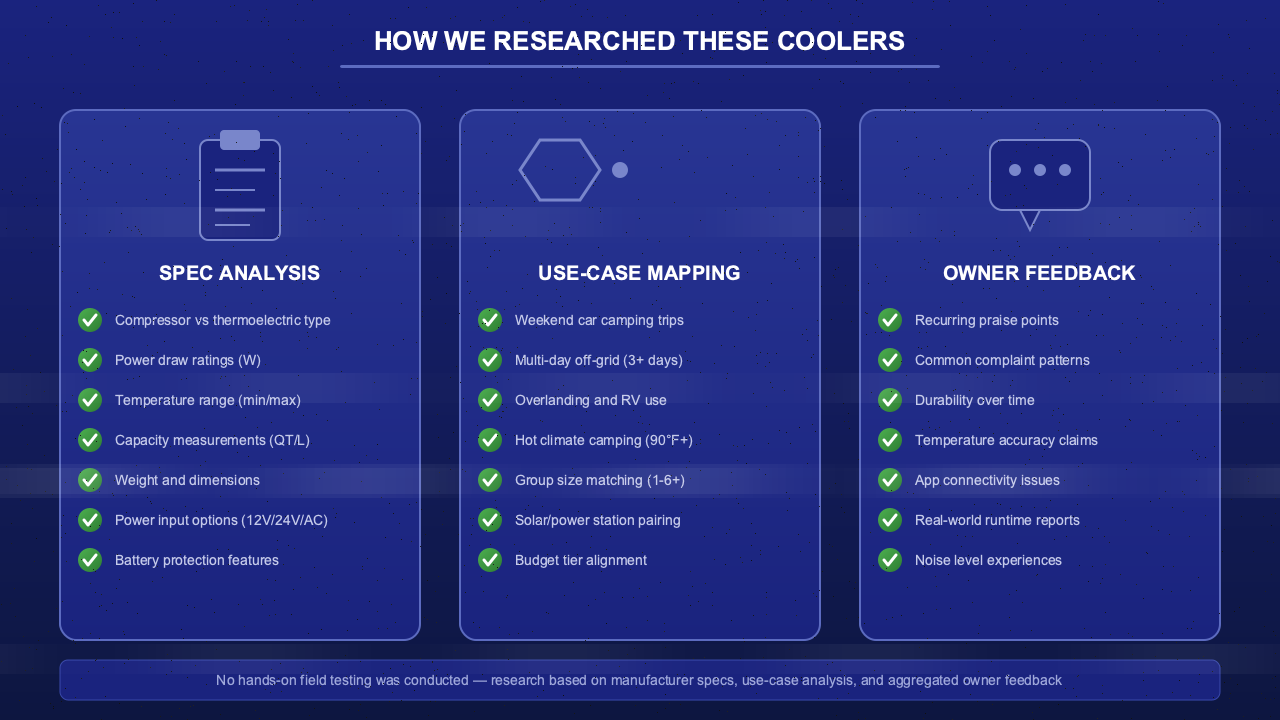
We did NOT perform hands-on field testing of these coolers. Instead, our research process focused on three areas: technical specification analysis (compressor types, power draw ratings, temperature ranges, and capacity measurements from manufacturer documentation), camping use-case mapping (matching each product’s capabilities to specific trip types and group sizes), and aggregation of owner feedback from public retail listings (identifying recurring praise points and common complaints without citing specific ratings or review counts).
Our evaluation criteria prioritized camping-specific factors over generic cooler metrics: 12V car battery compatibility and battery protection features, off-grid power management (solar readiness, dual-zone flexibility, built-in battery options), cooling performance under realistic ambient temperature conditions, and value relative to the specific camping scenarios each model targets. We also weighted portability, noise levels, and build quality — factors that matter more at a campsite than in a stationary kitchen setup.
What to Look for When Buying an Electric Camping Cooler
Cooler type — The compressor vs thermoelectric decision (covered above) is your starting point. If you camp in summer or need freezing, get a compressor. If you only take day trips in mild weather, thermoelectric saves money and weight.
Capacity — Match capacity to trip length and group size. 15-20 liters handles solo day trips. 30-40 quarts works for couples on weekend trips. 50+ quarts is family territory for 3+ day outings. Remember that you’ll lose usable space to insulation walls and the compressor housing.
Power inputs — At minimum, you want 12V DC (car outlet) and 100-240V AC (wall outlet/power station). Solar compatibility is a bonus for off-grid trips. Some premium models add 24V DC for truck systems. Avoid any cooler that only offers one power input — it limits your flexibility.
Temperature range — Look for coolers that reach at least 32°F for safe food storage. Models hitting -4°F give you true freezer capability, which doubles your food options on longer trips (frozen meat, ice cream, ice packs).
Battery protection — Non-negotiable for car camping. Without it, your cooler can drain your car’s starting battery and leave you stranded. Every compressor model in this roundup includes multi-level battery protection. Most thermoelectric models do not.
Dual-zone capability — Worth the premium if your trips require both refrigerated and frozen items simultaneously. Eliminates the need to carry two separate coolers. Not worth it if you only ever need one temperature.
Portability — Check weight, handle design, and whether it has tie-down points for securing in a vehicle. A 40-lb compressor cooler needs a good grip system and ideally a vehicle mounting solution.
Noise level — Compressor models produce 40-50 dB. Thermoelectric models are silent. If you sleep next to your cooler, the noise difference matters.
Common Mistakes to Avoid
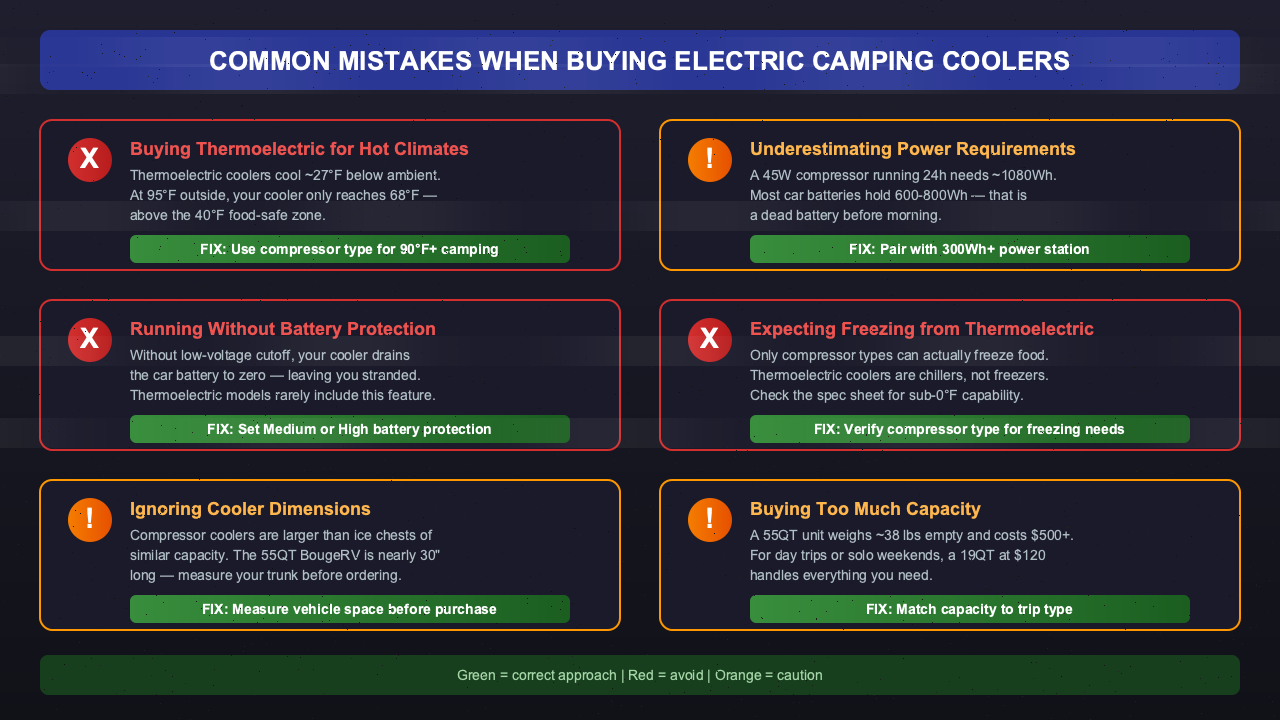
Buying thermoelectric for summer camping — Thermoelectric coolers can only cool 36-40°F below ambient. In 95°F weather, your cooler interior sits at 55-59°F, well above the 40°F safe food storage threshold. If you camp in hot weather, you need a compressor.
Running a cooler without battery protection — This is how campers end up with dead car batteries in the backcountry. Always engage at least Medium battery protection on compressor models. For thermoelectric models without protection, use a standalone low-voltage cutoff switch.
Underestimating power needs for multi-day trips — A car battery alone won’t sustain any electric cooler for more than a day. For 3+ day trips, you need a solar panel, portable power station, or a cooler with a built-in battery. Plan your power budget before you pack.
Ignoring cooler dimensions — Compressor coolers are larger than ice chests of similar capacity because of the compressor housing and insulation. Measure your trunk, back seat, or truck bed before ordering. The 55QT BougeRV is nearly 30 inches long — make sure it fits your vehicle.
Treating any electric cooler as a freezer — Only compressor types can actually freeze. Thermoelectric coolers are chillers, not freezers. If you need frozen food capability, verify the spec sheet shows temperatures at or below 0°F before buying.
Which Electric Camping Cooler Should You Buy?
For most campers: The BougeRV CRD2 43QT Dual Zone at $309.99 is the best all-around pick. Dual-zone fridge and freezer, app control, and solar-ready power inputs cover the widest range of camping scenarios without breaking the bank.
On a strict budget: The EUHOMY 19QT at $134.96 gives you genuine compressor cooling and true freezer temps at a price that undercuts most thermoelectric models. Best value per dollar for solo campers and couples.
For day trips only: The Ivation 15L thermoelectric bag at $69.99 is light, silent, and cheap. Just don’t expect it to handle summer heat or multi-day trips.
For off-grid independence: The BougeRV RockyV3 55QT with built-in 240Wh battery at $569.99 runs without any external power source for short periods. Pair it with a solar panel for true off-grid capability.
For buy-it-for-life durability: The Dometic CFX2 28L at $598.69 is the premium overlander’s choice. Proven compressor, strong build quality, and resale value justify the price for frequent campers.
For compact dual-zone: The ICECO GO20 at $449.00 fits dual-zone capability into the smallest footprint available. SECOP compressor quality in a package that fits between your truck seats.
Frequently Asked Questions
Can an electric cooler run on a car battery overnight?
Most compressor coolers draw 40-60W and will drain a car battery in 8-15 hours. Always use battery protection mode, or pair with a portable power station for overnight use.
Do electric coolers work as well as a real refrigerator?
Compressor coolers perform identically to home mini-fridges and can reach freezing temps down to -4°F. Thermoelectric coolers are less powerful, limited to 36-40°F below ambient temperature.
Can you put ice in an electric cooler?
It's not recommended. Ice causes condensation that can damage electronics. Compressor coolers don't need ice since they cool electrically. Thermoelectric coolers can handle a small amount but it defeats the purpose.
How much solar power do I need to run an electric camping cooler?
A 100W solar panel paired with a 200Wh power station can run a compressor cooler indefinitely in sunny conditions. Thermoelectric coolers need more power due to constant draw.
What's the difference between a 12V compressor cooler and a thermoelectric cooler?
Compressor coolers use refrigerant gas to actively cool to freezing temps down to -4°F. Thermoelectric coolers use electrical current to create a temperature differential, limited to 36-40°F below ambient air. Compressors are more expensive but far more capable.
Are expensive electric coolers worth it for camping?
Premium models like Dometic CFX2 offer proven durability, better insulation, and reliable compressors that last years. For frequent campers or overlanders, the investment pays off. For occasional day trips, a budget thermoelectric cooler under $100 is sufficient.