How to Choose a Folding Camping Wagon: Capacity, Weight & Frame Specs (2026 Guide)
Load rating, cargo volume, empty weight, frame material and folded size compared across 6 folding camping wagons, plus how to match one to your trip.
Most folding camping wagons look identical in a product photo, and the numbers that separate a good one from a frustrating one — load rating, cargo volume, empty weight, folded footprint — are scattered across different lines of the same listing. This guide compares six current wagons spec by spec so you can match the numbers to the gear you actually haul.
Quick Answer
The decision collapses into five checks, in this order:
- Load rating: 220–500 lb across the six wagons below. At or above 300 lb covers a full family load; under 250 lb is for light gear only.
- Cargo volume: published for just three of the six (120 L, 120 L and 280 L). A missing number means the maker never published one — it is not evidence of a small basket.
- Empty weight: 8 lb to 19.36 lb. Below 15 lb and one person can lift it from the car; above it, plan two trips.
- Folded size: five of the six publish it, from 22 x 9.8 x 7.5 in up to 22.6 x 16.1 x 9.1 in. Measure your trunk before ordering, because one of the six publishes no folded figure at all.
- Skip the 500 lb class if your load is light. It costs $52 more than the cheapest wagon here, weighs 10 lb more empty, and you still have to lift it over the bumper.
The Six Folding Camping Wagons Compared
| Model | Load rating | Cargo volume | Empty weight | Frame | Folded size | Price |
|---|---|---|---|---|---|---|
| Amazon Basics JC160 | 265 lb | Not published | 19.36 lb | Alloy steel | Not published | $80.91 |
| EAYNON 46-in Extended | 500 lb | 280 L (9.89 cu.ft) | 18.3 lb | Alloy steel | 1.28 cu.ft (volume only) | $89.98 |
| HIKEMOON 34-in Long | 360 lb | 120 L | 14 lb | Metal | 7.28 x 16.37 x 18.11 in | $56.99 |
| PEAKUNWIND Lightweight | 220 lb | Not published | 8 lb | Carbon steel | 16.77 x 7.28 x 22.99 in | $37.04 |
| ROSONG Collapsible | 250 lb | 120 L | 12 lb | Metal | 22 x 9.8 x 7.5 in | $37.99 |
| Sekey Tailgate | 300 lb | Not published | 10.32 lb | Carbon steel | 22.6 x 16.1 x 9.1 in | $39.98 |
Prices are the listed Amazon prices on November 3, 2026 and they move daily. Ratings are Amazon’s own: 4.5 stars from 14,448 ratings for the Amazon Basics JC160, 4.5 from 2,515 for the HIKEMOON, 4.5 from 5,552 for the ROSONG, 4.5 from 230 for the PEAKUNWIND, 4.4 from 970 for the Sekey and 4.3 from 1,052 for the EAYNON.
| Model | Unfolded size | Wheels | Wheel diameter | Rating | Ratings count |
|---|---|---|---|---|---|
| Amazon Basics JC160 | 20" D x 40.9" W x 27.6" H | 4 | Not published | 4.5 / 5 | 14,448 |
| EAYNON 46-in Extended | 38.6" D x 23.7" W x 46.4" H | 4 | Not published | 4.3 / 5 | 1,052 |
| HIKEMOON 34-in Long | 33.97" D x 16.37" W, 41.34" handle | 4 | Not published | 4.5 / 5 | 2,515 |
| PEAKUNWIND Lightweight | 30" D x 17" W x 36.22" H | 4 | Not published | 4.5 / 5 | 230 |
| ROSONG Collapsible | 32.7" D x 17.5" W x 35.6" H | 4 | Not published | 4.5 / 5 | 5,552 |
| Sekey Tailgate | 37.79" L x 16.1" W x 36.0" H | 4 | Not published | 4.4 / 5 | 970 |
Two details in that table are worth calling out. The Amazon Basics JC160 publishes two different unfolded figures — 27.6 x 40.9 x 20 in in the listing title and 41.3 x 19.9 x 36.6–46.5 H in in the bullet list — so treat its dimensions as approximate. The HIKEMOON’s 41.34 in is the height of its handle above the ground, not the height of the basket.
What Each Spec Actually Means
Load rating is not cargo volume
A load rating is a stress limit on the frame, the axles and the wheels. Cargo volume is how much gear you can actually fit. The EAYNON publishes 280 L (9.89 cu.ft) at a 500 lb rating; the ROSONG and HIKEMOON publish 120 L each at 250 lb and 360 lb; three wagons publish no volume figure at all.
A higher rating does not mean a bigger basket, and a missing volume number is not proof of a small one.
Shape changes what 120 L actually buys you. A long, narrow body like the HIKEMOON’s takes a folded tent along the floor, while a short, wide body like the ROSONG stacks chairs and coolers but leaves unusable gaps in the corners.
Empty weight decides whether you carry it or drag it
The spread runs from 8 lb (PEAKUNWIND) to 19.36 lb (Amazon Basics JC160), with the Sekey at 10.32 lb, the ROSONG at 12 lb, the HIKEMOON at 14 lb and the EAYNON at 18.3 lb. That heaviest cart is roughly 2.4 times the weight of the lightest, and weight is the number you feel every single time you unload it.
If your walk from the car to the pitch is more than a few steps, 15 lb is the practical ceiling. The three lightest wagons here are all priced under $40, but the 14 lb HIKEMOON at $56.99 shows that a still-carryable weight can cost $20 more.
Folded size decides whether it lives in your car
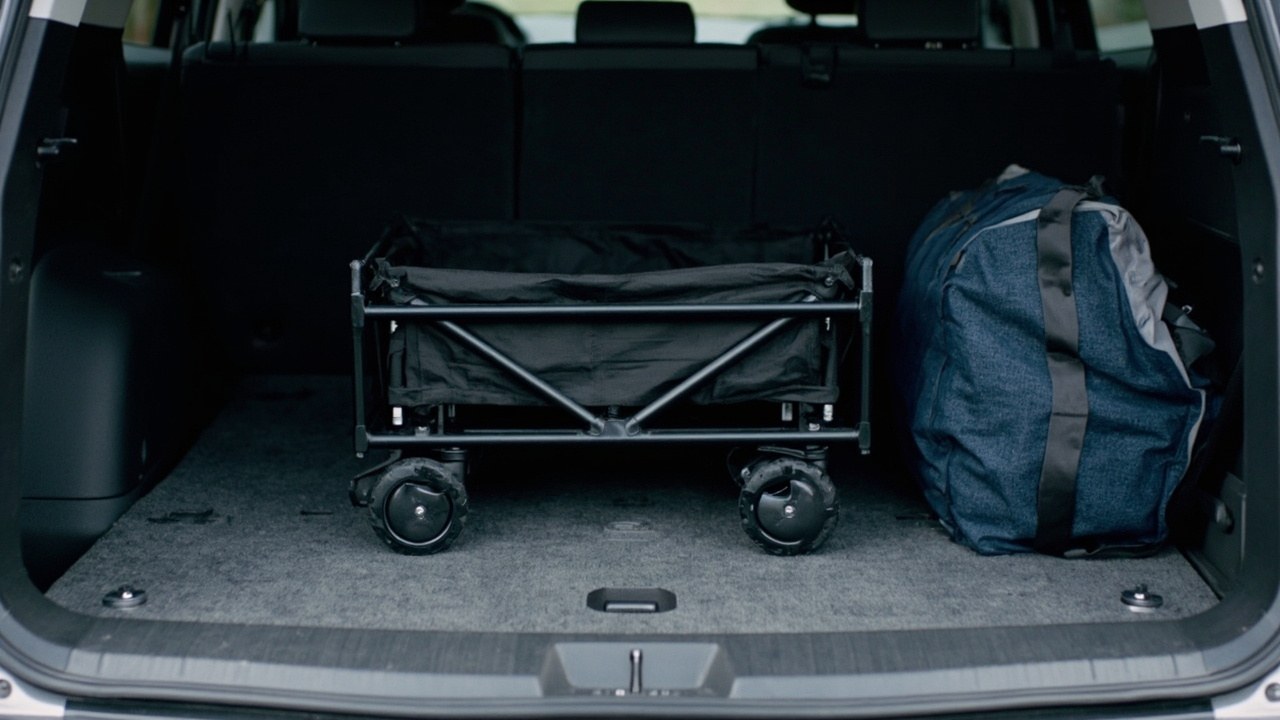
Five of the six publish a folded package. The ROSONG folds to 22 x 9.8 x 7.5 in, the Sekey to 22.6 x 16.1 x 9.1 in, the HIKEMOON to 7.28 x 16.37 x 18.11 in and the PEAKUNWIND to 16.77 x 7.28 x 22.99 in. The EAYNON gives a folded volume of 1.28 cu.ft instead of dimensions, and the Amazon Basics JC160 gives nothing, so for those two you are guessing until the package arrives.
Compare that folded figure against your trunk opening, not against the wagon’s unfolded size. A package 22 in long but only 7.5 in thick slides in flat; the same length at 16 in thick stands on edge and eats floor space.
Frame material: alloy steel, carbon steel and unqualified metal
Two listings specify alloy steel (Amazon Basics, EAYNON), two specify carbon steel (PEAKUNWIND, Sekey) and two say only metal (HIKEMOON, ROSONG). The last pair gives you no tubing gauge to compare, which is one of the numbers behind why a 265 lb alloy-steel cart weighs more than twice a 220 lb carbon-steel one.
Frame labels are only half the story. The 8 lb PEAKUNWIND lists carbon steel while the 19.36 lb Amazon Basics lists alloy steel, so what actually moves the weight number is the whole build — tubing, wheels, fabric and handle — not the label on its own.
Wheels: four on all six, and no published wheel diameter
Every one of these wagons has four wheels, and each describes 360-degree rotating front wheels or swivel casters for maneuvering. None of the six publishes a wheel diameter, so roll-over clearance and behavior in soft sand cannot be compared from the specs at all.
Only the EAYNON explicitly claims an all-terrain beach wheel with dual-bearing construction for sand, gravel and grass, and the PEAKUNWIND markets 360-degree wheels for trails and sand. For everything else, treat the wheels as hard-surface casters and keep the wagon on pavement, packed gravel and firm campsite roads.
Body length decides what lies flat
Length beats volume when you are carrying rigid gear. The Sekey handles it with a drop-down tailgate that creates nearly 38 in of usable length for tents, folding chairs, canopies and fishing rods. The HIKEMOON goes the other way, with a body the maker describes as 50% longer than a standard wagon so long items lie along the floor instead of hanging off the end.
Which Wagon Fits Your Trip
Solo campers and light loads
The PEAKUNWIND 220 lb lightweight folding wagon is the one to pick if you are alone with a chair, a small cooler and a duffel. It is the lightest cart here at 8 lb, uses a high-strength carbon steel frame with 300D Oxford fabric, and has a telescopic adjustable handle plus 360-degree rotatable wheels.
It folds to 16.77 x 7.28 x 22.99 in, carries a 220 lb rating, and the listing backs it with a six-month quality guarantee. The 220 lb ceiling is the limit: this is a personal load cart, not a firewood hauler.
Two-person weekends
The ROSONG 250 lb collapsible wagon is the value pick. Twelve pounds empty, 120 L of basket, a 1.2 mm steel frame, 600D Oxford fabric, wear-resistant PU wheels, 360-degree rotating front wheels and an extendable handle, with the wheels detaching for cleaning. At $37.99 with 5,552 ratings behind it, this is the most proven cart in the group on price, and the folding size of 22 x 9.8 x 7.5 in is the most trunk-friendly of the six.
Family car camping
The Amazon Basics 265 lb collapsible utility wagon is the all-around answer for a family load: an alloy-steel frame, an extendable handle, exterior storage compartments for small items and a carry bag, rated to 265 lb. It is also the most-reviewed cart in this comparison at 14,448 ratings and a 4.5-star average, which matters when you are buying sight-unseen. At 19.36 lb it is the second-heaviest here, so make sure the load lands close to the car. The tent is the other heavy piece in a family load — our camping tent shortlist covers the shelters that pair with it.
Beach days and sports hauling
The EAYNON 500 lb extended beach wagon is the volume play: 280 L (9.89 cu.ft) of storage, a heavy-duty alloy steel frame, tear-resistant 600D Oxford fabric that removes for cleaning, drink holders, 360-degree rotating front wheels and an all-terrain beach wheel with dual-bearing construction. The maker carries a one-year manufacturer warranty, and the $89.98 price buys more than twice the basket volume of the two 120 L wagons. If you need two decks instead of one big floor, our double-decker wagon review covers the tier above.
Long gear and long-haul camping
The HIKEMOON 34-inch extra long folding wagon is built for length: a 34 in body the maker rates as 50% longer than a standard wagon, a 360 lb rating, 120 L of basket, a removable and tear-resistant 600D Oxford fabric, two mesh cup holders and a three-section adjustable handle that reaches 42 in. It weighs 14 lb, which is still light enough to lift into a trunk solo, and it folds to 7.28 x 16.37 x 18.11 in — a package thin enough to slide against a seat back.
Tailgate setups and gear-hauling
The Sekey 300 lb tailgate wagon wins on length and details: drop the tailgate for nearly 38 in of usable length for tents, folding chairs, canopies and fishing rods, then raise it to contain a normal load. It is 10.32 lb empty on a reinforced carbon steel frame with cross-bracing, carries a 300 lb rating, and adds PVC-coated 600D Oxford fabric, side organizer pockets, two cup holders, an adjustable upright handle and swivel wheels. One line in its own listing is worth repeating: cargo transport only, not intended to carry children.
Loading a Wagon Without Damaging the Frame
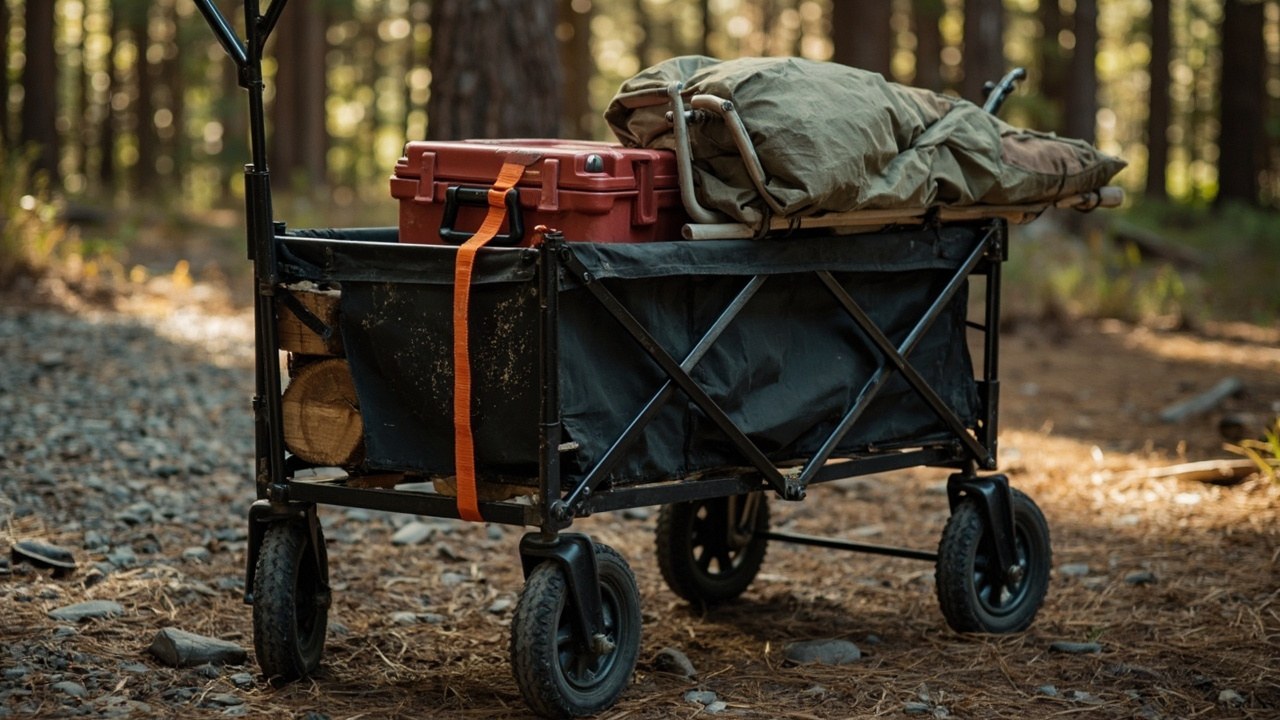
- Load low and forward. Put the heaviest items at the bottom of the basket and over the axle. Ratings are for evenly distributed load — the Sekey listing states this outright — so keep weight off the top edge rather than stacked in one corner.
- Use the tailgate for what it is for. On the Sekey, drop it only when you are loading long rigid gear; with a normal camp load, keep it raised so the sides do the containing.
- Strap soft gear. Loose firewood, sleeping bags and clothing shift into the frame joints and the seams. Ratchet straps or a bungee over the basket cost less than a new fabric bed.
- Split the kit. A wagon that carries the tent, the cooler and the chairs in one trip is the whole point. When a tent is part of the load, our budget-friendly tent picks keep the bundle lighter and cheaper.
- Build the base camp in two pieces. A wagon and a canopy make the standard car-camping setup, and the canopy shelter roundup covers the shelters worth pairing with a cart.
- Put the power station in the basket. Every amp-hour of battery and every panel you carry takes a wheel slot, so pack them together rather than in a separate bag. The solar charging kit guide covers the panels and power banks that make a long stay workable.
Storage and Maintenance Between Trips
- Fold it dry. A fabric basket packed damp into a bag stays damp for weeks and will smell on the next trip.
- Brush before you fold. Sand and grit left in the seams and around the wheel mounts keep working at the fabric every time the cart moves.
- Check the locks and bolts. Leg locks, handle clamps and wheel bolts carry the load, so give them a quick check before a long drive and again at the site.
- Treat the basket as the consumable part. The fabric can be replaced; the frame rarely needs to be. Keep the bag for the folded cart in the same trunk space as the wagon so neither gets left behind.
Conclusion
Choosing a folding camping wagon comes down to reading four numbers in the right order: load rating, cargo volume, empty weight, folded size. Buy on load rating only and you will end up with a cart that is too heavy to lift; buy on price alone and you may end up with a cart whose folded size the maker never published.
On that basis: the ROSONG at $37.99 is the best value for two people, with 120 L and a 250 lb rating; the PEAKUNWIND at $37.04 is the cheapest and the lightest at 8 lb; the HIKEMOON at $56.99 is the long-body answer; the Sekey at $39.98 is the pick when long gear has to lie flat; the Amazon Basics JC160 at $80.91 is the best all-round buy with the largest review count; and the EAYNON at $89.98 has by far the largest published basket at 280 L and is the only one of the six claiming an all-terrain beach wheel. For product-by-product detail across the wider range, our camping wagon side-by-side breaks down the runners-up with ratings and prices.
Frequently Asked Questions
How much weight should a folding camping wagon hold?
For most car-camping trips, 220–300 lb of rated capacity is plenty. That covers a cooler, a folding table, camp chairs and firewood for two people with room to spare. Move up to 360–500 lb if one person is doing all the hauling, if a full-size tent goes in the cart, or if firewood is the heaviest thing you carry. Beating a rating by a wide margin adds nothing except a heavier price tag.
Is a higher load rating the same as a bigger wagon?
No. Load rating is how much weight the frame and wheels carry; cargo volume is how much gear fits inside. The 360 lb HIKEMOON and the 250 lb ROSONG publish exactly the same 120 L basket, while the 500 lb EAYNON publishes 280 L (9.89 cu.ft) and the 300 lb Sekey publishes no volume figure at all. How much you can lift and how much you can fill are two separate decisions.
How much does a folding camping wagon weigh when empty?
Across the six wagons compared here, empty weights run from 8 lb for the PEAKUNWIND to 19.36 lb for the Amazon Basics JC160, and the heaviest is roughly 2.4 times the lightest. Under about 15 lb is the practical ceiling for anyone who has to carry the cart from the car, and all three of the lightest wagons here are priced under $40.
What size does a folding camping wagon take up in a car?
Folded packages in this group run from 22 x 9.8 x 7.5 in (ROSONG) to 22.6 x 16.1 x 9.1 in (Sekey), with the PEAKUNWIND folding to 16.77 x 7.28 x 22.99 in — longer but much thinner. The EAYNON publishes a folded volume of 1.28 cu.ft instead of dimensions, and the Amazon Basics JC160 publishes no folded size at all, so measure your trunk before ordering those two.
Are folding camping wagons good for rough terrain?
All six wagons here use four wheels and are built for hard surfaces: campsite driveways, parking lots, paths and beach access. None of the six publishes a wheel diameter, so roll-over clearance and soft-sand performance cannot be compared from the specs. Only the EAYNON explicitly claims an all-terrain beach wheel with dual-bearing construction for sand, gravel and grass. On anything deeper, expect to drag rather than roll.
Do I need a wagon for a car camping trip?
If your pitch is a few steps from the car, two duffel bags will do the same job for free. A wagon earns its place when you are moving a full tent, a cooler, firewood and chairs for four or more people, or when one adult handles all the carrying on arrival. In that case pick the cheapest model that clears your load rating and stop there — the extra money is better spent on the tent and the sleep system.