8 Best Beach Tents in 2026: Pop-Up, Canopy & Shade
8 beach tents from $32 to $308, compared for wind resistance, UV blocking and setup speed. The $60 WhiteFang pop-up is the pick for most families.
Products Reviewed
A beach umbrella sounds fine until a 20 mph gust sends it cartwheeling across the sand with your phone, sunglasses and toddler’s snacks underneath. Anchored beach tents solve that, and they block UV from every angle rather than just overhead.
The choice comes down to one thing: how much you care about setup speed against how much you care about shade area. Pop-ups open in seconds and enclose you; canopies take five minutes and shade more ground; wind-powered shade needs neither poles nor walls, only a breeze.
Prices below were pulled from Amazon on October 7, 2026 and they move constantly, so check the live listing before you buy. Budget shoppers should start with the Venustas at $31.99; most families should start with the WhiteFang Deluxe at $59.99.
Quick Answer: Our Top Picks
- Best overall — WhiteFang Deluxe ($59.99) — Extendable sand-free floor, three vent windows, stakes and guy lines in the box.
- Best budget — Venustas Pop-Up ($31.99) — Four size variants and zip-up privacy on all four sides, at the lowest price here.
- Best for shade area — Shibumi Shade Quiet Canopy ($308.00) — 150 sq ft with no poles. The price jumped sharply; the coverage is unmatched.
- Best for travel — Neso 7×7 ($120.00) — 4 lbs, packs into a carry-on, still shades a six-person group.
- Lightest — Venustas Pop-Up ($31.99) — 3.5 lbs and the cheapest shade here. Also the best budget pick.
- Tallest — Alvantor Pop-Up ($34.42) — 4 lbs and 53 inches of headroom. Carries in a beach tote.
- Most sturdy frame — Coleman Skyshade ($51.00) — Open-top canopy on a rigid frame. The best choice in wind.
Quick Comparison
| Product | Price | Type | Capacity | Weight | Wind | UV | Setup | Best For |
|---|---|---|---|---|---|---|---|---|
| Venustas Pop-Up | $31.99 | Pop-up | 3-8 person | 3.5 lb | Moderate | UPF 50+ | Instant | Lightest + best budget |
| Alvantor Pop-Up | $34.42 | Pop-up | 2-3 person | 4.0 lb | Weak | UPF 50+ | Instant | Tallest |
| WolfWise Pop-Up | $42.73 | Pop-up | 3 person | — | Moderate | UPF 50+ | 10 sec | Most spacious |
| Picnic Time Manta | $53.20 | Pop-up | 2-3 person | — | Moderate | UPF 50+ | Instant | Brand name |
| WhiteFang Deluxe | $59.99 | Pop-up | 3-4 person | — | Moderate | UPF 50+ | 30 sec | Best overall |
| Coleman Skyshade | $51.00 | Pole canopy | 2-3 person | Not listed | Strong | Open shade | ~5 min | Most sturdy |
| Neso 7×7 | $120.00 | Pole canopy | Up to 6 | 4.0 lb | Strong | Open shade | ~5 min | Best for travel |
| Shibumi Shade | $308.00 | Wind-powered | Up to 8 | 4.0 lb | Needs wind | Open shade | 3 min | Most shade area |
Prices and weights pulled from Amazon on October 7, 2026. Wind ratings are our read of frame type and anchoring method, not a published spec, and “Not listed” means Amazon doesn’t publish a weight for that listing. Beach tents are shade structures, not camping shelters — for overnight, see our best camping tents.
Best Pop-Up Beach Tents
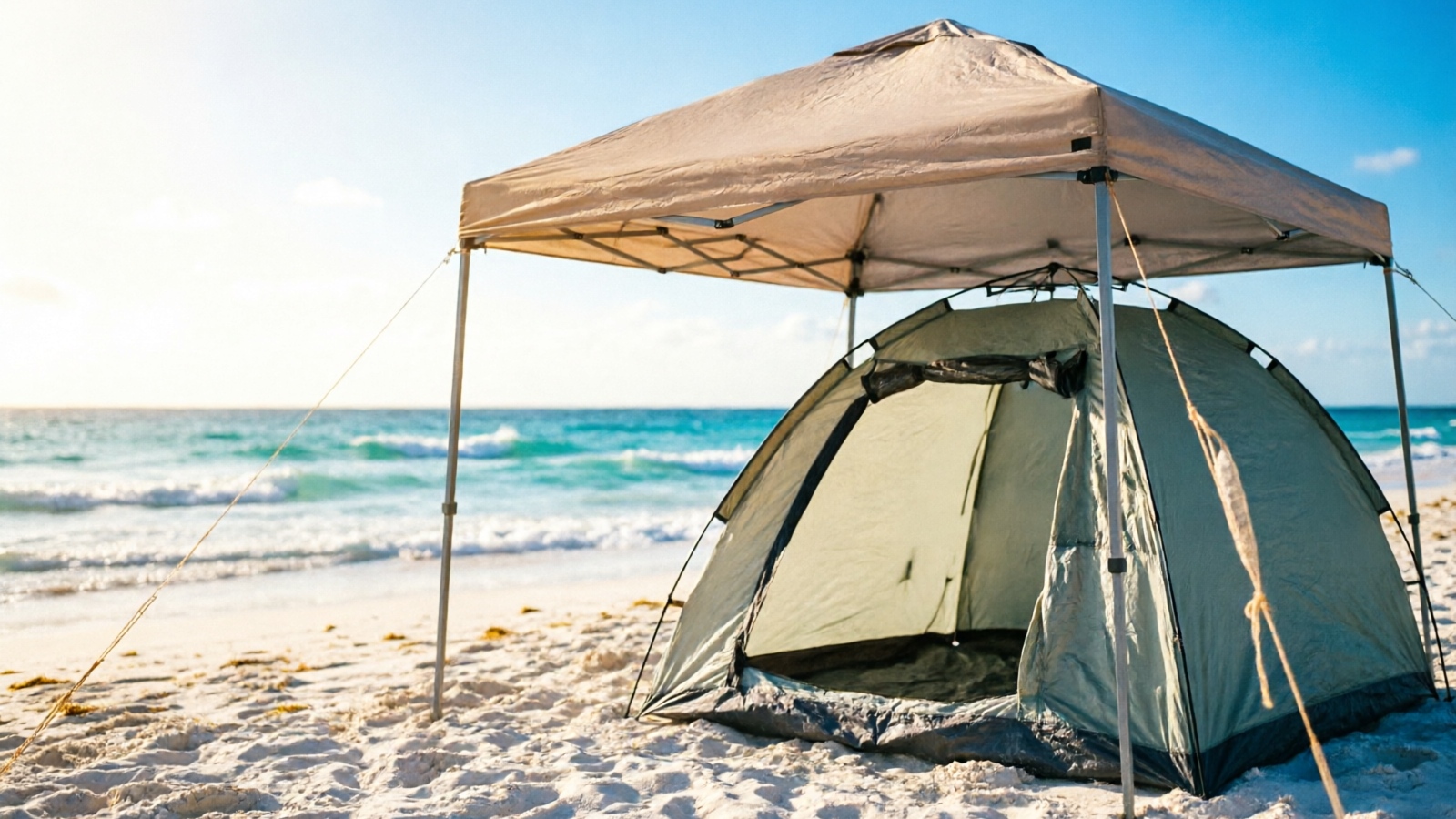
Pop-up tents pull from the bag and spring open in seconds. Enclosed, with mesh windows, zip-up sides and storage pockets, all claiming UPF 50+. The trade-off is consistent: they catch wind like sails, and folding one back up takes practice.
WhiteFang Deluxe Pop-Up ($59.99) — Best Overall
The pick for most families, and the reason is one panel. The extendable floor unrolls outward to create a sand-free sitting area outside the tent, so the kids aren’t sitting on wet grit and you aren’t dragging the whole structure sideways to find shade. Stakes and guy lines both come in the box, which is more than most competitors at this price manage, and three ventilating mesh windows let air move without giving up the UV block.
Setup is about 30 seconds. It catches heavier fabric than the Alvantor, and the floor collects sand and wants a brush-out when you get home.
The drawbacks are real but minor. Folding takes five to ten minutes for the first few times, and the zippers soften after a season of grit and salt. It also lists at 3-4 person, so a family of five should size up rather than squeeze.
What we like: Extendable floor keeps sand out, three vent windows, stakes and guy lines included, holds shape better than lighter pop-ups. What could be better: Heavier than ultralight pop-ups, floor collects sand, zippers wear with grit, folding needs practice.
Who it’s for: Families who want a sitting area outside the tent and an anchoring kit already in the box.
Worth naming what that buys you: because the anchoring hardware is in the box, the first trip needs no hardware-store run, and that is the difference between a tent you actually use and one that stays in the boot. Owners who’ve run it through a full summer report the fabric still stiff and the zips still aligned, which isn’t guaranteed at this price.
Venustas Pop-Up Beach Tent ($31.99) — Best Budget, Lightest
The cheapest tent here, the lightest, and the one that does the most for the money. Four size variants run from 3-4 up to 8 person, which means the same product covers a couple’s day and a large group’s afternoon without a second purchase. The ability to zip all four sides shut turns it into a private changing room, which matters more with young kids than anything else here — plus three internal pockets and three mesh windows at $31.99.
Downsides: the window screens don’t stay propped up reliably, so they flap or drop when the wind gets up. Sand works its way into the fabric and never fully leaves. The 3-4 person size is genuinely tight for four adults, and the poles start to feel flimsy after a season in salt air.
What we like: Cheapest here at $31.99, lightest at 3.5 lbs, four size variants, zip-up privacy on all four sides, three pockets and three windows. What could be better: Window screens fall down, sand traps in fabric, 3-4P tight for four adults, poles soften over time.
Who it’s for: Budget families who need a changing room and a size that works as the group changes.
The 3-8 person spread across four variants also makes it the tent to buy when your numbers change trip to trip — grandparents visiting one weekend, six people the next. Owners report the zipped sides hold their shape when folded properly, which is why it works as a changing room for adults as well as kids.
Alvantor Pop-Up Beach Tent ($34.42) — Tallest
The tallest thing in this roundup, and the reason is headroom rather than floor area. Zero assembly and an instant pop-up means the shade starts while you’re still kicking sand off, and the 53-inch centre height is taller than anything else here — enough to sit upright in a low beach chair rather than crouching. At 4 lbs it isn’t the lightest; the Venustas at 3.5 lbs is, and the two are close enough that headroom is the better tiebreaker on an open beach.
The compromises stack up at 2-3 person, which is the smallest capacity in the roundup. The carrying strap is the part most likely to break after a season of use, and the sandbags need filling every single time you pitch, which adds friction to something you otherwise set up in ten seconds. The pop-up spring is aggressive — keep children clear when it goes.
What we like: 4 lbs fits a beach tote, instant zero-assembly, 53-inch height is the tallest here. What could be better: 2-3P capacity only, carrying strap breaks, sandbags need filling each pitch, aggressive spring.
Who it’s for: Solo beachgoers or couples who care more about carrying it than about wall space.
If you’re walking in across deep sand, weight compounds fast: by ten minutes the gap between 3.5 lbs and 5 lbs is the gap between carrying it and wishing you hadn’t — which is why the Venustas is the pick for a long walk and this one is the pick if you want to sit up. Owners who’ve used it in tropical heat report the 53-inch height keeps it usable when the sun is high and there’s nowhere to duck, and our pop-up tent guide covers when carrying weight should win over wall space.
Picnic Time Manta ($53.20) — Brand Name Pick
Picnic Time is an established outdoor brand, and the Manta is the option here for people who’d rather buy a name they recognise than gamble on an unknown one. It’s fully assembled and pop-up: pull it from the bag and it’s standing. Built-in storage pockets are moulded into the structure rather than added, so they don’t snag when you fold.
Durability is the trade. The hinge and pole joints are the weak points, and owners report breakage after surprisingly few uses, so fold it along the printed crease lines rather than stuffing it into the pouch in a hurry. The printed instructions are close to useless, so watch the brand’s video instead.
What we like: Established brand, fully assembled instant pop-up, moulded-in pockets, compact carry case. What could be better: Weakest frame in the roundup, joints break after few uses, violent folding, poor instructions.
Who it’s for: Buyers who’d rather pay for a recognised brand name than take durability risk.
That name buys warranty service and replacement parts that generic pop-ups don’t offer, and for a family pitching once a season the failure mode matters less than knowing who to call. Owners who fold it carefully along the printed creases report far fewer joint failures than those who stuff it in a hurry. At 2-3 person it suits a couple with one child’s shade, not a family group.
The pockets moulded into the structure are the detail most copy leaves out, and they matter more than they sound: loose pockets snag on the frame during folding, which is where the joint damage usually starts.
WolfWise Pop-Up Beach Tent ($42.73) — Most Spacious Pop-Up
The most spacious pop-up here by a clear margin — an 87-inch interior, which is more room than the others at two or three times the price. One side zips all the way to the bottom, so it gives real privacy rather than the token half-height flap most pop-ups offer. Setup is about 10 seconds, and a blackout version drops the interior temperature noticeably, which matters for a sleeping child in full sun.
Its price dropped substantially, which makes it the value pick of the roundup on square footage alone. The catch is that 3 person is tight for three adults, the folding instructions are genuinely bad, and sand sticks in the mesh windows — blackout fabric also absorbs heat if you don’t keep a side open. The carry bag zipper is the part that degrades first.
What we like: 87-inch interior is the widest here, full-height zip privacy, 10-second setup, blackout version available. What could be better: Tight for 3 adults, folding needs practice, sand in mesh, blackout absorbs heat, bag zipper wears.
Who it’s for: Couples or small families who want floor space and privacy more than they want wall fabric.
At $42.73 for an 87-inch interior it is the strongest floor-space-per-dollar play on this page, and the blackout version is worth hunting down for anyone with a napper. Owners report the full-height zip holds position in wind once the guy lines are tensioned, which design alone doesn’t guarantee. Sand in the mesh windows is the maintenance cost of that space — a brush, not a wash.
Pop-Up Setup and Anchoring: Getting It Up, Keeping It Up
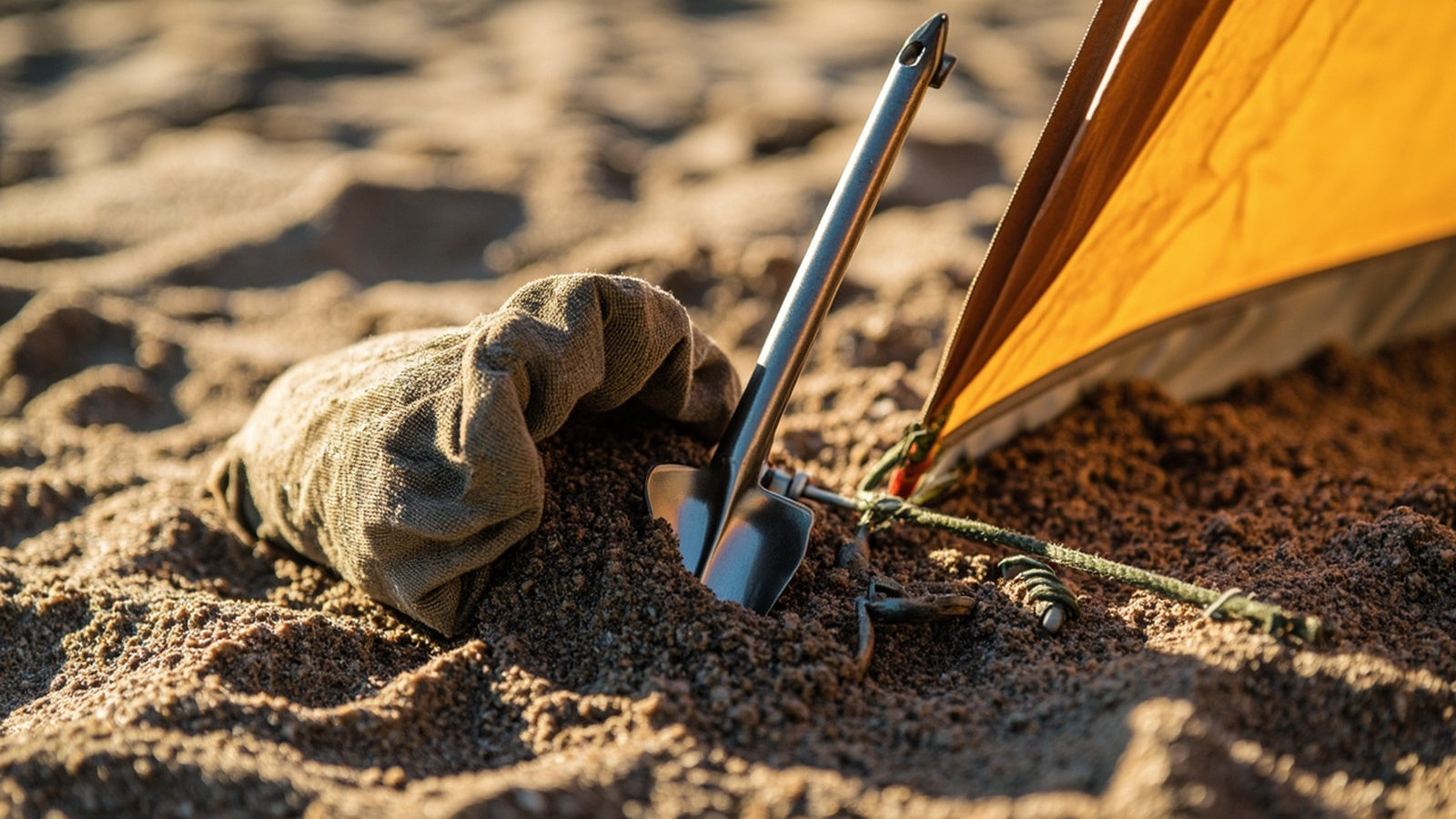
The word “pop-up” describes the first ten seconds, not the whole job. A pop-up beach tent opens itself and then stays up only as long as its anchors do, and wind is what takes them down — not a burst, but a steady onshore breeze that gradually works a corner loose. Fill the sandbags with wet sand, which is two to three times denser than dry, and push the stakes into damp sand below the surface crust, because the dry top layer is what the first gust peels away.
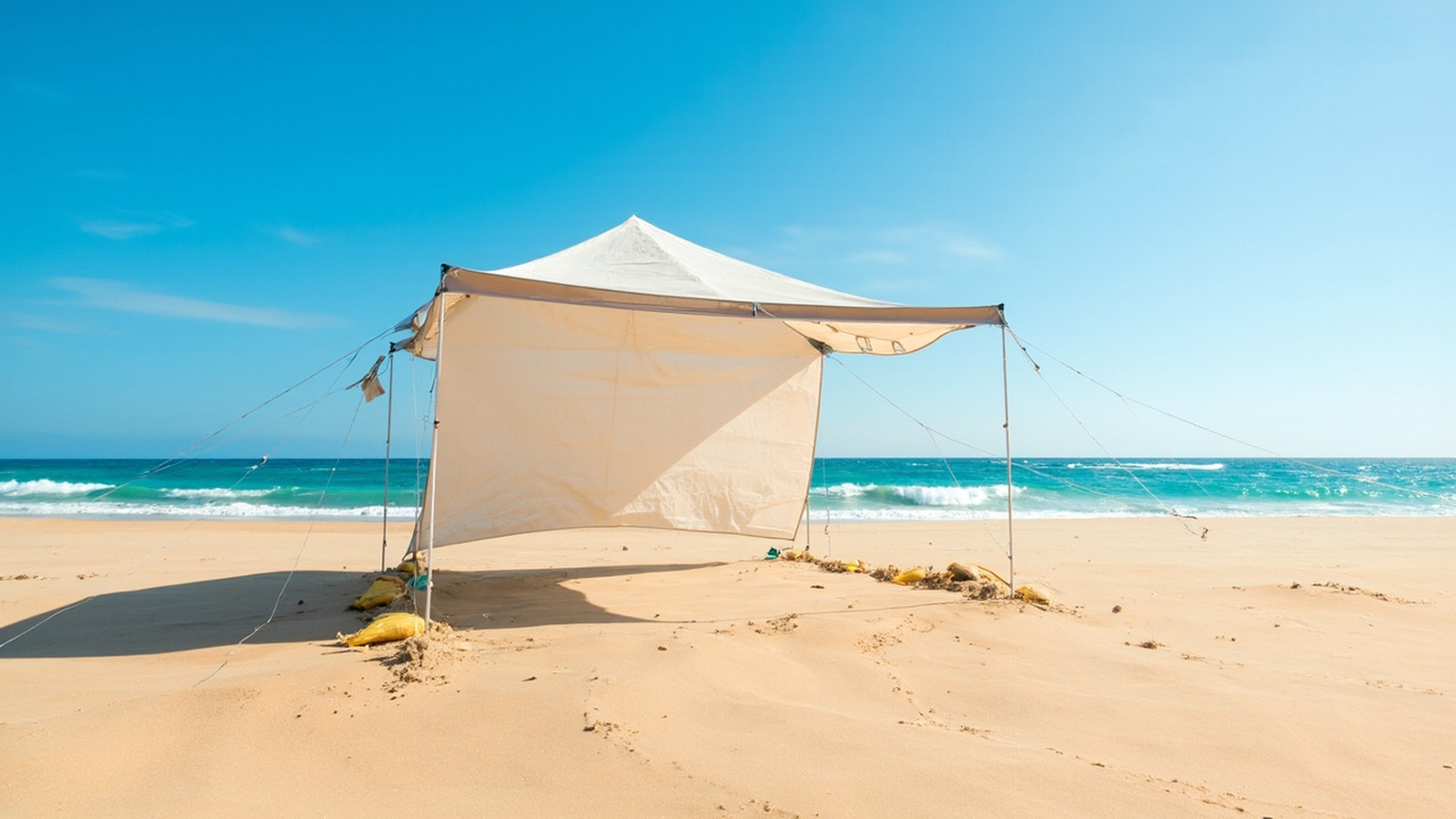
Run the guy lines at 45 degrees rather than horizontally, so the pull resists lift instead of dragging the frame sideways. On an exposed beach add sand screw anchors, which run $10 to $15 and are the cheapest insurance on this list. If the forecast shows anything above 15 mph, pack it: past 20 mph nothing on this page is dependable, and a collapsed tent across a public beach is your problem, not the manufacturer’s.
For the folding itself it’s twist-and-fold — hold two opposite edges, twist your wrists in opposite directions, keep going until the frame collapses into rings, then fold the disc into the bag. The WhiteFang is the least dramatic to fold, the WolfWise the worst. Practise once at home following the how to fold a tent sequence so the first time isn’t in a car park with sand blowing sideways.
Best Pole-Assembly Beach Canopies
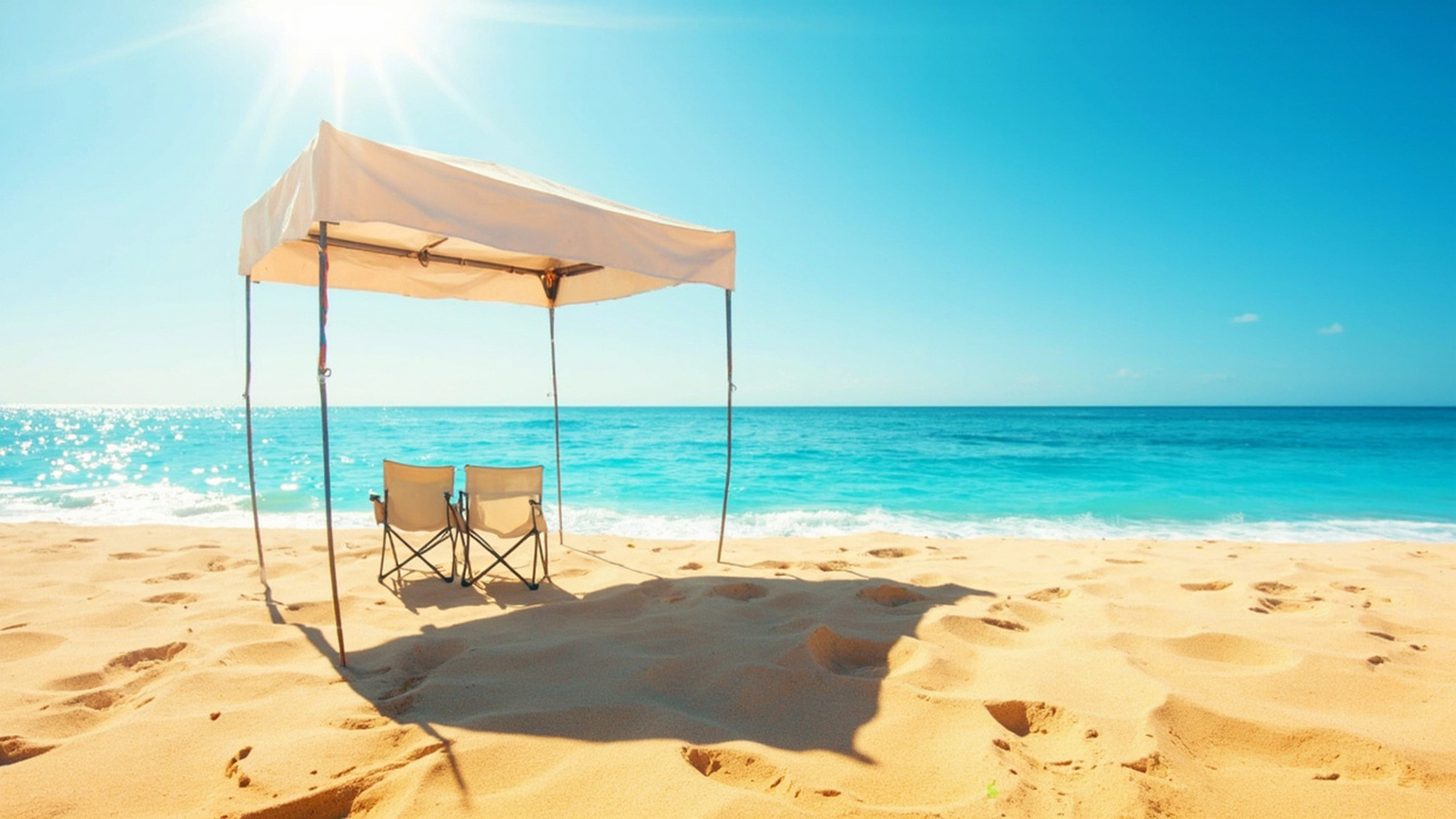
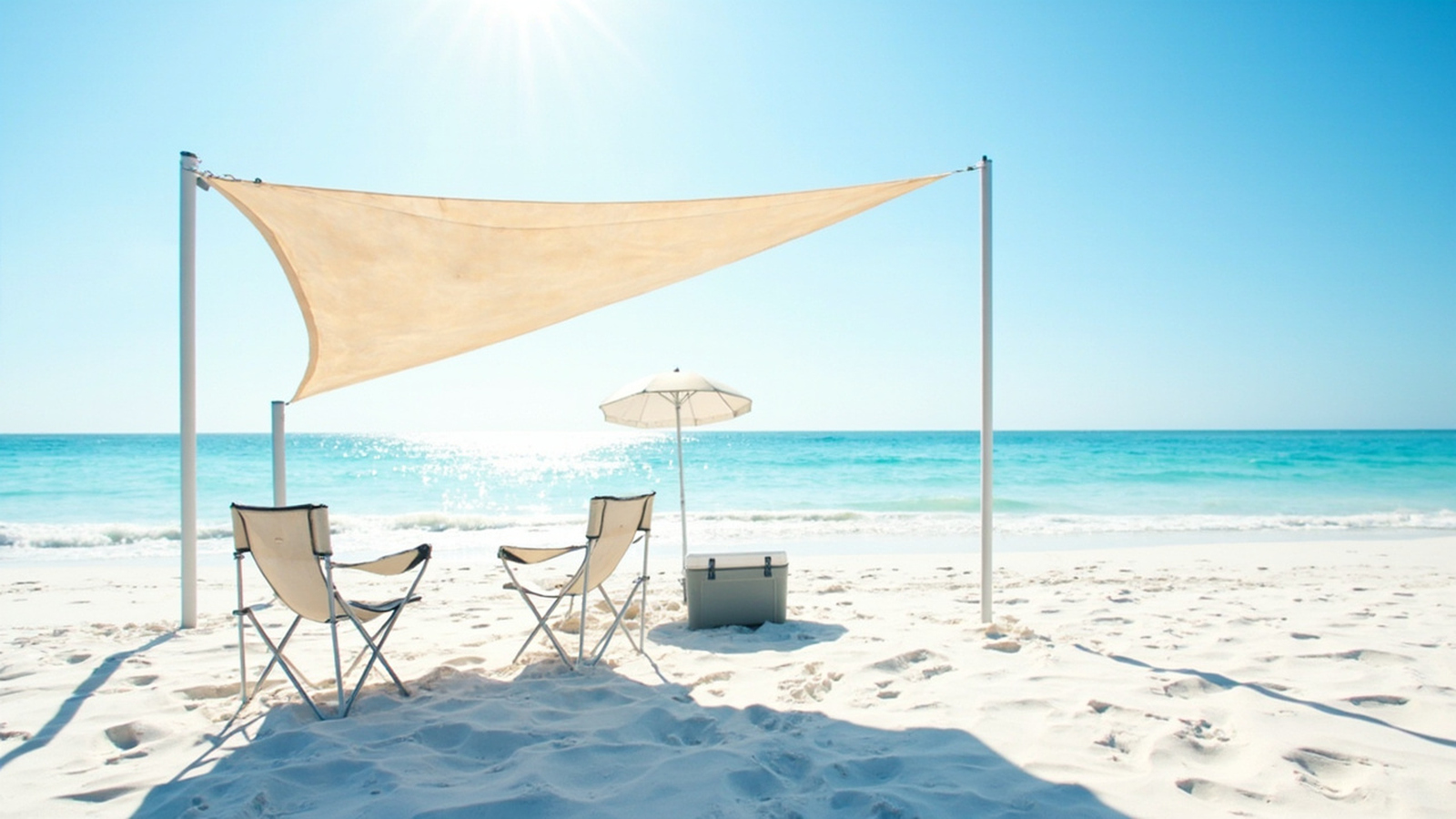
Pole-assembly canopies trade setup speed for structure and shade area. Fiberglass poles carry the load to the sand, the top is open, and you can walk in without ducking or unzipping anything. Our pop-up tent roundup covers the camping side of that trade-off.
Coleman Skyshade ($51.00) — Most Sturdy
The sturdiest structure here, and the only reason is the frame. Pop-ups rely on tensioned fabric across a folding hoop; the Skyshade carries that load down rigid poles into four separate stake points, which is why it’s the one we’d leave standing when the wind picks up. It also fits over beach chairs that shorter pop-ups can’t accommodate, which is the practical difference you’ll notice on day one.
Pair it with a camping cooler and a camping chair and it becomes a proper day base rather than just shade.
The trade-offs are real: it’s a full-length pole canopy rather than a pop-up, setup takes longer, and solo pitching in wind is awkward. Fiberglass poles snap if you twist them the wrong way, so don’t force a bent section straight. Amazon doesn’t publish a weight for this listing, but the full-length canopy makes it the bulkiest thing to carry here, which matters more than weight on soft sand.
What we like: Most structurally wind-resistant here, fits over tall beach chairs, pre-attached poles, useful at parks and tailgates too. What could be better: Heaviest here, open-top so no privacy, poles snap if forced, slower than a pop-up.
Who it’s for: Anyone whose beach days happen on exposed or breezy sand where fabric tents give up first.
Our outdoor canopy roundup covers the same rigid-frame logic at other sizes, but this one at $51.00 is the version most people end up buying. Pitch it in the morning with the sun behind the open side — an open top only stays cool if air can move through it.
Neso 7×7 Beach Tent ($120.00) — Best for Travel
The only one here built around a specific trip: flying somewhere. At about 4 lbs in a compact pouch it clears carry-on limits, which is the whole pitch — you can shade a six-person group on a beach you reach by air travel without paying to check a bag. The four-corner design gives 7 by 7 ft of shade, more than three umbrellas combined, and the patented reinforced corners stop the usual failure where fabric tears at the anchor point.
At $120 it is expensive for fabric on poles, the Lycra stretches and sags after a season outdoors, and first-time assembly is genuinely frustrating. Sandbags alone aren’t enough on a windy beach — add ground stakes, which is the step people skip.
What we like: 7×7 ft of shade, 4.0 lbs and carry-on friendly, reinforced corners, sand anchor included. What could be better: $120 is a lot for fabric and poles, Lycra sags over time, assembly is hard first time, sandbags alone insufficient.
Who it’s for: Fly-in holidaymakers who need shade on arrival without checking a bag.
The 7×7 footprint also makes it the easier choice for a group spread along the sand, since shade area scales where people actually sit. Owners who’ve flown with it report the pouch clearing overhead on regional aircraft, which is the practical test the marketing copy skips. The reinforced corners are also what stops the standard beach-canopy failure, where fabric tears at the anchor point after a season in sun.
Best Wind-Powered Beach Shade
Shibumi Shade Quiet Canopy ($308.00) — Most Shade Area
Nothing else on this page works this way. There are no poles, no frame and no assembly hardware — the wind lifts the fabric into an arch over roughly 150 sq ft, enough for up to eight people. It weighs about 4 lbs and packs into a 26-inch sleeve, lighter than the umbrella it replaces, and this Quiet Canopy version is built for lower noise than the original.
The price is the story now. This listing sits at $308, up from $175 earlier in the year, which makes it more than double the next-most-expensive item here and more than five times the WhiteFang — so the honest framing is that it is no longer a budget decision at all, it’s a group-coverage decision. It also needs wind to do anything, since on a flat calm day it’s a piece of fabric lying on the sand, and because it isn’t enclosed, blowing sand and insects get in and it flaps audibly in a strong breeze.
What we like: 150 sq ft of shade, no poles to lose, 4.0 lbs in a 26-inch sleeve, eight-person coverage. What could be better: $308 by far the most expensive, useless without wind, not enclosed, noisy in strong gusts.
Who it’s for: Groups at breezy beaches who need the largest shaded area and don’t need walls.
If you’re unloading a dry bag of gear from the car, 150 sq ft means everyone sits in the shade rather than taking turns — which is the actual argument for the price.
How to Choose the Right Beach Tent
Pop-Up vs. Pole Canopy vs. Wind-Powered
Pop-ups ($31.99 to $59.99) are enclosed, private and instant. Pole canopies ($51 to $120) are open-topped, taller and sturdier. Wind-powered ($308) is open-air, needs a breeze, and covers the most ground — our canopy guide covers the same split on the camping side.
Size: Match Your Group
Stated capacity is optimistic on every one of these. Solo or a couple: Alvantor or Picnic Time. Families of three to four: WhiteFang, which lists at 3-4 person; larger groups go to the Venustas at 6-8 person, or the Shibumi if you only need shade and there’s a breeze.
Weight and Portability
Walking more than ten minutes across soft sand? Venustas at 3.5 lbs, or Shibumi and Neso at about 4 lbs. Driving? Choose on features instead — weight barely matters once it’s in the boot.
Wind Resistance
The pole-assembly designs are sturdiest because the load runs down a rigid frame. Pop-ups catch wind like sails whatever the fabric quality, and the Neso needs ground stakes on top of its sandbags, while the Shibumi needs wind to work at all. Using every included anchor is the single biggest thing you can do — cutting corners is the number one reason beach tents end up down the beach.
UV Protection and Heat
Every pop-up here claims UPF 50+, which is the category floor rather than a differentiator. Heat is what varies: enclosed pop-ups trap it, and mesh windows only partly fix that on a 90°F day, while canopies and the Shibumi stay cooler because air moves through them. For the coolest seat, choose an open design and add a camp chair and a fan.
Which Beach Tent Should You Buy
For most families, the WhiteFang Deluxe at $59.99: extendable floor, three vents, and a full anchoring kit in the box. On a tight budget, the Venustas at $31.99 does more than its price suggests.
If you carry your shade across sand, the Venustas at $31.99 is 3.5 lbs and fits a tote. If wind is the deciding factor, the Coleman Skyshade at $51.00 is the sturdiest frame here. If you’re flying in, the Neso 7×7 goes through carry-on, and only buy the Shibumi at $308 if you specifically need 150 sq ft of shade and there’s a breeze.
Staying overnight rather than day-tripping? None of these will keep rain off you — start with our beach camping guide instead.
Frequently Asked Questions
Are beach tents worth it? Yes. UPF 50+ blocks around 98% of UV, which sunscreen alone doesn’t manage across a full day, and you also get privacy, wind shelter and dry storage for phones and keys. From $31.99 and under 5 lbs.
Do beach tents work in wind? Roughly 10 to 15 mph with every anchor in use. The pole canopies are sturdiest, the Shibumi needs wind, and past 20 mph nothing here is dependable.
Beach tent vs. beach canopy? Tents are enclosed: shade, UV, wind, privacy. Canopies are open-top: more shade, no privacy. The Venustas, Alvantor, Picnic Time, WhiteFang and WolfWise are tents; the Coleman and Neso are canopies; the Shibumi is wind-powered.
How do you keep a beach tent from blowing away? Wet sand in the bags, stakes into damp sand, guy lines at 45 degrees, and screw anchors on exposed beaches. Never leave it standing unattended.
Best for families with kids? The WhiteFang at $59.99 for most. On a budget, the Venustas at $31.99 — four sizes, three pockets, privacy on all four sides. For a big group that only needs shade, the Shibumi’s 150 sq ft.
Can you use a beach tent for camping? Daytime shade only. No rain fly, no waterproof floor, mesh lets bugs through. For overnight use a proper camping tent.
What is the best pop up beach tent? The WhiteFang Deluxe at $59.99 — extendable floor, three vent windows, anchoring kit included. Cheapest credible option is the Venustas at $31.99; lightest is the Alvantor at $34.42.
How do you fold a pop-up beach tent? Twist-and-fold: hold opposite edges, twist opposite ways, keep going until it collapses into rings, then fold the disc into the bag. Practice before the first trip.
Are beach tents allowed on all beaches? No. Many cap the footprint at 10×10, require anchoring, or ban shelters during sea turtle nesting from May to October. Check the specific beach first.
Do beach tents block UV? The five pop-ups claim UPF 50+, close to 98% blocked when the fabric is taut. Coverage drops if you leave sides open. It complements sunscreen, not replaces it.
References
- Travel + Leisure — Best Beach Canopies — Lifestyle magazine covering beach canopy products
- Southern Living — Best Beach Tents — Southern US lifestyle publication with beach tent recommendations
- Consumer Reports — Beach Tents — Product testing authority on beach tent safety and UV protection
- HGTV — Best Pop-Up Canopy Tents — Outdoor living site covering pop-up canopy tents
- 知乎 — 沙滩帐篷推荐 — 沙滩帐篷/遮阳帐篷选购推荐和对比
- 什么值得买 — 沙滩帐篷实测 — 户外沙滩帐篷使用评测