8 Best Camping Foods in 2026: Meals, MREs & Snacks
We researched 8 camping foods from $5 to $80 — freeze-dried meals, MREs, jerky, bars, and waffles for backpacking and car camping in 2026.
Products Reviewed
Camping food has a reputation problem. Most people picture bland oatmeal and sad hot dogs. Modern camping food has evolved past survival rations into genuinely enjoyable meals. The challenge is choosing between freeze-dried pouches, MRE self-heating packs, jerky, energy bars, and meal kits — each designed for a different camping style.
We researched 8 products across four categories: freeze-dried meal kits ($29-80), single pouches ($10-14), ready-to-eat MREs ($45), and trail snacks ($5-26). Prices range from $5.18 to $79.99. Here’s what works — the best camping food for every style and budget.
Quick Answer: Our Top Picks
Best Overall — CarniVault Freeze Dried Meat ($79.99) 88 servings of protein-packed meat and rice entrees in one stackable bucket, with a 25-year shelf life. Over a week of dinners for two campers at roughly $1.79 a serving. The best camping food for multi-day base camps.
Best Budget — Jack Link’s Beef Jerky ($5.18) 8 oz of 100% real beef, no refrigeration, no prep. The cheapest protein per dollar in our lineup. The universal trail snack for every camping food style.
Best No-Cook — APack Ready Meals MRE 12 Pack ($45.00) 12 complete meals with self-heating flameless heaters. No stove, no water. Each includes entree, side, snack, dessert, and drink.
Quick Comparison
| Product | Price | Type | Servings | Rating | Best For |
|---|---|---|---|---|---|
| CarniVault Freeze Dried Meat | $79.99 | Protein | 1.5 lb | — | Best Overall |
| 4Patriots 72-Hour Survival Food Kit | $29.00 | Meal Kit | 20 servings | — | Best Value Kit |
| Peak Refuel Beef Stroganoff | $13.95 | Single Meal | 2 | 4.5★ | Best Single Pouch |
| Backpacker’s Pantry Mac & Cheese | $9.99 | Single Meal | 2 | 4.3★ | Best Vegetarian |
| APack Ready Meals MRE 12 Pack | $45.00 | Ready-to-Eat | 12 meals | — | Best No-Cook |
| Jack Link’s Beef Jerky | $5.18 | Protein Snack | ~8 | 4.6★ | Best Budget |
| Honey Stinger Waffles | $18.99 | Energy Snack | 16 | 4.6★ | Best Energy Snack |
| CLIF BAR Variety Pack | $26.36 | Energy Bar | 16 | 4.5★ | Best Meal Bar |
Prices from Amazon as of May 2026. Actual prices may vary.
Note: Mountain House and Peak Refuel are reviewed in-depth in our Best Freeze Dried Food guide. This article covers them alongside other camping food categories.
Best Freeze-Dried Meal Kits for Multi-Day Trips
CarniVault Freeze Dried Meat ($79.99) — Best Overall
The biggest bang-for-buck protein supply we found. 1.5 lb of cooked freeze-dried meat (2-pack) that pairs with any carbs you already pack — real protein for multi-day trips. Prep is just-add-water, so all you need is a camping stove and a boil.
The 25-year shelf life means buy today, eat on trips for years, and keep the rest as emergency backup. The bucket stacks in a pantry or trunk without taking over.
Trade-offs: meat-only means you plan your own carbs, and the 2-pack weighs more than pouches. This is a car camping and base camp option. At roughly $1.79 per serving, though, no other meal kit in our lineup comes close on cost per meal.
What we like: Real cooked meat, 25-year shelf life, pairs with anything, stackable grab-and-go pack.
What could be better: $79.99 upfront for a meat-only lineup, needs your own carbs, not a complete meal kit.
Who It’s For: Car campers wanting a complete multi-day camping food supply. Best for base camps and emergency prep. See our car camping guide for complete trip planning.
4Patriots 72-Hour Survival Food Kit ($29.00) — Best Value Kit
20 servings of storage-stable meals for $29 — about $1.45 per serving, the best value per calorie in our lineup. The kit is built for a 72-hour emergency window (one person, three days) and carries a 25-year shelf life that nearly matches Mountain House. 4Patriots is an emergency food specialist, and the dual-use appeal (camping + emergency prep) explains the massive following.
The quality gap is real: meals taste “decent” but don’t match Mountain House. They are simple rice, soup, and bake-style dishes that need boiling water, so budget a stove or heat source. Portions are smaller than premium brands, and 20 servings covers one person only.
What we like: $29 for 20 servings, 25-year shelf life, emergency-grade packaging, covers all 3 meals.
What could be better: Taste below Mountain House, simple recipes need seasoning, needs boiling water, small portions, 72-hour supply for 1 person only.
Who It’s For: Budget-conscious campers who want maximum camping food meals per dollar with emergency prep value.
Best Single-Serve Freeze-Dried Meals
Peak Refuel Beef Stroganoff ($13.95) — Best Single Pouch
The most nutritious pouch in our lineup: 1,040 calories and 49g protein from 100% real beef. No TVP filler. Add hot water, stir, wait 10 minutes. Backpackers burning 3,000+ calories per day need this recovery fuel, and the no-filler beef formula is the draw.
The catch: portions feel small despite the calorie count. Beef chunks can be overcooked. It needs more water and longer soak than the label indicates. At $6.98 per serving, it’s pricier than Mountain House singles.
What we like: 1,040 cal + 49g protein, 100% real beef, no TVP, simple hot water prep.
What could be better: Portions feel small, $6.98/serving pricey, beef chunks overcooked, needs extra water/time, salty.
Who It’s For: Hikers needing high-calorie, high-protein camping food for recovery after long trail days.
Backpacker’s Pantry Mac & Cheese ($9.99) — Best Vegetarian
Mac & cheese is the ultimate camping comfort food. Backpacker’s Pantry has been making trail food since 1951. At $9.99 for 2 servings, it’s the cheapest quality freeze-dried camping food here. Real cheese sauce delivers 24g protein with a vegetarian recipe — rare in freeze-dried form.
Downsides: cheese flavor can be weak. Over-hydrating makes it mushy. Some clumping without thorough stirring. The dehydrated prep (not freeze-dried) keeps price low but texture isn’t as good. See our best camping coolers guide for storing perishable alternatives on car camping trips. For more meal planning ideas, check our camping meal plan.
What we like: $9.99 cheapest meal, vegetarian, 24g protein, real cheese sauce, comfort food.
What could be better: Cheese flavor weak, mushy if over-hydrated, clumps without stirring, modest portions.
Who It’s For: Vegetarian campers craving comfort food, or anyone wanting an affordable filling lunch.
Best No-Cook Camping Meals
APack Ready Meals MRE 12 Pack ($45.00) — Best No-Cook
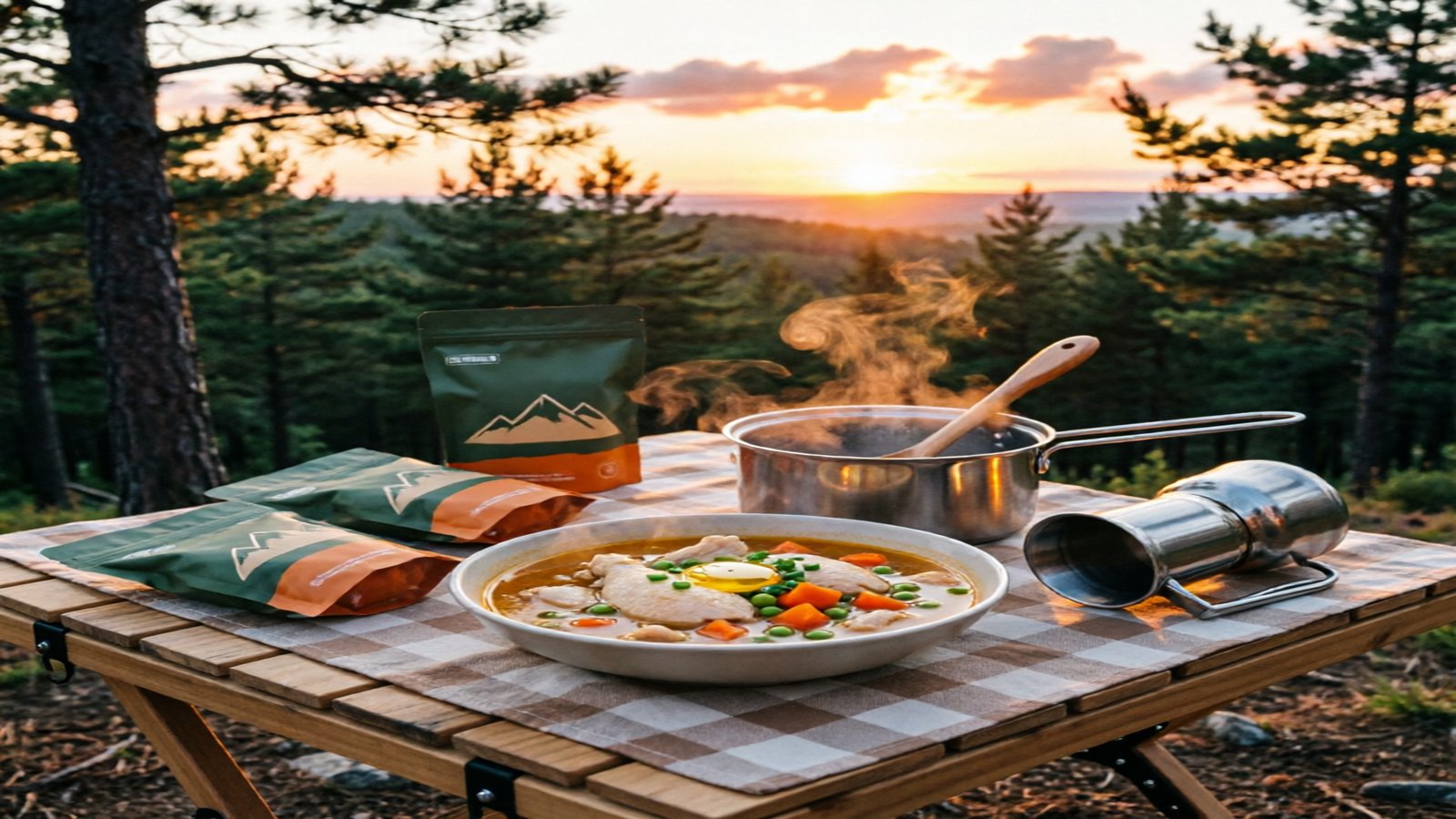
Military-format meals built for field use. The 12-meal pack spans 6 menu varieties, and every kit includes a flameless ration heater: slide the pouch in, add water, and it heats itself in minutes — no stove, no flame. At $45 for a dozen ready-to-eat meals, it’s a complete hot-meal solution for off-grid trips, and menu variety is the whole appeal of the format.
Compromises: taste is hit or miss. The full pack is heavy and bulky — not for backpacking. Heaters are finicky below 40°F, and the menu is fixed at 6 varieties, so long trips get repetitive.
What we like: Self-heating (no stove), 12 meals with 6 menu varieties, complete ready-to-eat format, emergency prep dual-use.
What could be better: Taste inconsistent, heavy for backpacking, heaters finicky in cold, fixed 6-menu rotation.
Who It’s For: Campers who want zero-cook complete camping food, or anyone building an emergency supply.
Best Trail Snacks for Camping
Jack Link’s Beef Jerky ($5.18) — Best Budget Protein
America’s #1 jerky brand. 8 oz of 100% real beef with 10g protein per serving. Zero prep, no refrigeration, no cooking — tear open and eat. At $5.18, it’s the cheapest protein per dollar in our lineup.
Weaknesses: can be tough and dry, quality varies by batch. High sodium (600mg+ per serving) makes it unsuitable as your only protein source. Fat content inconsistent between bags. Not a meal replacement — it’s between-meal energy.
What we like: $5.18 cheapest, 10g protein, zero prep, no refrigeration, 8 oz lasts multiple sessions.
What could be better: Can be tough/dry, high sodium, quality varies by batch, not a meal replacement.
Who It’s For: Every camper. The default trail camping food for protein between meals.
Honey Stinger Organic Waffles ($18.99) — Best Energy Snack
Pocket-sized stroopwafels filled with organic honey. At 1 oz each, they’re the lightest energy option here — perfect for a hip belt or pack lid. Used by pro cyclists and thru-hikers worldwide. USDA Organic, clean honey energy without synthetic gels — a quick pre-workout boost that tastes better than most energy gels.
Downsides: $1.19 per waffle adds up on long trips. Only 1g protein — it’s a quick carb boost, not substantial nutrition. Can be sticky in heat. Some arrive crushed. For quick trail energy, the convenience-to-taste ratio is unbeatable.
What we like: 1 oz ultralight, USDA Organic, doesn’t melt/crush, clean honey energy.
What could be better: $1.19/waffle adds up, low protein (1g), sticky in heat, some arrive crushed.
Who It’s For: Trail hikers and cyclists needing quick natural energy — the best camping food for pocket-sized snacking.
CLIF BAR Variety Pack ($26.36) — Best Meal Bar
The #1 energy bar brand in America. 16 bars, 6 flavors in one box. Each 2.4 oz bar delivers 10-11g protein from organic oats — substantial enough for a meal replacement. Non-GMO verified. The variety prevents boredom on multi-day trips — rotate flavors across days and nobody opts out.
Compromises: flavors vary in quality. Can arrive crushed. Higher sugar than jerky. At ~250 calories per bar, you’d need 2-3 for a full meal. But for breakfast on the trail or between-meal fuel, CLIF BARs are reliable.
What we like: 16 bars, 6 flavors, 10-11g protein, organic oats, meal-replacement potential.
What could be better: Flavors vary in quality, can be crushed, higher sugar, 2-3 bars needed for full meal.
Who It’s For: Campers wanting reliable camping food meal-replacement bars with variety for multi-day trips. See our family camping essentials guide for full trip checklists.
How to Choose the Right Camping Food
Trip Style: Backpacking vs. Car Camping
Backpackers need calorie density per ounce — Peak Refuel (520 cal/serving), CLIF BARs (250 cal), and jerky (80 cal/serving). Skip MREs and meal buckets — too heavy. Car campers can bring anything. The CarniVault freeze-dried bucket, APack MRE 12-pack, and 4Patriots 72-hour kit all work when weight doesn’t matter.
Build a 3-Layer Food System
Don’t rely on one category. Dinners: freeze-dried meals or MREs. Daytime fuel: CLIF BARs, jerky, waffles. Emergency backup: extra bars or MREs. A common mistake: buying only dinners with nothing for daytime eating.
Cooking Requirements
No-cook (MREs, jerky, bars, waffles): zero equipment. Hot water only (Mountain House, Peak Refuel, Backpacker’s Pantry, 4Patriots): a small stove or thermos. Most campers should aim for hot water — a Jetboil weighs 13 oz and boils in 100 seconds.
Nutrition: Calories, Protein, Sodium
Peak Refuel leads at 1,040 cal and 49g protein — ideal for active hikers. The problem across the board: sodium. Most freeze-dried meals and MREs hit 1,200-1,600mg per serving. For a 3-day trip it’s fine. Balance with fresh fruit and nuts when possible.
Shelf Life
Mountain House (30 years) and 4Patriots (25 years) last essentially forever. Peak Refuel/Backpacker’s Pantry: 5-10 years. MREs: 3-5 years. Snacks: 1-2 years. Store in a cool, dry place.
Frequently Asked Questions
Best food to bring camping? Backpackers: freeze-dried camping food + bars + jerky. Car campers: anything goes. MREs for no-cook. Build a 3-layer camping food system: dinners, daytime snacks, emergency backup.
How much food for a camping trip? 2,500-3,500 cal/person/day. Two freeze-dried meals + 2-3 snacks per person per day. Budget $10-15/person/day for camping food.
Do I need a stove? No. MREs self-heat. Jerky, bars, waffles need zero prep. Freeze-dried meals need only hot water.
How long does freeze-dried food last? Mountain House: 30 years. 4Patriots: 25 years. Peak Refuel/Backpacker’s Pantry: 5-10 years. MREs: 3-5 years. Snacks: 1-2 years.
Are freeze-dried meals healthy? Calorie-dense, not health food. Peak Refuel: 1,040 cal, 49g protein, but high sodium. Pair with fresh options.
Freeze-dried vs. dehydrated? Freeze-dried preserves texture/flavor better, costs more. Dehydrated is cheaper but mushier. Both need hot water.
Can I bring grocery store food? Yes — cheaper for car camping with a cooler. Trade-off: perishability. Freeze-dried wins for backpacking.
Are MREs good for camping? Functional, not gourmet. Self-heating is convenient. Each pack is a complete ready-to-eat meal with a flameless heater included. Freeze-dried camping food tastes better if you have a stove.
References
- Serious Eats — What to Eat on a Camping Trip — Food media perspective on camping meal planning
- Fresh Off The Grid — Camping Recipes — Camping and backpacking recipe specialists
- REI — Camping Food Guide — Expert advice on camping food categories
- 知乎 — 露营食品推荐 — 户外露营食品/冻干食品选购指南
- 什么值得买 — 露营食物实测 — 冻干食品/MRE/能量棒露营实测对比