Stargazing Camping Guide: Dark Sky Spots, Gear & Tips
Plan a stargazing camping trip — find dark sky parks, choose binoculars and red-light gear, and discover the best US stargazing destinations.
Stargazing camping means traveling to a dark, remote campsite specifically to observe the night sky — away from city light pollution that blocks most stars from view. A typical suburb shows about 50 stars; a dark sky site reveals 2,000 to 5,000+ [source: IDA / Falchi et al., Science Advances, 2016].
This guide covers planning, gear, destinations, and technique for your first trip.
How to Plan a Stargazing Camping Trip
Check the moon phase. Target the new moon (plus or minus five days). A full moon is brighter than city light pollution and ruins stargazing completely. Use timeanddate.com for moon phase calendars. Pick a dark location. Use a light pollution map to find Bortle 1 to 3 sites (explained below). The darker, the better. Check cloud cover. Clear skies are essential. Use cleardarksky.com for astronomical forecasts — regular weather apps don’t show cloud transparency or seeing conditions.
Book your campsite. Many dark sky locations have campgrounds that fill up in summer. Reserve two to three months ahead. See our camping guide for beginners for general trip planning. Pack stargazing gear. Red-light headlamp, binoculars, star chart, sleeping pad, warm layers, hot drinks. Details in the next section. Arrive before sunset. Set up camp in daylight so your eyes can start adapting during twilight. Everything is harder to find in the dark — literally. Know what’s visible tonight. Check a star chart app for planets, the Milky Way position, and any active meteor showers before you head out.
Stargazing Camping Gear: What to Pack
Must-Have Gear
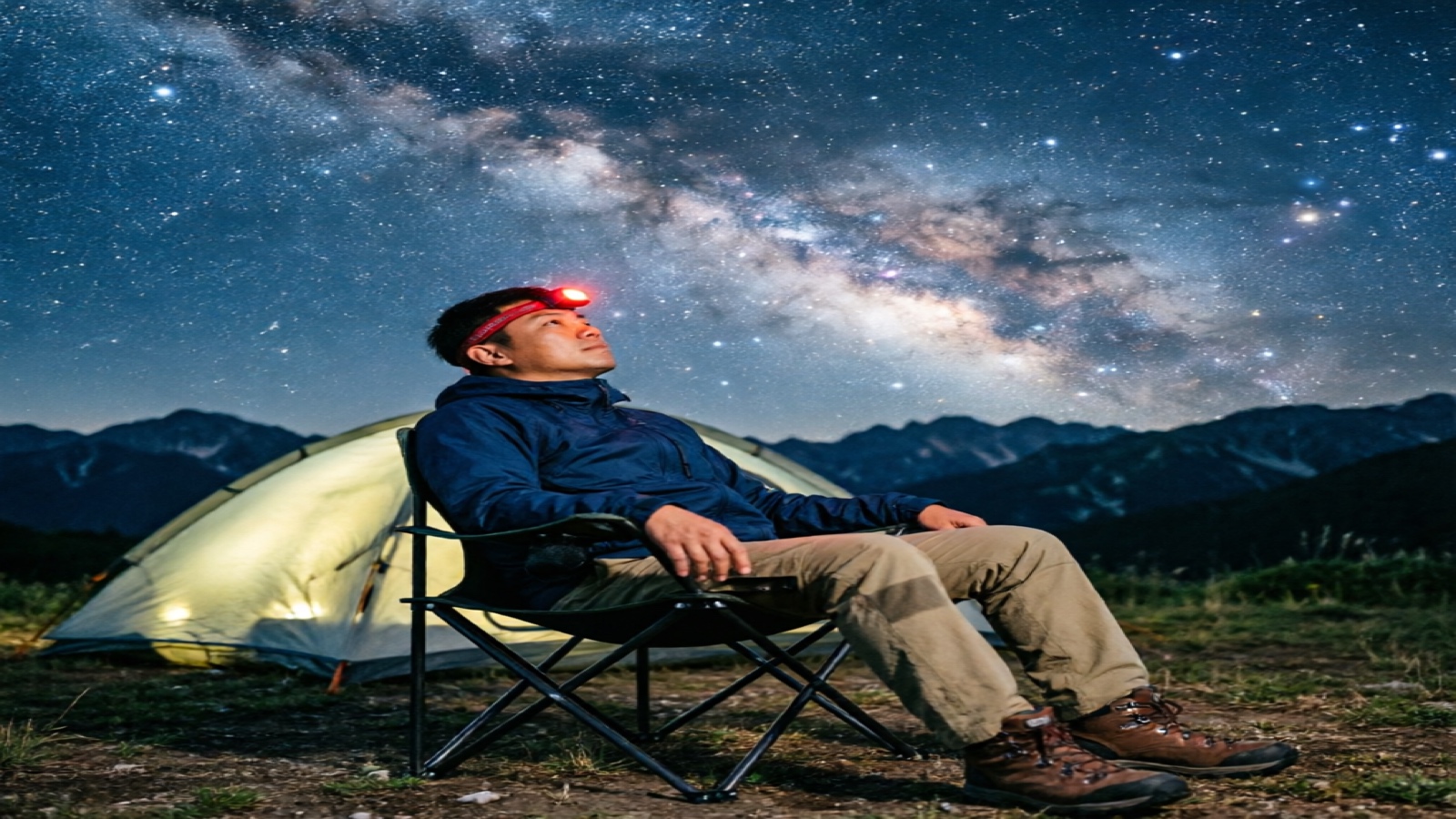
Red-light headlamp. White light destroys night vision for 20 to 30 minutes; red light preserves it. The LHKNL Headlamp 2-Pack ($19.99) has dedicated red LED mode with USB-C recharging.
The budget option, GearLight LED Headlamp 2-Pack ($14.99), runs on AAA batteries with seven modes. Users report it fits over beanies. See our camping lantern guide for more options.
Star chart. A physical planisphere emits no light and never needs charging. The Explore Scientific Planisphere ($24.99) is a double-sided dial — rotate to match date and time, and it shows what’s overhead. More reliable than a phone in freezing cold when batteries drain fast.
Binoculars. You don’t need a telescope — good binoculars show Jupiter’s moons, nebulae, and star clusters. The Celestron Cometron 7x50 ($39.99) offers a wide 6.6-degree field ideal for beginners.
For deep-sky objects, the Celestron SkyMaster 15x70 ($89.00) gathers far more light and includes a tripod adapter. Campers report it resolves galaxies the 7x50 can’t, though hand-holding is tough past 10 minutes.
Comfort Gear
Sleeping pad. Lying flat is the most comfortable way to view the whole sky. The Coleman Self-Inflating Sleeping Pad ($25.99) has a built-in pillow and self-inflates. See our best camping sleeping pad reviews for more options.
Insulated bottle. Nights drop 20 to 30 degrees after sunset and you’ll be still for hours — hot drinks are survival gear. The Stanley Heritage Vacuum Bottle ($9.98) keeps drinks hot 24 hours in a rugged steel body.
For more capacity, the THERMOS Stainless King 40 oz ($38.68) has a handle and enough volume to share.
Warm layers. Beanie, gloves, insulated jacket, warm socks — all mandatory. See our sleeping bag guide for the full sleep system.
Understanding Light Pollution and Dark Sky Parks
Light pollution is artificial city light that scatters in the atmosphere, creating sky glow that drowns out all but the brightest stars. 99% of the US population lives under light-polluted skies [source: Falchi et al., Science Advances, 2016].
The Bortle Scale
The Bortle scale measures sky brightness from 1 (darkest) to 9 (brightest):
| Bortle Class | Sky Description | Stars Visible | Milky Way | Where to Find |
|---|---|---|---|---|
| 1 | Excellent dark-sky site | 5,000+ | Bright, structured | Remote deserts |
| 2 | Typical truly dark site | 4,000–5,000 | Clearly visible | National parks far from cities |
| 3 | Rural sky | 3,000–4,000 | Visible but faint | 30+ miles from small towns |
| 4 | Rural/suburban transition | 2,000–3,000 | Barely visible | 15–30 miles from towns |
| 5 | Suburban sky | 1,000–2,000 | Not visible | 5–15 miles from suburbs |
| 6–7 | Bright suburban | 500–1,000 | None | Near suburban developments |
| 8–9 | City sky | Under 500 | None | Urban areas |
For stargazing camping, target Bortle 1 to 3 sites.
International Dark Sky Parks and Reserves
The International Dark-Sky Association (IDA) certifies exceptional night sky sites worldwide. As of 2026, over 100 sites are certified globally, including 60-plus in the US, with designations like Dark Sky Park, Reserve, and Community.
How to Find Stargazing Spots Near You
Online Tools
Dark Site Finder (darksitefinder.com) — interactive light pollution map. Light Pollution Map (lightpollutionmap.info) — global VIIRS satellite data with Bortle overlays. Clear Dark Sky (cleardarksky.com) — astronomical weather and darkness forecasts.
Target sites 50-plus miles from major cities and 20-plus miles from small towns. Elevation and open horizons both help — avoid deep canyons.
BLM land and national forests often have the darkest skies in the lower 48 — and camping is free. See our dispersed camping guide for beginners for finding and camping on public land.
Best Stargazing Destinations in the US
Western US
Joshua Tree, California — Bortle 2, International Dark Sky Park. Jumbo Rocks and Hidden Valley campgrounds host stargazing programs. Best October through May.
Death Valley, California — Bortle 1, one of North America’s darkest sites. Furnace Creek campground, annual Dark Sky Festival in February/March. Best October through March.
Great Basin, Nevada — Bortle 1 at 10,000-plus feet elevation. Annual Astronomy Festival in September. Best June through September.
Bryce Canyon, Utah — Bortle 2 with 100-plus ranger-led astronomy programs per year. North Campground has dedicated astronomy sites. Best May through October.
Central and Eastern US
Big Bend, Texas — Bortle 1, the largest dark sky area in the lower 48. Best October through April.
Cherry Springs, Pennsylvania — Bortle 2, the East Coast’s premier dark sky site with a dedicated Astronomy Field. Best May through October.
| Destination | State | Bortle | Best Season | Campground | Highlight |
|---|---|---|---|---|---|
| Joshua Tree | CA | 2 | Oct–May | Jumbo Rocks | Milky Way over rock formations |
| Death Valley | CA | 1 | Oct–Mar | Furnace Creek | Darkest skies in NPS system |
| Great Basin | NV | 1 | Jun–Sep | Lower Lehman | 10,000ft+ elevation clarity |
| Bryce Canyon | UT | 2 | May–Oct | North CG | 100+ ranger astronomy programs |
| Big Bend | TX | 1 | Oct–Apr | Chisos Basin | Largest dark area, lower 48 |
| Cherry Springs | PA | 2 | May–Oct | Astronomy Field | Best on East Coast |
| Acadia | ME | 3 | Jun–Sep | Blackwoods | Cadillac Mountain night sky |
| Glacier | MT | 2 | Jun–Sep | Many Glacier | Northern lights possible |
See our national park camping guide for general park tips.
Stargazing Tips for Beginners
Your eyes need 20 to 30 minutes to adapt to darkness. Any white light resets the clock. Use red light only and enable night mode on all devices.
Start with the Big Dipper — follow the pointer stars to Polaris. Learn three to four constellations per trip: Orion (winter), Summer Triangle (summer), Cassiopeia (year-round).
First night: Milky Way, Big Dipper, Orion, Jupiter, Moon craters. A few trips in: Andromeda Galaxy, Orion Nebula, Pleiades, meteor showers. Experienced: ISS passes, nebulae, galaxies.
Phone night mode captures decent Milky Way shots. DSLR/mirrorless: wide lens, tripod, 15 to 25 second exposure, ISO 3200 to 6400.
Stargazing Camping with Kids
Kids adapt to darkness faster than adults and make natural astronomers. Start simple: find the Big Dipper, spot the Moon, look for shooting stars.
Make it a game: who spots the most satellites? The Perseids in August is the best family event — warm nights, high meteor rates. Keep sessions to 30 to 45 minutes for young kids, and pack hot chocolate and blankets.
See our full camping with kids guide for family-specific camping advice.
Night Sky Calendar: Best Times to Go
Major Meteor Showers
| Event | Peak Date | Meteors/Hour | Notes |
|---|---|---|---|
| Quadrantids | Jan 3–4 | 60–120 | Short peak, cold nights |
| Lyrids | Apr 21–22 | 10–20 | First spring shower |
| Eta Aquariids | May 5–6 | 40–50 | Best from southern US |
| Delta Aquariids | Jul 28–29 | 15–20 | Warm nights, long window |
| Perseids | Aug 11–13 | 80–100 | Best overall for camping |
| Draconids | Oct 8–9 | Variable | Early evening viewing |
| Orionids | Oct 21–22 | 10–20 | Fast meteors |
| Leonids | Nov 17–18 | 10–15 | Occasional storms |
| Geminids | Dec 13–14 | 120–150 | Highest rate, very cold |
Seasonal Recommendations
- Summer: Milky Way core, Perseids, warmest nights. Book early.
- Fall: Crisp air, fewer crowds, Orionids.
- Winter: Geminids peak but brutal cold.
- Spring: Lyrids, mild weather, wildflower bonus.
New moon weekends arrive every 29 days — these are your best stargazing windows.
Stargazing Camping Etiquette and Safety
Dark Sky Etiquette
Use only red light after dark — no white headlamps or flashlights. Avoid campfires during viewing hours. Position your car to avoid sweeping headlights when leaving.
Safety at Remote Dark Sky Sites
Remote sites often lack cell service — download offline maps and share your plan before heading out. GPS your campsite before dark and layer up for long still sessions. See our camping safety tips.
Common Mistakes That Ruin Stargazing Trips
Not checking the moon — A full moon is brighter than city light pollution. Using white light — One flash resets 30 minutes of dark adaptation for you and everyone nearby. Going on a cloudy night — Check astronomical cloud forecasts, not regular weather apps. Staying too close to town — Even 20 miles out, sky glow from small towns is visible. Go farther.
Forgetting warm clothes — Standing still in the dark for hours gets cold fast, even in summer. Expecting Hubble images — Your eyes won’t see nebula colors. The magic is the scale: thousands of stars, the Milky Way band, meteors streaking across the sky. Rushing — Give your eyes 30 full minutes. The longer you look, the more you see. Not using an app or chart — Without a reference, the sky is overwhelming.
Frequently Asked Questions
What is the best time of year to go stargazing camping?
Late spring through early fall (May to September) offers the warmest nights and longest viewing windows. Plan around the new moon — the five days before and after give the darkest skies. Summer Milky Way season (June through August) is the most popular.
Where are the best places to stargaze in the US?
Top dark sky destinations include Death Valley (California), Big Bend (Texas), Cherry Springs (Pennsylvania), Great Basin (Nevada), and Joshua Tree (California). All are certified International Dark Sky Parks with on-site campgrounds.
Do I need a telescope for stargazing camping?
No. Your eyes, a star chart app, and binoculars are enough to see constellations, the Milky Way, meteor showers, and Jupiter’s moons. Start with 7x50 or 10x50 binoculars — they show far more than naked eye without the cost and bulk of a telescope.
How do I find dark sky parks near me?
Use the International Dark-Sky Association map at darksky.org for certified sites. Apps like Dark Sky Finder and Light Pollution Map show Bortle scale readings for any location. Also check the NPS Night Sky page for national parks with dark sky programs.
What should I pack for stargazing camping?
Beyond normal camping gear: a red-light headlamp, a star chart app or planisphere, binoculars, a sleeping pad for lying back, warm layers, and a thermos of hot drinks.
Why can’t I see many stars when I go camping?
Most likely light pollution — even small towns 20 miles away create sky glow. Use a light pollution map to find Bortle 1 to 3 sites. Other factors: moon phase, cloud cover, and not giving your eyes 20 to 30 minutes to adapt.
References
- 什么值得买 — 天文观测装备推荐与露营观星攻略: smzdm.com
- 知乎 — 新手观星入门指南与暗黑天空公园推荐: zhihu.com
- 小红书 — 露营观星装备清单与拍照技巧: xiaohongshu.com
Frequently Asked Questions
What is the best time of year to go stargazing camping?
Late spring through early fall (May to September) offers the warmest nights and longest viewing windows. Plan around the new moon — the five days before and after give the darkest skies. Summer Milky Way season (June through August) is the most popular.
Where are the best places to stargaze in the US?
Top dark sky destinations include Death Valley (California), Big Bend (Texas), Cherry Springs (Pennsylvania), Great Basin (Nevada), and Joshua Tree (California). All are certified International Dark Sky Parks with on-site campgrounds.
Do I need a telescope for stargazing camping?
No. Your eyes, a star chart app, and binoculars are enough to see constellations, the Milky Way, meteor showers, and Jupiter's moons. Start with 7x50 or 10x50 binoculars — they show far more than naked eye without the cost and bulk of a telescope.
How do I find dark sky parks near me?
Use the International Dark-Sky Association map at darksky.org for certified sites. Apps like Dark Sky Finder and Light Pollution Map show Bortle scale readings for any location. Also check the NPS Night Sky page for national parks with dark sky programs.
What should I pack for stargazing camping?
Beyond normal camping gear: a red-light headlamp (white light ruins night vision for 30 minutes), a star chart app or planisphere, binoculars, a sleeping pad for lying back, warm layers, and a thermos of hot drinks.
Why can't I see many stars when I go camping?
Most likely light pollution — even small towns 20 miles away create sky glow. Use a light pollution map to find Bortle 1 to 3 sites. Other factors: moon phase, cloud cover, and not giving your eyes 20 to 30 minutes to adapt.