Glamping Guide: Types, Destinations & How to Plan Your Trip
Complete guide to glamping — what it is, accommodation types, top US destinations, packing tips, and how to plan your first luxury outdoor stay.
Glamping (short for glamorous camping) is outdoor lodging that combines nature with real comfort — actual beds, electricity, running water, and often amenities like Wi-Fi, hot tubs, and full kitchens. You get the outdoors without sleeping on the ground or pitching a tent.
The term originated in the UK around 2005 and exploded globally through Airbnb and Instagram around 2015. The US luxury camping market is projected to reach $4.8 billion by 2028 as travelers increasingly seek nature experiences without sacrificing comfort [source: Grand View Research, 2024].
This guide covers the basics of luxury camping — accommodation types, top US destinations, packing lists, and planning steps for your first trip.
Glamping vs. Camping vs. Hotels
| Factor | Camping | Glamping | Hotel |
|---|---|---|---|
| Shelter | Your own tent | Pre-built (tent/yurt/dome) | Room in building |
| Bed | Sleeping bag + pad | Real mattress + linens | Standard hotel bed |
| Bathroom | Outhouse or none | Private or shared | Private en-suite |
| Electricity | Rarely | Usually included | Always included |
| Cost/night | $0–$35 | $50–$500 | $80–$400 |
| Nature access | Immersive | High | Low to none |
| Setup effort | High | None | None |
Choose camping if you love the process and don’t mind roughing it — see our camping guide for beginners for the basics. Choose luxury camping if you want nature plus comfort. Choose hotels when convenience matters more than the outdoors.
Types of Glamping Accommodations
These stays come in many forms, each with different comfort levels, price points, and vibes.
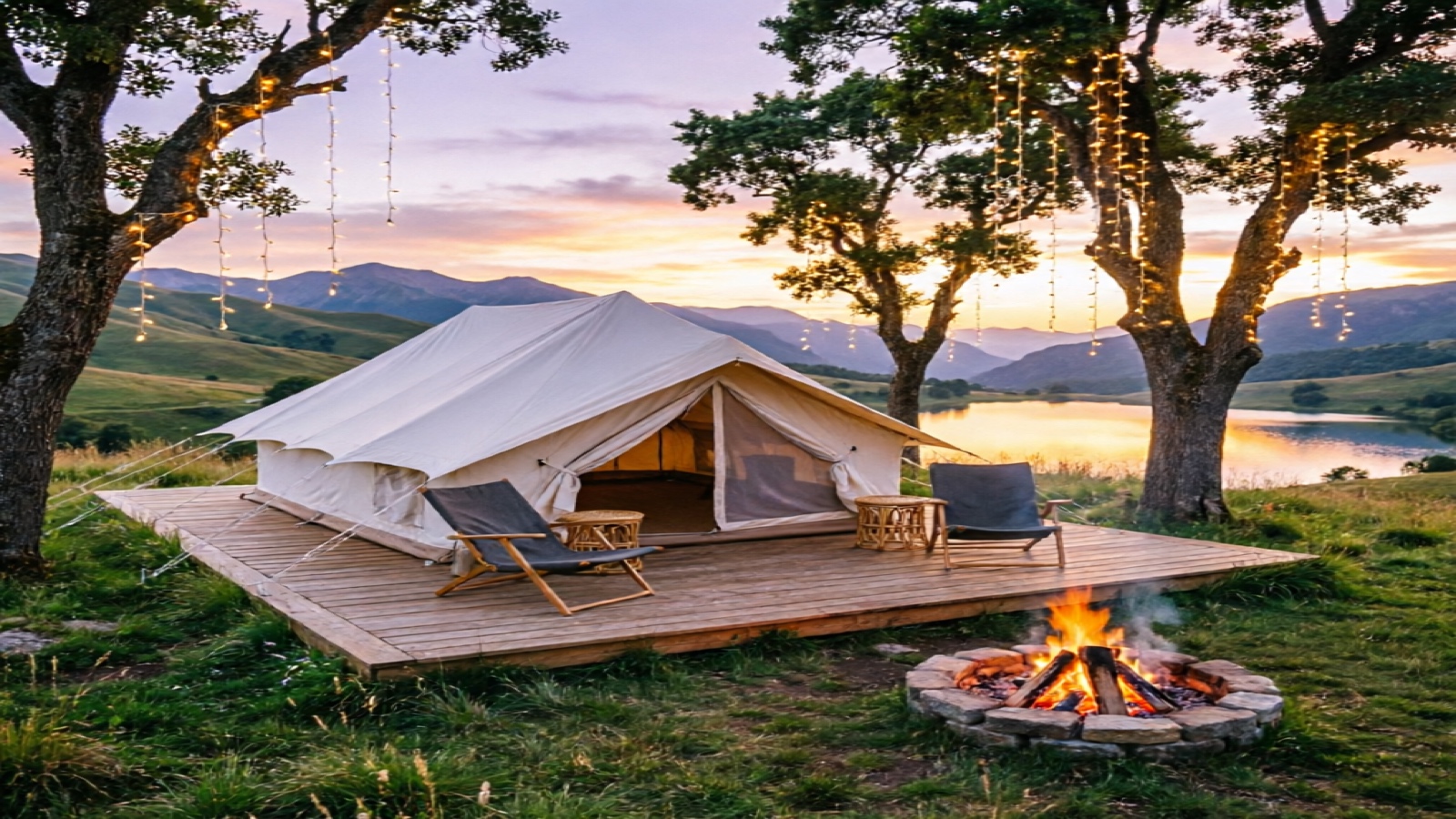
Safari tents are large canvas wall tents with real beds, rugs, and furniture. At $80–$300 per night, they’re the most common upscale camping type and the safest bet for first-timers.
Yurts are circular, domed structures with wood frames and canvas covers, often insulated with a wood stove inside. At $60–$250 per night, they handle cold weather well and work great for groups.
Geodesic domes are futuristic transparent or semi-transparent bubbles with stargazing windows and modern interiors. At $100–$400 per night, they’re the most photogenic option.
Treehouses range from rustic platforms to luxury multi-room retreats elevated in the trees. At $100–$500+ per night, they deliver a unique experience.
Pods and cabins are prefabricated small structures, often Scandinavian-inspired, with heating and small kitchens. At $50–$200 per night, they’re the budget-friendly option.
| Type | Price/Night | Weather Protection | Uniqueness | Best For |
|---|---|---|---|---|
| Safari tent | $80–300 | Good | Moderate | First-timers, couples |
| Yurt | $60–250 | Excellent | High | Groups, cold weather |
| Dome | $100–400 | Good | Very high | Couples, stargazing |
| Treehouse | $100–500+ | Moderate | Very high | Unique experiences |
| Pod/Cabin | $50–200 | Excellent | Moderate | Budget, road trips |
How to Plan Your First Glamping Trip
Choose your accommodation type. First-timer? Safari tent or cabin is the safest bet — comfortable without being overwhelming. Set your budget. Budget stays run $50–$150 per night, mid-range $150–$300, and luxury $300+. Pick your dates. Peak season (June–August) books up fast — reserve two to three months ahead. Shoulder seasons (May, September–October) offer better prices with fewer crowds.
Choose a location. For your first trip, stay within a one to three hour drive from home. Use the platforms in the next section to search. Read reviews carefully. Check for real photos, bathroom distance, heating and AC, cell service, and what’s included versus what you bring. Pack smart. See the packing section below — pack for camping-lite, not a hotel stay. Plan activities. Most sites are near hiking, water, or local attractions. Plan two or three activities but leave downtime.
How to Find Glamping Near You
Several platforms make finding the right stay straightforward:
Glamping.com is a dedicated directory with curated properties. Hipcamp (filter by “Glamping”) has large US inventory including private land. Airbnb (search “glamping,” “yurt,” “safari tent,” “dome”) has the largest selection. Booking.com (filter “glamping” under property type) works well for international options.
State parks increasingly offer luxury outdoor stays — check individual park websites. Some national parks have concessionaires operating upscale lodging, like Yosemite AutoCamp and Zion Wildflower. See our national park camping guide for park-level details.
Book early for summer dates (Memorial Day through Labor Day). Check cancellation policies — these stays fill up fast. Look for new listings, which are often cheaper and less reviewed.
Best Glamping Destinations in the US
California
AutoCamp (Yosemite, Russian River, Joshua Tree), Costanoa (Half Moon Bay), and Ventana (Big Sur) lead California’s outdoor lodging scene. The state offers redwoods, coast, desert, and mountains within driving distance — unmatched diversity. Price range: $100–$500 per night.
Texas
Collective Retreats (Hill Country), Lazy L&L Campground (Guadalupe River), and El Cosmico (Marfa) offer rustic-luxe experiences. Texas Hill Country delivers river beauty, affordability, and year-round weather. Price range: $60–$300 per night.
Florida
Westgate River Ranch (equine resort), Florida Keys eco-lodges, and family-friendly KOA Holiday sites make Florida a winter outdoor haven. Price range: $80–$350 per night.
| State | Highlight | Price Range | Best Season |
|---|---|---|---|
| California | Redwoods, coast, desert | $100–$500 | Apr–Oct |
| Texas | Hill Country rivers | $60–$300 | Mar–May, Sep–Nov |
| Florida | Beaches, springs | $80–$350 | Nov–Apr |
| Oregon | Forests, coast yurts | $50–$250 | Jun–Sep |
| Colorado | Mountains, hot springs | $100–$400 | Jun–Sep |
| New York | Catskills, lakes | $80–$300 | May–Oct |
Glamping for Different Travelers
With Kids
Look for family-friendly sites with pools and activities. Safari tents, cabins, and pods provide space and safety. Pack games, snacks, and familiar bedding for younger kids. See our camping with kids guide for family-specific tips.
With Dogs
Many sites are pet-friendly — always check individual policies. Cabins and safari tents with decks work best. Pack a leash, food, waste bags, and a dog bed. See our camping with dogs guide for the full checklist.
For Couples
Treehouses, domes with stargazing, and private hot tubs make for romantic getaways. Pack wine, board games, and a camera. See our camping for couples guide for romantic outdoor stays.
Solo
Check reviews carefully and choose established sites for safety. Pods, van conversions, and small cabins work well. A solo luxury camping trip is ideal for digital detox, reading retreats, and recharging in nature.
What to Pack for Glamping
Packing for these stays requires less than camping but more than a hotel stay. Always pack clothing layers (nights get cold even in summer), comfortable walking shoes, personal toiletries, a flashlight, bug spray, sunscreen, and a phone charger with power bank.
Check with your host before packing: many sites provide linens, towels, and kitchen supplies, but some don’t. Food is rarely included unless explicitly stated.
The Glocusent 135 LED Camping Lantern ($19.99) doubles as a 5,000mAh power bank and runs up to 200 hours on low. It’s a solid lighting backup even at sites with electricity.
For shower access at rustic sites, the Spopal Portable Camping Shower ($39.99) runs 90 minutes on a charge with four spray modes. Works with any water source — bucket, jug, or stream.
DIY Glamping Ideas
You don’t need a resort to get the upscale camping experience. These upgrades transform regular camping:
Easy upgrades: String lights around your campsite create instant ambiance. The Brightech Ambience Pro Solar String Lights ($21.99) are solar-powered with shatterproof Edison-style bulbs — no electricity needed. Add real pillows, a rug at the tent entrance, and cushioned camp chairs.
Intermediate upgrades: A canvas bell tent or wall tent, real plates and utensils instead of disposable, and a portable espresso maker. The STANLEY All In One French Press ($23.19) is vacuum-insulated stainless steel that keeps coffee hot for four hours — real coffee at camp, not instant.
Advanced upgrades: A MARBERO 30W Portable Solar Panel ($37.99) provides off-grid power for devices with QC3.0 USB ports. An Elegear Self-Inflating Sleeping Pad ($52.98) delivers 3.15 inches of memory foam with an R-value of 9.5 — hotel-bed comfort at camp.
For the full outdoor lounge experience, the Guide Gear Oversized Padded Camping Chair ($107.99) has a 400-pound capacity and furniture-like comfort. See our best camping chairs reviews for more options.
Glamping by Season
Spring (March–May): Wildflowers, moderate temperatures, fewer crowds. Best in Texas Hill Country, Florida, and California coast. Book early — spring fills fast at popular spots.
Summer (June–August): Peak season with highest prices. Best in Oregon, Colorado, and Montana to escape the heat. Book three or more months ahead and consider weekdays for lower rates.
Fall (September–November): Best value season — cooler temps, fall colors, lower prices. New England foliage, Blue Ridge, and California wine country shine. October books early for leaf-peeping destinations.
Winter (December–February): Limited cold-state options but great in Florida, Arizona, Southern California, and Texas. Insulated yurts with wood stoves and heated cabins handle cold-weather luxury stays. See our winter camping guide for cold-weather outdoor stays.
Glamping Tips for First-Timers
Start local — Book a site one to two hours from home for your first trip 2. Read the fine print — Know what’s included before you pack 3. Arrive before dark — Navigating a new site at night is stressful 4. Bring layers — Tents and domes run warm by day and cold by night 5. Check the bathroom situation — Some sites have en-suite, others share facilities 6.
Download offline maps — Cell service is unreliable at many spots 7. Pack earplugs — Nature is loud at 5 AM with birds, wind, and wildlife 8. Don’t overpack — You’re not roughing it, but you’re not at a hotel either 9. Bring bug protection — Even luxury sites have mosquitoes 10. Use the amenities — If your site has a hot tub, fire pit, or kayak, use it
The Anker Soundcore 2 Bluetooth Speaker ($45.99) is IPX7 waterproof with 24-hour battery life — perfect for music around your site without worrying about rain.
Frequently Asked Questions
What is glamping?
Glamping is outdoor lodging that combines nature with real comfort — actual beds, electricity, running water, and often Wi-Fi and full kitchens. You don’t pitch a tent or sleep on the ground.
How much does glamping cost?
Prices range from $50 per night for basic canvas tents to $500+ for luxury treehouses. Most US stays average $100–$250 per night depending on location, season, and accommodation type.
What should I pack for glamping?
Less than regular camping. Most sites provide bedding, towels, and basics. Pack personal items, weather layers, a flashlight, bug spray, and food if meals aren’t included.
Is glamping good for kids?
Yes — these stays introduce kids to the outdoors without the discomforts of traditional camping. Many sites are family-friendly with activities and child-safe setups.
How is glamping different from camping?
Camping means your own tent, sleeping on the ground, and camp stove cooking. These properties provide pre-built shelter with real beds, often electricity and plumbing, and sometimes meals and housekeeping.
Where can I find glamping near me?
Use Glamping.com, Hipcamp (filter Glamping), Airbnb (search glamping or yurt), and Booking.com. State parks and recreation.gov also offer luxury camping at federal sites.
The Bottom Line
Luxury camping opens the outdoors to anyone who wants nature without the roughing-it part. Start with a safari tent or cabin close to home, use the booking platforms in this guide, and pack for camping-lite.
The best luxury camping trips balance outdoor time with real comfort — hiking all day, then sleeping on an actual mattress with real sheets. Pick your accommodation type, set a budget, and book.
References
- 什么值得买 — 精致露营装备与体验推荐: smzdm.com
- 知乎 — Glamping入门指南与住宿选择: zhihu.com
- 小红书 — 网红露营地推荐与拍照打卡: xiaohongshu.com
Frequently Asked Questions
What is glamping?
Glamping (glamorous camping) is outdoor lodging that combines nature with real comfort — actual beds, electricity, running water, and often Wi-Fi and full kitchens. You don't pitch a tent or sleep on the ground.
How much does glamping cost?
Prices range from $50 per night for basic canvas tents to $500+ for luxury safari tents and treehouses. Most US glamping stays average $100–$250 per night depending on location and season.
What should I pack for glamping?
Less than regular camping. Most sites provide bedding, towels, and basics. Pack personal items, weather layers, a flashlight, bug spray, and food if meals aren't included.
Is glamping good for kids?
Yes — glamping is one of the best ways to introduce kids to the outdoors with nature access without the discomforts of traditional camping. Many sites are family-friendly with activities and child-safe setups.
How is glamping different from camping?
Camping means pitching your own tent, sleeping on the ground, and cooking on a stove. Glamping provides pre-built shelter with real beds, often electricity and plumbing, and sometimes meals and housekeeping.
Where can I find glamping near me?
Use Glamping.com, Hipcamp (filter Glamping), Airbnb (search glamping or yurt), and Booking.com (filter glamping). State parks and recreation.gov also offer glamping at federal sites.